




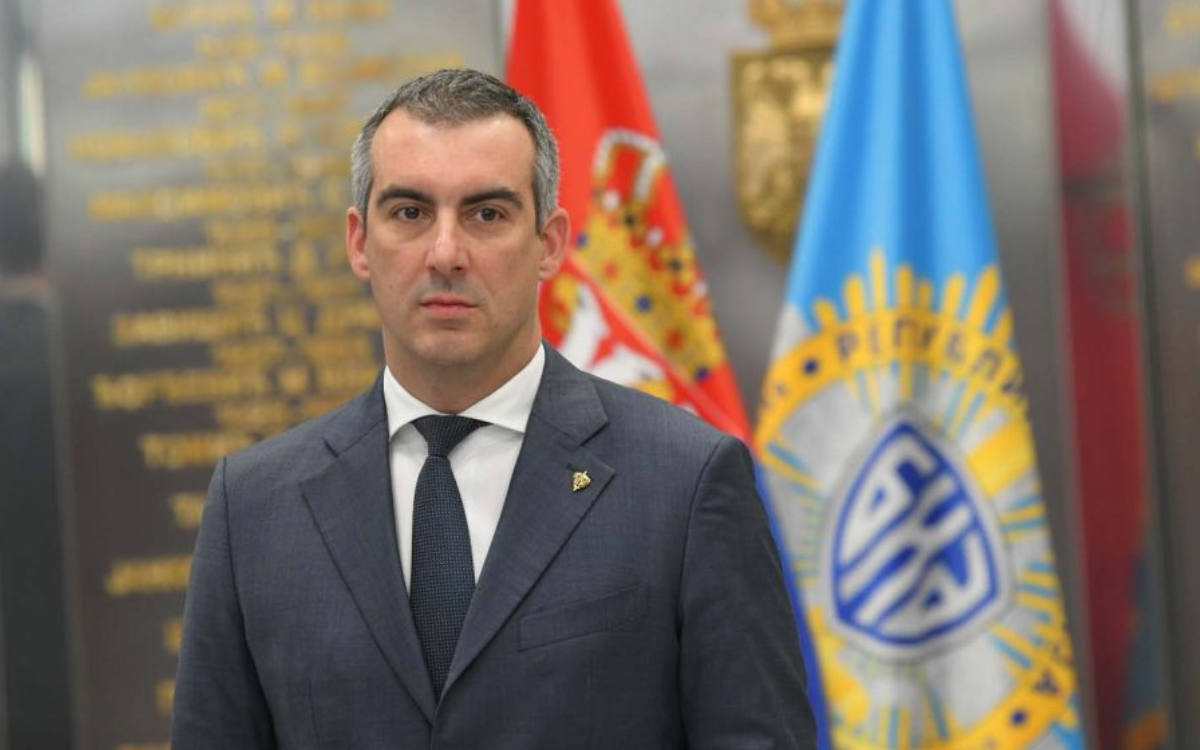
Milan Zvezdanović, a former independent inspector at the Security Intelligence Agency (BIA), has filed a criminal complaint with the Public Prosecutor’s Office for Organised Crime against BIA Director Vladimir Orlić and other, as yet unidentified, agency officials and responsible persons over suspected disclosure of official secrets.
Among other things, Zvezdanović is asking prosecutors to obtain original audio recordings of telephone calls and other communications collected through special evidentiary measures and submitted to investigating judges, and compare them with content broadcast on Informer Television and in documentary series produced by the Centre for Social Stability.
According to the criminal complaint, prosecutors should investigate whether confidential information obtained by the BIA through covert surveillance measures was unlawfully leaked to the media and used in television programmes and documentary series featuring students, university professors, journalists and other critics of the government.
Zvezdanović filed the complaint over suspected commission of the criminal offence of disclosure of official secrets under Article 369 of the Criminal Code. He also asked prosecutors to establish whether any unauthorised disclosure of confidential information was part of an organised and coordinated mechanism within the BIA, involving predetermined roles and responsibilities.
He wants prosecutors to obtain discs containing recorded communications
A particularly important part of the criminal complaint concerns audio recordings of telephone calls and other communications collected through special evidentiary measures which, where such recordings were made in specific cases, were submitted to investigating judges at the competent higher courts.
Zvezdanović is asking prosecutors to obtain reports on the implementation of special evidentiary measures from the BIA and the relevant courts, together with accompanying data storage devices, including CDs and other electronic media containing original audio recordings of communications involving individuals subjected to covert surveillance.
In addition to the recordings themselves, he wants prosecutors to obtain records showing who accessed, listened to, copied, exported, stored or potentially forwarded them to third parties.
He also proposes establishing who had access to the original recordings, copies and accompanying documentation, and whether electronic records exist that could indicate unauthorised duplication or removal of materials from official systems.
The main purpose of the proposed checks is to compare the original recordings with information published in documentary series produced by the Centre for Social Stability and programmes broadcast on Informer Television.
According to the proposal submitted by Zvezdanović, this would establish whether media content included details from conversations that were not publicly available and which may have originated from materials collected through covert surveillance.
If any content similarities are established, Zvezdanović wants prosecutors to investigate the origin of the information and determine whether it could have come from other sources or whether it reached the media through the unauthorised disclosure of official information.
He particularly emphasises that similarities between recorded conversations and media content alone would not be sufficient to establish that a criminal offence had been committed. It would also be necessary to determine the origin of the information, how it reached the media and who may have been involved in passing it on.
Investigation sought into the programme “Under Surveillance” and Centre for Social Stability documentaries
In addition to audio recordings, Zvezdanović wants prosecutors to investigate the origins of video footage broadcast in Informer Television’s programme “Under Surveillance” (Na merama).
He suspects that some of the footage may have been recorded during covert surveillance and filming operations or other legally regulated activities carried out by the competent state authorities.
He therefore proposes that prosecutors obtain the original video recordings used in the programme and compare them with official video materials potentially held by the BIA or other relevant authorities.
He wants prosecutors to establish whether the footage broadcast in the programme is identical or substantially similar to materials produced during official BIA operations, who recorded it, under what legal authority, who had access to the originals and copies, and whether the recordings were duplicated, transferred to external storage devices or handed over to third parties.
The complaint also calls for an examination of whether electronic records exist showing access to, downloading, copying or transferring these materials, and whether any potential disclosure to media outlets was authorised by law.
Zvezdanović also proposes examining the Centre for Social Stability’s documentary series “NGO Dossier,” “Vojvodina Dossier,” “Evil Times,” “Department Dossier,” “Special Ex-File,” “Fifth Column,” “De-Blockade” and “Time of Terror.”
From Informer Television, he wants prosecutors to obtain original recordings and relevant production documentation for the programmes “Collegium,” “Parallels,” the documentary series “Evil Times – The Making of Propaganda,” and “Under Surveillance.”
The complaint specifically proposes comparing the content of the Centre for Social Stability’s documentary series with any analytical reports and official BIA findings concerning University of Belgrade Rector Vladan Đokić, University of Niš Rector Natalija Jovanović, Professor Radivoj Jovović, Biljana Đorđević, Dinko Gruhonjić, Bojan Pajtić and Veran Matić.
Regarding the programme “Parallels,” the proposed investigation would examine potential similarities between information presented in the broadcasts and BIA analytical reports concerning Zagorka Dolovac, Mladen Nenadić, Tanasije Marinović, Jelena Kleut, Nenad Kragujevac and Vukašin Vujičić.
Zvezdanović points out that these individuals are not being named as part of an allegation that the BIA unlawfully collected information about them or passed it on to third parties. Rather, their names are included to define the scope of the investigation and enable comparisons between official documentation and publicly broadcast material.
He calls for an investigation into the role of BIA Director and agency officials
The criminal complaint covers the period from November 1, 2024, to October 25, 2026. Zvezdanović wants prosecutors to investigate whether an organised system for collecting, processing and unlawfully disclosing confidential information to media outlets and other entities operated within the BIA during that period.
In this context, he specifically calls for an examination of the role of BIA Director Vladimir Orlić, including whether he issued instructions, authorised or otherwise facilitated the potential disclosure of official information to individuals outside the state institutional system.
He proposes that prosecutors establish whether written or verbal orders existed concerning the preparation, duplication and disclosure of analytical reports and recorded communications, whether Orlić was informed about any potential removal of information from the agency, and whether he took measures within his authority.
He also wants prosecutors to obtain statements and information from Relja Željski, head of the BIA’s Analytics Directorate, as well as individuals who served as head of the agency’s Situation Centre during the specified period and other officials and employees who had access to the disputed materials.
Zvezdanović believes investigators should also establish whether there was a predetermined division of responsibilities between those collecting information, preparing analytical reports, authorising access to documentation and potentially forwarding it to unauthorised recipients.
For this reason, he has proposed that prosecutors also examine whether the legal elements of an organised criminal group are present, while noting that the hierarchical structure of the BIA itself does not constitute evidence of the existence of such a group.
Calls for digital forensic examination
Among the investigative measures he has proposed is a digital forensic examination of relevant documents, electronic records and audio-visual materials.
According to the proposal, the examination should establish when documents were created and whether they were subsequently modified, identify the existence of copies and traces of electronic transfers, and determine whether official materials match broadcast content in terms of substance, timing and technical characteristics.
He has specifically proposed that, if an unauthorised disclosure of official secrets is established, investigators identify the entire chain through which the information was passed, from the person who initially accessed the data to the final recipient, including any intermediaries and individuals who may have ordered the disclosure.
In his complaint, Zvezdanović refers to Article 369 of the Criminal Code, which prescribes a prison sentence of six months to five years for the basic form of the criminal offence of disclosing official secrets. A qualified form of the offence, including cases involving particularly confidential information, carries a prison sentence of one to eight years.
However, the complainant points out that the classification of information as “top secret” is not sufficient on its own to prove a criminal offence. It is also necessary to establish the legal status of the specific information, who was authorised to access it and how it was potentially disclosed.
In conclusion, Zvezdanović is asking prosecutors to investigate all the circumstances outlined in the complaint, secure relevant electronic records and original data storage devices, determine whether those named bear any responsibility, and take legally prescribed action if grounds for suspicion of criminal offences are established.
MORE TOPICS:
Source: Nova.rs, Miloš Ž. Lazić Foto: BIA
 Add Serbian Times as your Google source