




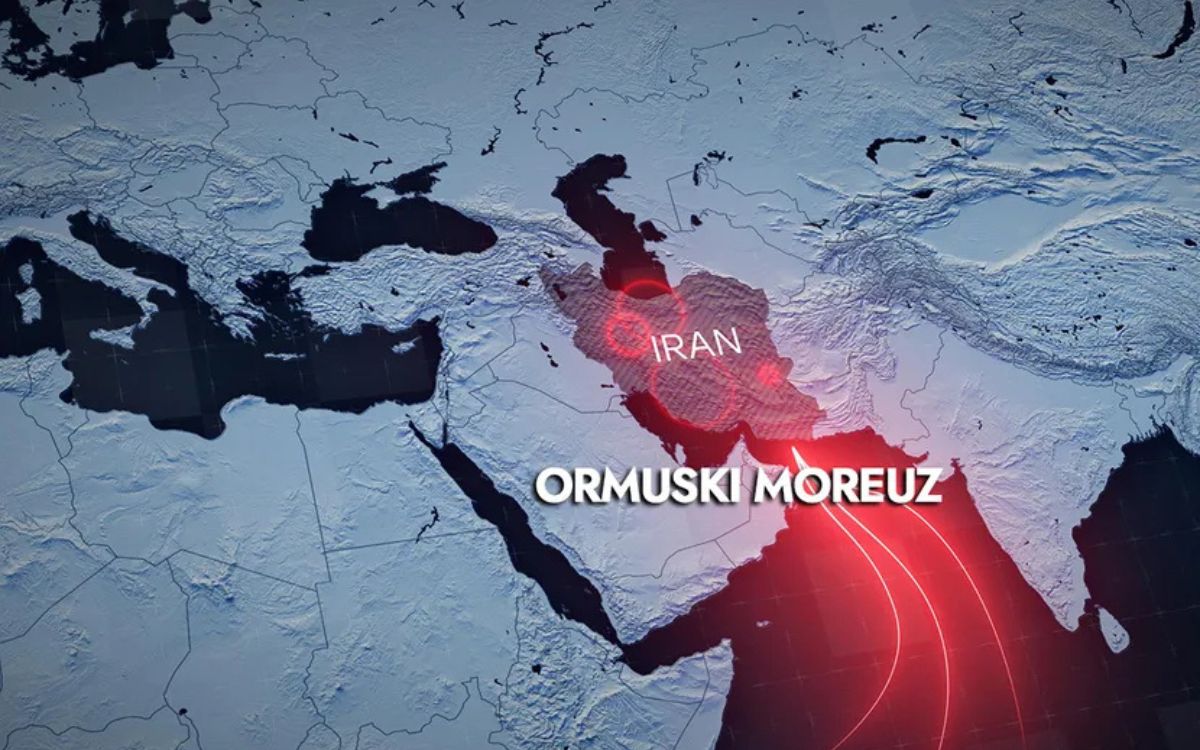
Many European countries such as Italy, Greece, Spain, Poland and Belgium rely on the Strait of Hormuz for importing or refining oil. Although experts claim that closing this corridor will not completely cut Europe off from supplies, they warn that it will continue to raise the price of “black gold” and cause disruptions on the market.
As military escalation in the Middle East reaches its peak, Iran’s announcement about closing the Strait of Hormuz has caused a sharp rise in crude oil and natural gas prices. Faced with rising energy costs at home, European leaders are hastily trying to avoid a chain energy crisis, and they are especially concerned about how to mitigate the price shock that is already being felt on the stock exchanges.
Located between the Persian Gulf and the Gulf of Oman, this strait is a narrow maritime corridor that is largely under Iranian control. It represents one of the world’s most critical energy chokepoints, considering that around 20 percent of global oil production passes through it.
How long will the crisis last?
Johannes Raubal, a senior crude oil analyst at the company “Kpler”, estimates that disruptions related to Hormuz will last another three to four weeks. This means that Europe will remain exposed to high prices and volatility, with crude oil prices currently carrying a “risk premium” of about 13 euros per barrel.
“Prices will begin to stabilize only when credible prospects for negotiations between the US and Iran appear, or if the flow through Hormuz is restored. We expect that most of the risk premium will fall once negotiations become tangible, and that it will largely disappear when a structured agreement is reached,” Raubal told Euronews.
The European Commission is convening technical experts to address the new energy crisis, which is seriously complicating the bloc’s ongoing battle to reduce high electricity prices, all with the aim of reindustrialization and EU competitiveness.
Although oil imports into the EU are diversified – with Norway (14.6 percent), the US (14.5 percent) and Kazakhstan (12.2 percent) being the three main suppliers – several Union countries still import oil from Gulf producers. Saudi Arabia accounted for 6.8 percent of the bloc’s total imports in the first nine months of 2025, and according to EU data, the largest importers are Spain, Germany, France and the Netherlands.
Iraq has already recorded oil production shutdowns as a result of military strikes. Other Gulf states – including the UAE, Kuwait, Saudi Arabia and Qatar – have roughly 10 to 20 days of flexibility before they are forced into shutdowns, assuming normal production rates.
Are there alternative routes?
Berd Langenbruner, a research analyst at “Global Energy Monitor”, states that there are two viable oil pipelines that could serve as an alternative to the Strait of Hormuz, but with limitations.
The first option is the Saudi East–West oil pipeline, with a capacity of five million barrels per day. It stretches across Saudi Arabia, from the processing center Abqaiq to Yanbu on the Red Sea.
“Yanbu was not designed to be Saudi Arabia’s main export hub, so its infrastructure and tanker loading capacity will likely limit the actual flow,” says Langenbruner.
The second alternative is the Habshan–Fujairah oil pipeline in the United Arab Emirates, which can transport crude oil to the Fujairah terminal in the Gulf of Oman. However, Langenbruner points out that it has a significantly smaller daily capacity of 1.8 million barrels.
“The UAE already use it as a routine export route because it bypasses the insurance and security costs of transit through the strait, so there isn’t much spare capacity available,” the analyst adds.
The recently built Goreh–Jask pipeline in Iran could, in theory, bypass the strait, but not without complications.
“This pipeline is located in Iran, which is already under heavy US sanctions and whose infrastructure is under direct military strikes. In addition, its confirmed capacity is about 300,000 barrels per day, which is quite small compared to what the strait allows to pass every day,” explains Langenbruner.
Maritime transport in collapse
In the end, only a small portion of what normally flows through the strait can pass through alternative pipelines, compared to the 20 million barrels per day that usually move through that corridor.
Meanwhile, transport through the Strait of Hormuz between Iran and Oman has almost stopped after ships in the area were hit during Iran’s retaliation for strikes by the US and Israel. Insurance companies have announced that they are canceling war risk coverage after Iran’s Revolutionary Guard declared the strait closed.
Also, tankers will likely avoid transit through the Red Sea and the Suez Canal on their way to Europe.
“For the quantities that cannot go through pipelines and rely on ships, the alternative is redirecting tankers around the Cape of Good Hope to reach Europe, which significantly extends transport time and costs. And that only helps the oil that is not already trapped in the Persian Gulf,” says Langenbruner.
Where can Europe find salvation?
Production in the North Sea remains one of the safest alternative supply sources for Europe. Oil from fields in Norway and the United Kingdom can be delivered by tankers directly to European ports.
The US and West Africa also offer viable replacements, with producers such as Nigeria and Angola sending oil directly to Europe via Atlantic routes.
North Africa, especially Algeria and Libya, provides very short supply routes across the Mediterranean to southern Europe. These shipments avoid the world’s main chokepoints and have minimal transport distance. However, political instability, particularly in Libya, represents a constant risk to sustainable supply.
Producers from the Caspian region and Central Asia, such as Kazakhstan and Azerbaijan, offer additional diversification. Their oil usually travels by pipeline to export terminals on the Black Sea before being sent through the Turkish straits into the Mediterranean.
Suppliers from Latin America, particularly Brazil and Guyana, can deliver oil to Europe via Atlantic routes that completely avoid Middle Eastern chokepoints.
Polin Heinrichs, a lecturer in war studies at King’s College London, concludes that if Europe wants to take its security strategy seriously, it will have to reduce the uncertainty stemming from dependence on fossil fuels.
“Our security strategy is currently reduced to reacting to crises caused by fossil fuels. And by that I mean both in terms of the fuels themselves and in terms of the powers that depend on them to support their power, including the United States,” Heinrichs points out.
MORE TOPICS:
Source: Telegraf, Foto: Shutterstock