




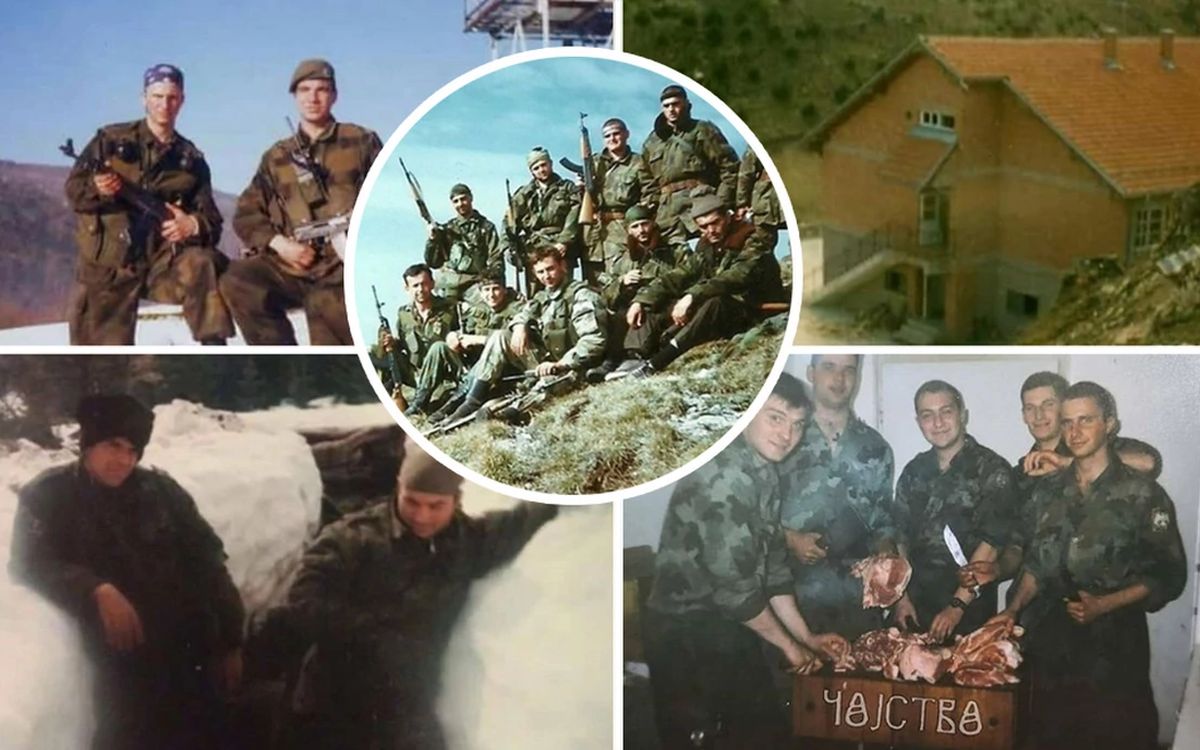
Twenty-seven years ago, forces of the KLA, the Albanian army, and NATO attacked the area of the Kosare watchtower on the Yugoslav-Albanian border. The attack was powerful and surprised the Army of Yugoslavia.
The KLA took the watchtower but failed to penetrate deeper into Kosovo and Metohija, which was the primary goal of the attack. The Army of Yugoslavia had 108 killed, and the KLA more than 200. We recall the text created based on the testimonies of participants in the Battle of Kosare in the show “Dozvolite…” in 2014 and 2016, writes the Radio Television of Serbia portal.
About 1,500 KLA members, supported by Albanian artillery, NATO aviation, and instructors, attacked the area of the Kosare watchtower on a front several kilometers wide early in the morning on April 9, 1999.
Watchtower was constantly under strike by NATO forces
Until April 9, NATO had not targeted Kosare, but it had hit other positions on the Yugoslav-Albanian border. The watchtower was located on the slopes of Prokletije, not far from Djakovica and Decani.
At that moment, there were slightly more than 100 members of the border units of the Army of Yugoslavia on the front. Due to fierce air attacks, but also KLA diversions, significant help could not arrive immediately.
The military leadership’s assessment was that a ground attack would most likely start from Macedonia, where about 16,000 NATO soldiers were already located, and there was no assumption that the main attack would go through Kosare.
That part of the territory was in the zone of responsibility of the 125th Motorized Brigade, which was reorganizing its units, fighting KLA terrorists in Metohija, and was constantly under NATO strikes, so from the start of the war until April 9, it had not managed to fully prepare for stopping the attack at Kosare.
Watchtower built in the era of SFR Yugoslavia
On the second day of the battle, the KLA occupied the Kosare watchtower, which was reported by world media. However, this was not a major success because the watchtower itself was surrounded by hills and very unfavorable for defense.
The facility itself was very luxurious by military standards and was built during the time of the JNA, in a spot clearly visible from Albania, in order to demonstrate the high standard of socialist Yugoslavia.
After the fall of the watchtower, reinforcements arrived from several hundred members of the Army of Yugoslavia from infantry and special units, so the front line was stabilized on April 19 and there were no major shifts until the end of the war.
By intercepting radio communications, the Army of Yugoslavia established that the artillery and mortars were guided very precisely by people speaking Italian and French. Scouts saw Italian, French, Turkish, British, and Army of BiH markings with lilies on enemy uniforms.
The struggle of “David and Goliath”
At the peak of the fighting, the Army of Yugoslavia had about 1,200 soldiers, and the KLA, with volunteers and Albanian units, had five to six thousand. KLA forces fought in shifts, while there was no rest for the VJ.
The large concentration of forces at Kosare cost the KLA the abandonment of many positions, as it was established that many parts of the border on the Albanian side were left almost without any defense.
The Army of Yugoslavia could not concentrate larger forces due to the 24-hour presence of NATO aviation, but also the very inaccessible terrain. In addition to infantry weapons, the VJ used mortars and howitzers of all calibers, as well as “Oganj” and “Orkan” rocket launchers.
The VJ commanding staff, despite the sudden attack, very quickly developed a defense of the front, as they were educated officers. Most of the soldiers had already been in uniform for a year and were well-trained for frontal combat.
All this, including the awareness that if the front line at Kosare fell, much more serious conflicts with the KLA and NATO would begin with an uncertain end, kept morale at a high level.
On the other hand, despite great professional help from NATO officers, the KLA had until then attacked the army and police from ambushes and did not have serious military training for frontal warfare—which was evident throughout the entire battle.
FIND OUT MORE
Goal of the attack was an incursion into the territory of Metohija
The Albanian army also joined the attacks, first with artillery, and then with about ten tanks, but this did not significantly affect the morale of the KLA.
The Army of Yugoslavia often went into attacks in freezing rain, frost, fog, and snow one meter deep, defending every position until the last moment—which further contributed to the drop in morale among the enemy.
It is also interesting that on the Yugoslav side of the border, the terrain was difficult to pass even for people, but the VJ managed at one point to introduce two T-55 tanks into the fight on the front.
Their appearance did not have real significance, but it caused panic and fear in the ranks of the KLA.
The goal of the attackers—the KLA, NATO, and the Albanian army—was to penetrate into Metohija and force the forces of the Army of Yugoslavia, until then masked and well-hidden, into open combat where the technological advantage of NATO aviation would come to the fore, writes “RTS.”
The aggressor managed to occupy only four kilometers in width and a few hundred to a thousand meters in depth of the territory of the FRY.
Roma as Navajo Indians
During the bloody battles at Kosare, there were many bizarre scenes that are hard to believe. It happened that people from both front lines, due to thick fog, wandered into enemy trenches and returned to their own without anyone noticing.
A man in a military uniform once approached VJ members warming themselves by a fire, sat next to them, and when they asked him after a few minutes which unit he was from, he answered in Albanian.
That KLA member was captured, and it was determined that after one of the attacks, he had been hiding in the bushes for a long time but came out when he saw the fire and people.
Two members of the Army of Yugoslavia managed to walk into an enemy trench in the fog, “captured” a heavy anti-aircraft machine gun, and brought it safely back to their trench.
Due to constant wiretapping, one VJ reserve officer remembered the American Navajo Indians from World War II and engaged two Roma, members of the VJ, who used their own language over radio communication to guide Yugoslav artillery and mortars.
Until the end of the war, NATO and the KLA failed to understand what was happening, because they did not understand the Romani language.
The battle before the battle
The war at the Kosare watchtower began long before April 9, 1999, specifically in March 1998 when the conflicts in KiM began.
Although the watchtower area was almost uninhabited, there were ethnically pure Albanian villages in the vicinity, with a large number of KLA members in them.
The watchtower itself, located a few hundred meters from the border line in a visible spot, was an easy target, and it often happened that terrorists from the border line fired a burst at the watchtower and fled.
Ambushes were also frequent, in which several VJ members were killed, and the attempt to transfer smaller or larger quantities of weapons and ammunition from Albania to Kosovo and Metohija was an almost daily occurrence.
Volunteers from all sides
The bulk of the border units consisted of soldiers on regular military service who had been serving since March 1998 and were mostly 19 or 20 years old.
In the Battle of Kosare, a large number of volunteers from the country and abroad fought in the ranks of the Army of Yugoslavia. Besides Russians—Cossacks from parachute units—there were people from other European countries among the volunteers.
The so-called “international detachment” of about thirty people consisted of people from the western part of Ukraine, Finland, Sweden, Denmark, the Netherlands, and one Scotsman and one Irishman from Great Britain.
Their motives for fighting on the side of Yugoslavia were adventurism, anti-American sentiments, but also a desire for war experience. Their pay was symbolic, the same as for regular soldiers.
Upon arriving at the front, foreign volunteers asked to be issued a certificate that they participated in the battles around Kosare, because with such a confirmation, they could get a 50 percent higher monthly salary on battlefields around the world.
The forces of the Army of Yugoslavia in the battle of Kosare in 1999 consisted of parts of the 125th Motorized Brigade, the 53rd Border Battalion, military police from the Belgrade and Kragujevac corps, parts of the 63rd Parachute and 72nd Special Brigades, and to a lesser extent volunteers from the country and abroad.
The commander of all VJ units at Kosare was Lieutenant Colonel Ljubinko Djurkovic, and his superiors were Colonel Dragan Zivanovic and Major General Vladimir Lazarevic.
In this battle, the opposing sides did not violate the rules and customs of war. Formally, it was a ground aggression from Albania against the FRY.
108 members of the army and volunteers died, and the bodies of several soldiers were never recovered from the border.
Today, in the area of the Kosare watchtower, there are about 150 graves of fallen members of the Kosovo Liberation Army, but it is estimated that several dozen more people from the KLA ranks are buried in Albania, writes “RTS.”
The Battle for Kosare officially ended on June 14, 1999, when the Army of Yugoslavia withdrew from Kosare based on the Kumanovo Agreement with KFOR forces. Unlike other parts of Kosovo, the withdrawal took place without any incidents, and the enemies observed each other peacefully.
MORE TOPICS:
Source: Blic; Photo: INSTAGRAM, KARAULA KOSARE / RINGIER / BLIC