




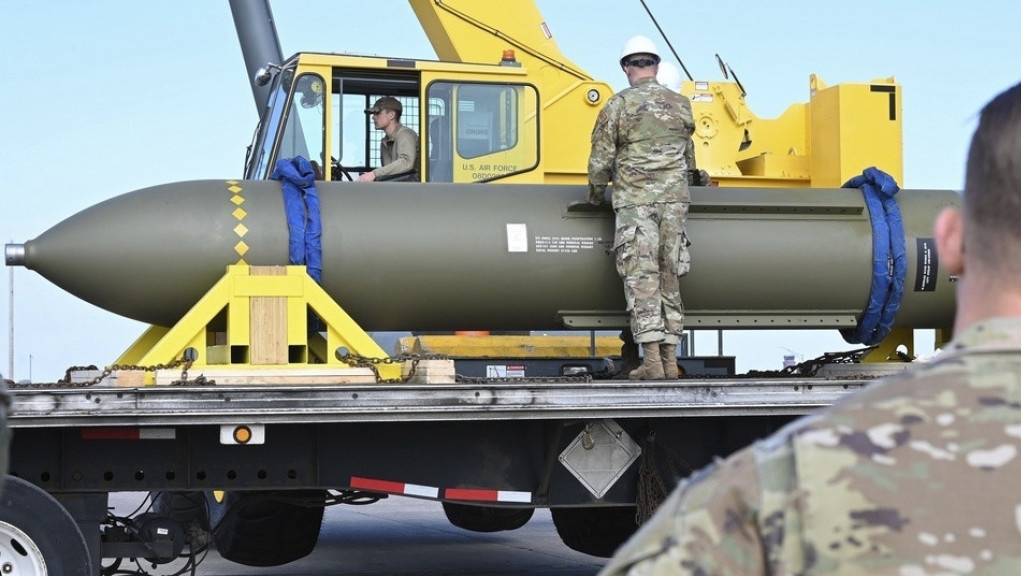
One of the options the U.S. could use against Iran to destroy its nuclear facilities is a deadly 13.6-ton bomb designed to penetrate underground targets.
The possibility of using a powerful American “bunker buster” bomb against Iranian nuclear facilities continues to loom over that country’s conflict with Israel. U.S. President Trump is keeping the world in suspense regarding whether he will join Israeli bombardments of Iranian nuclear sites.
“Maybe I’ll do it, maybe I won’t,” Trump told reporters when asked about potentially joining the attacks.
The White House later announced that the U.S. President would make a decision on whether the U.S. will enter the war within the next two weeks, depending on whether Iran agrees to negotiations.
That decision also depends on whether the GBU-57 A/B Massive Ordnance Penetrator (MOP) or “bunker bomb” can penetrate one of Iran’s key nuclear facilities, which is deeply buried in a mountain, a U.S. official told Axios on Thursday.
Iranian Deputy Foreign Minister Kazem Garibabadi said on state television on Thursday that Iran “will have to use all its means to teach the attackers a lesson and defend its national security and national interests,” if the U.S. decides to intervene in the conflict.
What is the “Bunker Bomb”?
The GBU-57 MOP is a weapon system intended for attacks on “hard and deeply buried targets, such as bunkers and tunnels,” according to a 2024 U.S. Air Force report.
Archived information from the U.S. Defense Threat Reduction Agency (DTRA) states that it is a 13.6-ton bomb, approximately 6.2 meters long and with a diameter of 80 centimeters. DTRA adds that the weapon can carry more than 2.4 tons of explosives and provides “ten times” greater explosive power compared to its predecessor, the BLU-109 bomb.
The Air Force Research Laboratory (AFRL) first hired Boeing in 2004 to develop MOPs, with an initial contract worth $30 million. The weapon was developed in three phases, according to DTRA.
The first bombs were received for testing in 2011, according to a San Francisco Chronicle report.
The weapon was tested at the White Sands Missile Range in New Mexico, a military base in the USA.
Where Would the U.S. Use the Bomb?
The Fordow Fuel Enrichment Plant (FFEP) is located deep beneath a mountain near the city of Qom in Iran and is considered one of Iran’s key uranium enrichment facilities within their nuclear program, according to Heather Williams, director of the nuclear issues project at the U.S. Center for Strategic and International Studies (CSIS).
Rafael Mariano Grossi, Director General of the International Atomic Energy Agency (IAEA), stated on June 16 that there is currently no damage at the Fordow site, unlike the facility in Natanz, where pilot fuel enrichment plants were destroyed.
A recent IAEA report estimates that 166.6 kilograms of uranium enriched to 60 percent has been produced at Fordow out of a total of 408.6 kilograms of uranium of that enrichment percentage that Iran possesses.
Uranium fuel needs to be enriched to approximately 90 percent to become a nuclear weapon, but experts have previously pointed out that Iran can make a nuclear weapon with as little as 60 percent enrichment.
Israel does not have enough weapons to destroy Fordow on its own, but, as Williams stated, “multiple strikes” by American “bunker bombs” deployed on B-2 bombers could destroy the facility.
If President Trump decides to use the GBU-57, it would represent “direct support for Israel and could lead to escalation and draw the U.S. into another war in the region,” Williams wrote.
There are other options Israel can use to attack Fordow, Williams added, such as continuous strikes on the facility by GPU-28 or BLU-109 weapons, which can penetrate targets and potentially attack surface entrances or exits of the facility.
Source: Euronews, Photo: AP/U.S. Air Force via AP
MORE TOPICS:
TRUMP ON SERBIA AND THE SO-CALLED KOSOVO: “They Should Give Me the Nobel Peace Prize for Them”!