




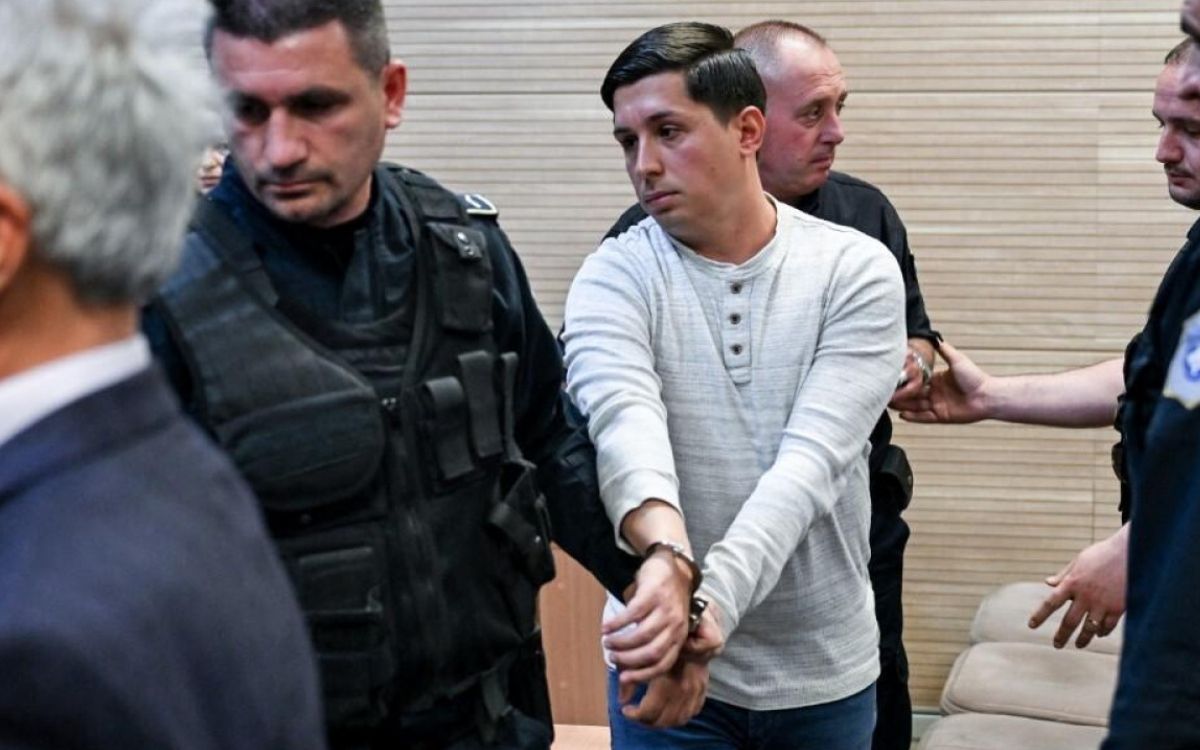
The verdict against Serb Dusan Maksimovic, who was sentenced to 30 years in prison due to the events in Banjska, has caused great public attention and opened numerous questions, primarily regarding the evidence against him, upon which the court’s decision is based. There is not a single piece of evidence that Maksimovic was actually in Banjska on September 24, 2023 – except for being a native of that place, although even the other defendants claim he did not participate in the conflict.
Maksimovic was sentenced to 30 years, while the remaining two defendants – Blagoje Spasojevic and Vladimir Tolic – were sentenced to life imprisonment.
The case of Dusan Maksimovic has drawn significant public interest because he is a man from Banjska against whom there is no evidence indicating that he was at the site of the armed conflict that day.
Maksimovic himself claimed during the proceedings that he had nothing to do with the armed conflict. His “guilt” is only that he is a native of Banjska.
“Today I want to thank my lawyer Jovana, who argued with evidence that every word of mine in this proceeding is the truth. I neither lied about anything, nor concealed anything, nor do I have any connection with the event of September 24 that happened in my village, Banjska. I sincerely believe and deeply hope that my next gratitude will be addressed to you, respected council, after the sentencing,” Maksimovic said in his closing statement.
Defendants: He did not participate in the conflict
What is particularly concerning is that even the remaining two defendants – Spasojevic and Tolic – stated that Maksimovic did not participate in the armed conflict and has no connection to the events of September 2023.
“For Dusan Maksimovic, I claim that he has no connection with the events in Banjska,” Spasojevic said.
Tolic, on the other hand, stated the same – that Maksimovic, an employee of the “Rajska Banja” company, had no connection with the events in Banjska.
What is known about the Maksimovic case?
Aside from the fact that even the defendants claim they only saw Maksimovic in prison, a series of other circumstances indicate that Maksimovic has no connection to the events. More precisely, there is no concrete evidence that would bring Maksimovic into direct connection with the armed conflict.
His lawyer, Jovana Filipovic, previously pointed out to the media that her client’s guilt practically comes down to the fact that he lives in Banjska, without material evidence to confirm the allegations.
Filipovic emphasized that the fact that Maksimovic was convicted of shooting, even though all relevant forensic findings were negative, speaks enough about the grounds and legality of the verdict. As she specified, DNA analysis, gunpowder residue tests, as well as traces of nitrates and nitrites, did not link her client to the use of weapons.
According to her, such results clearly indicate that Maksimovic was not in contact with weapons, let alone that he committed the act he is charged with.
He was not in Banjska
What further causes public distress is that, according to the defense’s claims, Maksimovic was not even in Banjska that day.
“He was in Suvi Do, then he came to Banjska. An alibi can be provided by his friends who were with him, but they were not allowed,” Filipovic said during the presentation of closing words.
The portal Nova.rs called lawyer Jovana Filipovic regarding her client’s case, but she did not want to speak to the media and referred them to state officials.
What happened in Banjska?
To recall, in the village of Banjska, near Zvecan in northern Kosovo, Kosovo police officer Afrim Bunjaku was killed first, and in the continued exchange of fire between the Kosovo police and an armed group, three men were killed – Stefan Nedeljkovic from Zvecan, Bojan Mijailovic, and Igor Milenkovic from Leposavic.
As Nova.rs wrote, authorities in Pristina have claimed since the beginning of the conflict that the controversial businessman Milan Radoicic, former vice-president of the Serb List, was also present during the shootout in Banjska.
Serbian authorities did not speak out until September 29, when Radoicic, through lawyer Goran Petronijevic, admitted that he organized the armed group of people in northern Kosovo.
The investigation into the conflict in Banjska is also being conducted by the Higher Public Prosecutor’s Office in Belgrade.
While Milan Radoicic remains free, Serbs in Kosovo have been sentenced to multi-year prison terms, two of whom received life sentences.
MORE TOPICS:
Source: Nova.rs, Photo: Armend Nimani / AFP
 Add Serbian Times as your Google source