



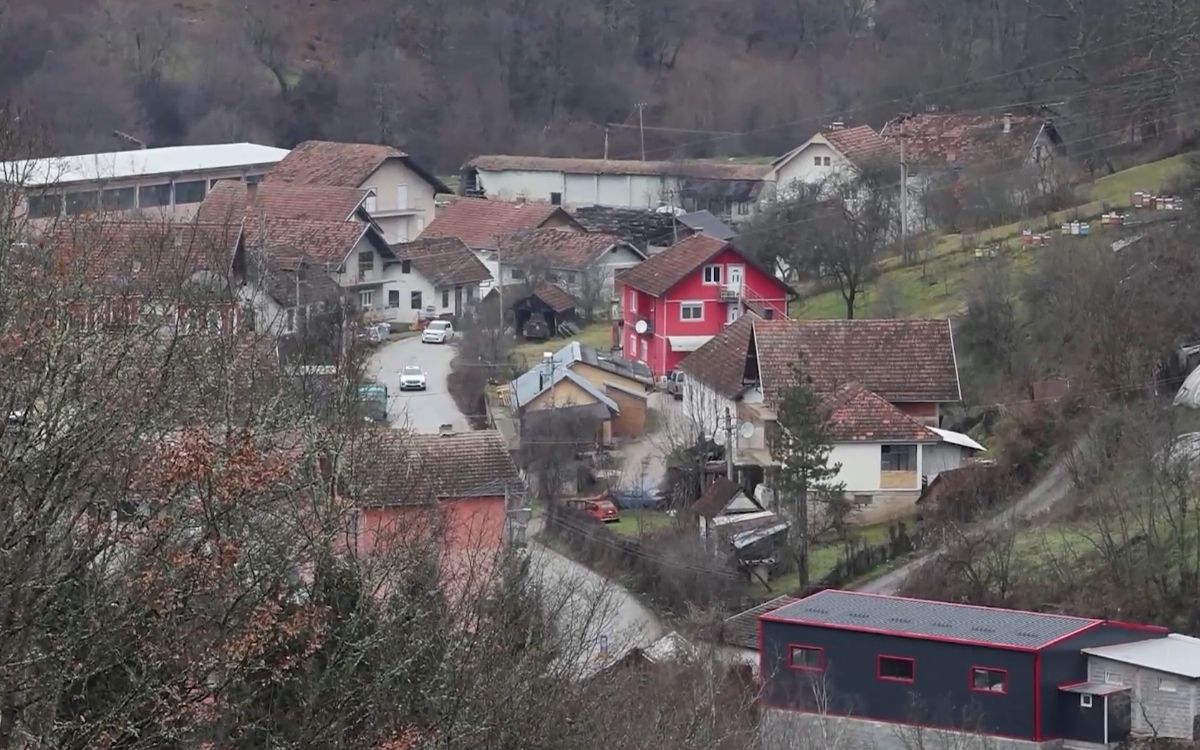
The border at the triple junction of Serbia, Montenegro, and Bosnia and Herzegovina, near Priboj, is the reason why the village of Sastavci is unique in the world. The Uvac River separates this village into two parts, so that it administratively belongs to the municipality of Priboj and Serbia, while territorially it belongs mostly to Bosnia and Herzegovina, specifically the municipality of Rudo. Due to this administrative entanglement that has remained unresolved for years, residents must cross the border to perform daily activities, sometimes multiple times a day.
This unusual case arose long ago when this territory was under Austro-Hungarian rule. Namely, a local Bey gave a dowry of several square kilometers of his estate to his Austrian son-in-law, and the meticulous Austro-Hungarians registered it immediately. With the change of governments and borders, this administrative entanglement was created.
“The local community of Sastavci belongs to the municipality of Priboj and is located on the territory of Republika Srpska or Bosnia and Herzegovina. All institutions of the Republic of Serbia are located on the territory of Bosnia and Herzegovina, specifically Republika Srpska—the police, school, post office, and clinic. Here, I am also a postman in both Serbia and Bosnia and Herzegovina,” said Sveto Vilotić from the local community of Sastavci.
If some of the locals, for example, were to get into a fight in one of the three village taverns, the police from Priboj would not intervene, even though their building is 50 meters away. Instead, members of the Rudo police station would have to intervene.
“When the police from the Rudo station come to Sastavci here, they cross twice; meaning they go from Bosnia to Serbia, from Serbia to Bosnia, then again from Bosnia to Serbia, and only then do they arrive here in Bosnia, on the territory,” says Vilotić.
When one crosses the bridge over the stream in Sastavci, they enter the territory of Bosnia and Herzegovina from Serbia, and in this enclave, even the priests are from two different states and parishes.
“On the territory of Bosnia and Herzegovina here, when someone dies, it means the priest comes from Rudo, but also from Priboj, and from Serbia. The priest from Rudo blesses the holy water,” explains Vilotić.
Borders have divided this village by a bridge, but also by two ends of the same street. Houses and families are divided between two states, and even the village cemetery.
“The border is close to us here. We have half of our property in Bosnia and half in Serbia, so we pay taxes to both the Rudo municipality and the Priboj municipality. Our cemetery, for example, is split: half in Serbia, half in Bosnia. I have a house at a relative’s place there; for instance, he and his brother, one of their houses is in Serbia, one is in Bosnia. And at the relative’s, for example, when he distills brandy, his cauldron is in Bosnia, and the brandy goes into Serbia, but that is 100 percent the case,” says resident Rajko Marković.
About 700 residents of this village have dual citizenship. Border commissions of the two states last met 15 years ago, but the knot has not been untied. During that time, the village of Sastavci lives separated by borders, with locals weighed down by unnecessary administration.
MORE TOPICS:
Source: Euronews; Photo: Printscreen YouTube / Deutsche Welle