




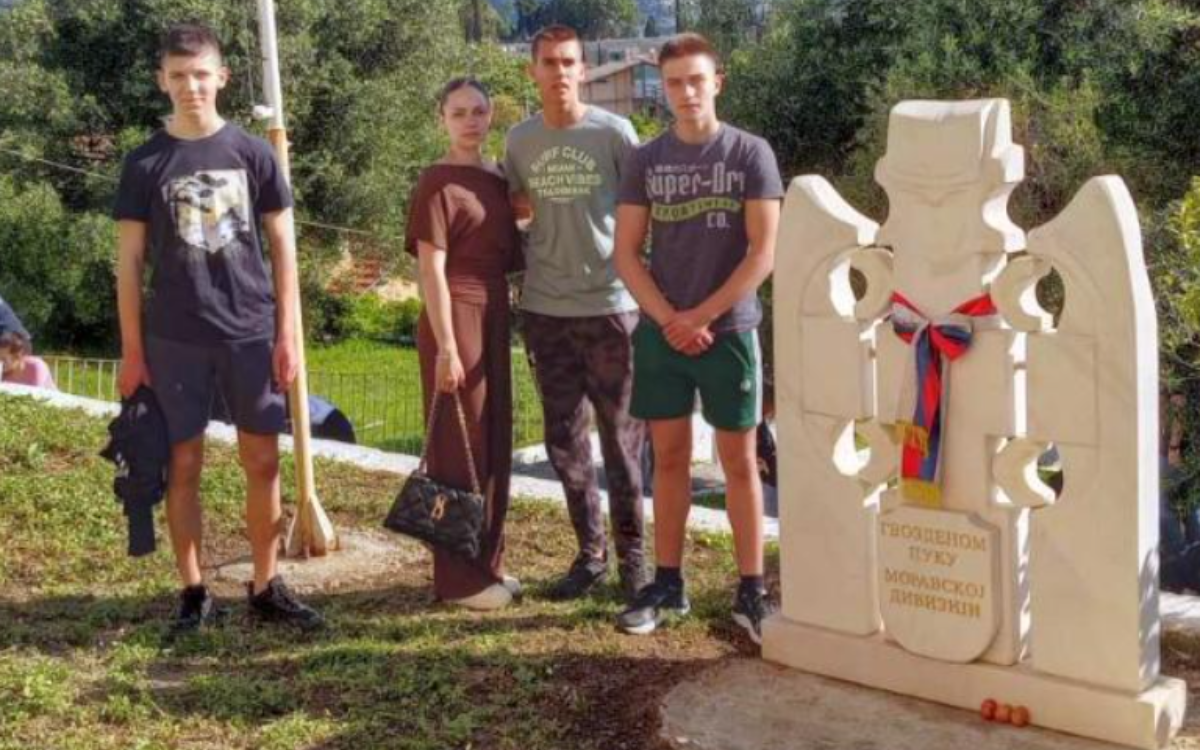
The team “King Petar I Karađorđević,” composed of two students each from “Svetozar Marković” Gymnasium and “Ivan Sarić” Technical School, won the quiz “The Great War – 110 Years Later.” The young four-member team visited Corfu, where the final was held and where they had the opportunity to learn more about the history of their country and people firsthand and connect with their ancestors.
Simply qualifying among the top two teams meant a trip to Corfu and participation in numerous programs within the “Days of Serbianism” event. What started as participation in a quiz ended as an incredible experience and an introduction to their own history.
“It’s simply an unrepeatable feeling; it cannot be described in words until one experiences it. The most emotional moment for me was when we were in Kato Korakiana. The place itself is beautiful, but the speech by Dimitrije Stikić, who pointed out the connection between history and the present, resonated deeply. It seems to me that young people today create a wall between the present and history, as if history is irrelevant to us today. But in fact, when we went there, we saw that without them, our ancestors, we would not be here today. They showed us what a fight for the homeland it was, and that we are here today thanks to them. History teaches us about ourselves. The struggle for life, for land, for people,” says Aleksandar Samac, a team member and student of “Ivan Sarić” Technical School.
At a time when young people are mostly on their phones, social networks, and live for the present moment, these four young people gave us a lesson not only in history but also in patriotism, because as Ršum says, “The homeland is defended by beauty, and honor, and knowledge.”
“We won simply by going there. Winning the quiz final is not as valuable as the fact that we went there, learned history more deeply, got closer to our ancestors, learned who we are, what we are, where we come from. That is the point. When we learn all this from a book, everything is different. Only when we went there did we see it all with different eyes and experience it more emotionally. Our love for our people, not just mere knowledge, led us there. When we stand on that land and hear the sound of water, when we experience that, it’s actually much different. This time, King Petar I, as our team was called, had a smaller army, but it achieved victory,” says Nevena Maravić, the only girl in the four-member team.
The youngest among them, a first-year student, emphasizes that the entire journey was extremely emotional for him, confirming the saying that the journey is more important than the destination.
“We achieved a convincing victory in the quiz in Subotica, and we were very happy because we knew that a trip to Corfu awaited us. But when we arrived, a different energy was felt. It was very emotional. At each program we attended, there was a sense of closeness, friendship with the Greek people. I am glad that Serbia has such friends as the Greeks, who helped our people resurrect. We met a large number of people from the entire region,” says Kosta Baćović, to which Professor Jasmina Marić adds, “I must say, tears sparkled on these cheeks, and those tears are the hardest, you know that boys don’t cry often.”
Andrej Horvat also confirms that emotions overwhelmed them upon their arrival in Corfu, emphasizing that everyone must know history to know who stands behind them and which heroes they are descendants of.
FIND OUT MORE:
Insights from Mentors and Students
“Those were moments of great emotional connection with our ancestors and history. The professor mentioned tears; yes, there were tears, I must admit, it’s not shameful, it’s a connection with ancestors. Without them, we would not exist. First of all, we must know who we are and where we come from so that we can learn our own history. It’s important to have good professors who will encourage us; I was lucky to have really good professors. I was always interested in my own past, history; I was interested in whether I had heroes behind me,” explains Andrej. “I think everyone should look back more at the past, since the vast majority of my peers certainly had a great-grandfather who was on the Salonica Front, but maybe they don’t even know it or don’t pay attention to it. Also, I think that schools don’t give enough importance to this topic; instead, they focus more on World War II. There is more talk about World War II, but in my opinion, World War I is much more important for Serbia because it was a war of liberation against Austria-Hungary,” Kosta agreed.
The team of high school students was led by history teachers from these schools, Jasmina Marić from “Ivan Sarić” Technical School and Sava Samardžić from the Gymnasium, who is also the author of the quiz. They explain that the starting point was a quiz organized by the “Circle of Serbian Sisters,” who sponsored the quiz, but the quiz itself is an original work by Professor Samardžić, which he elevated to a higher level for this occasion, with the help of Professor Marić.
“We organized the semi-final in Subotica, where we had guests from Žabljak, Prijedor, Kosovska Kamenica, Aleksandrovac, Smederevska Palanka. The agreement was that some of the most significant names would be the names of the teams, but not chosen by them; they would be assigned by lot. So we drew lots for the semi-final, and indeed the strength of the teams was balanced; everyone had an equal chance to go to Corfu, where the final was held. With great knowledge and dedication, hard work, and love for history, these children earned their trip to Corfu and the final,” explains Samardžić.
Professor Marić, the history teacher who mentored them, constantly encouraged and supported them, confirmed that a teacher is happiest when a student surpasses them in at least some aspect. She made no secret of her satisfaction and pride in her young proteges.
“These four children, at this moment, know the history of World War I better than all the history professors in Subotica, including myself. They are incredibly prepared, down to the smallest details, peculiarities; they found and learned so much. Truly a source of admiration and pride for the city, and the schools they come from, and then for us,” the professor’s praise for her students flowed out in one breath.
She also reflected on their stay in Corfu, which left an indelible mark on all of them and brought a plethora of emotions, memories, and lessons.
“It was truly a pilgrimage. A very intense, rich program, very intense activities; we saw some of the key points for the Serbian army’s stay in Corfu during 4.5 months, from January to May 1916. We saw the place where the Serbian army disembarked, we went to the former cemetery of the Morava Division, we went to the place where the Third Army headquarters was, then the cemetery of the Drina Division. Along the way, we heard and saw many things, thanks to perfect organization. We didn’t just have a mere history lesson, but performances that took place in those locations. We had lectures, choral performances, dramatic parts, readings, recitations. So endlessly touching, and as the crowning glory of it all, a 3-hour visit to the Memorial Ossuary on the island of Vido and the Holy Hierarchical Liturgy celebrated by the abbot of Corfu and the abbot of Hilandar Monastery, Metodije, from whose hands these children received their diplomas,” the professor points out.
MORE TOPICS:
BAD NEWS FOR BIDEN: Former president diagnosed with progressive prostate cancer, spread to bones!
MYSTERIOUS MISS V: How a wealthy Canadian woman ended up fighting for Serbia in WWI! (PHOTO)
WONDERFUL ROMAN BRIDGE ON GOLIJA: 30,000 eggs were needed to build this monument! (PHOTO)
Source: Subotica.com, Foto: Subotica.com