




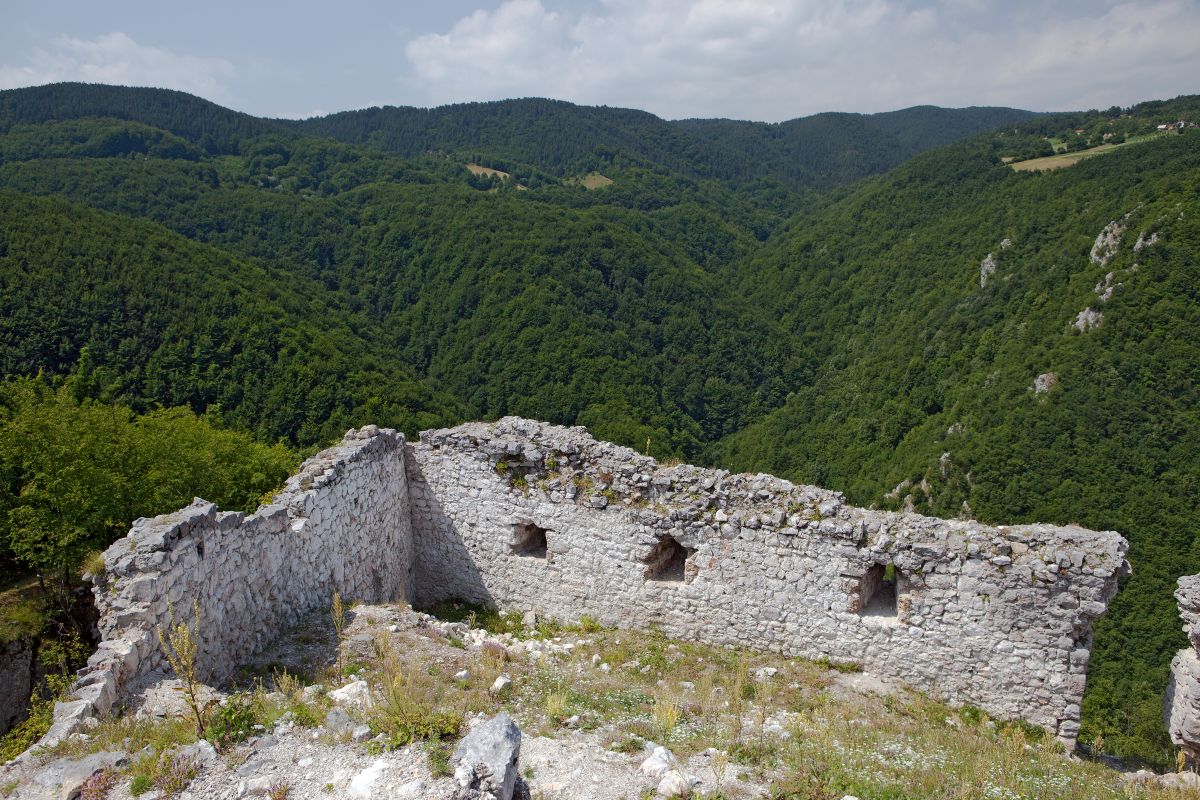
Listening to numerous legends about the wife of Đurđe Branković and her building of Smederevo, numerous fortresses of unknown origin found in Serbia are known as Jerinin gradovi (Jerina’s cities). One such is located on the slopes of Mount Tara near Bajina Bašta, nine kilometers away from Kaluđerske bare, today known as the Solotuša archaeological site.
“The fortress was built on a rocky plateau below which is a long limestone cliff that descends to the Solotuša river spring. There are no historiographical records about it, nor any special folk tradition, except for the names Grad, Kulina or Jerinin grad. According to archaeologists, Solotnik is a typical medieval castle, and this name owes to the village in which it is located. During archaeological research, fragmentary remains of a fortress from the Iron Age were discovered, with continuity in the early Byzantine period, while the castle with the manor house was built in the 15th century,” said Ranko Milanović from Tara National Park.

Petrified lime mortar, numerous weapon finds and scarce fragments of stone pottery, indicated that Solotnik was hastily built and was conquered in a Turkish attack, most likely between 1459 and 1463.
“According to a legend that is passed down from generation to generation, the city was built by three masters, but the cursed Jerina did not get along well with them and during construction, according to legend, she removed the ladders and they perished. The places where they fell later became villages and were named after these three builders – Luke, Kostin do and Palež,” says Milanović.
SAZNAJTE VIŠE:
The castle had an approximately trapezoidal base, dimensions 16.85 x 28.20 meters, two entrances and a circular defensive tower above the main gate from the southeast. In the construction, hewn limestone and rubble bound with lime mortar were used, and the walls are wide from 1.20 to 1.70 meters and preserved at a height of 4.2 meters. The water cistern, discovered in the castle, has an irregular circular base, with a circular well. Archaeological research at Kulina has not been completed.
What delights numerous visitors is the rich cultural and historical heritage, but also the incredible viewpoint from which the view reaches even neighboring Bosnia and Herzegovina.
MORE TOPICS:
Source: RINA; Photo: RINA