




Alongside the missiles and drones flying across the Middle East, the eyes of the world are fixed on the Strait of Hormuz, the narrow passage through which one-fifth of the world’s oil is transported and through which only ships that receive approval from Iran can now pass.
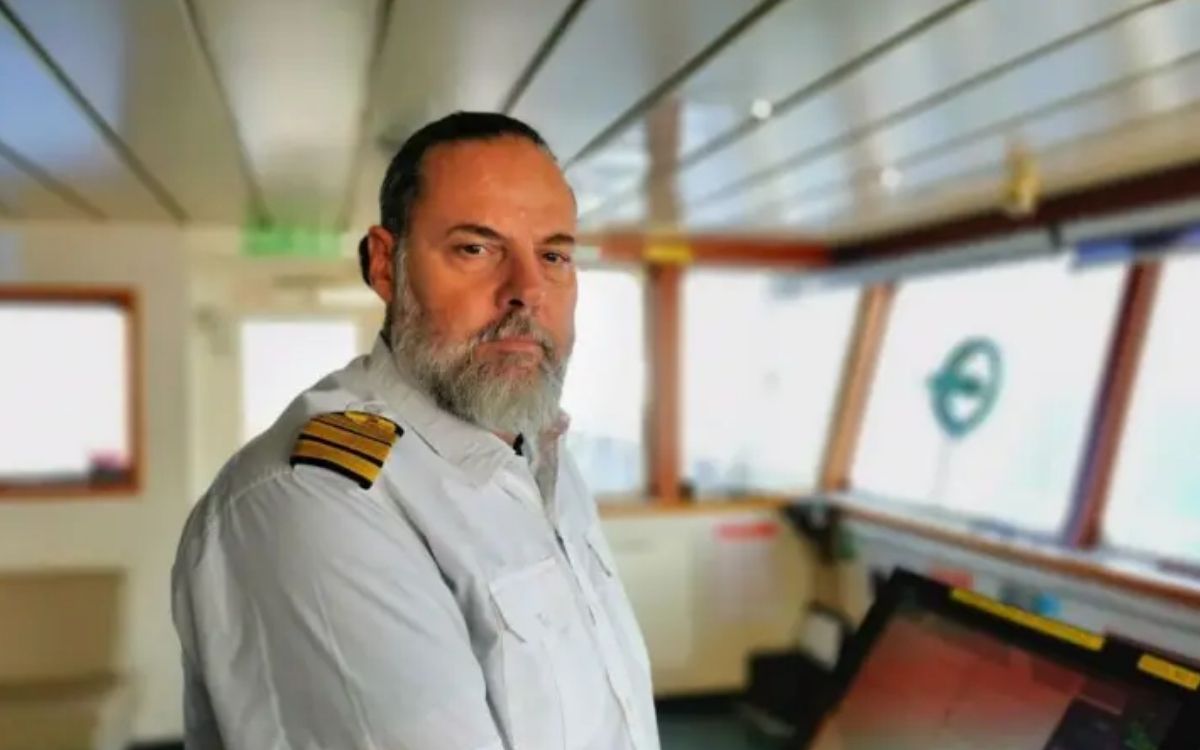
Among them was a cargo ship commanded by Captain Srđan Janković from Serbia, sailing under the flag of Malta.
“Drones and missiles were flying over us, targeting an Iranian military base or being fired from the base to other destinations; we were right in the middle, and occasionally we watched projectiles flying across the sky,” Janković told the BBC in Serbian.
He and his crew sailed into the Iranian port of Bandar Imam Khomeini, in the northern Persian Gulf, on February 26, and two days later, the United States and Israel began attacks on that country.
Iran responded with strikes on Israel, Qatar, the United Arab Emirates, Saudi Arabia, Oman, Bahrain, and Kuwait.
In short, all the countries on the other side of the Persian Gulf.
“I wasn’t as afraid of the war as I was of some army coming onto the ship and trying to establish authority; that’s what I feared the most,” says Janković, with whom we spoke while he was sailing across the Indian Ocean toward Africa.
On March 26, he and his crew managed to pass through the Strait of Hormuz and leave the Persian Gulf on their way to Latin America.
Due to US-Israeli attacks, Iran has effectively restricted the passage of ships through the Strait of Hormuz, and the traffic of oil and liquefied natural gas has dropped by 95 percent to date, the BBC fact-checking team reported.
The strait is equally important for global food security as it serves as the main export route for fertilizers that maintain crop production worldwide.
Analysts estimate that as much as a third of the global fertilizer trade could be affected by a prolonged closure.
The importance of the strait for global energy trade is also reflected in world prices, which have jumped since the beginning of the war, prompting the International Energy Agency to release a record 400 million barrels of strategic oil reserves onto the market.
Opening the passage through the Strait of Hormuz has also become one of the key issues of the US-Israeli war against Iran, although it was not among the goals at the beginning.
Washington claims the strait is closed, while Tehran repeats that this only applies to “hostile” countries.
Iran does not allow ships from the United States and its allies—including European countries that refused to participate in the war—to pass through the strait, but at the same time, it lets through Chinese, Indian, and ships carrying cargo for other Asian countries, such as the Philippines and Bangladesh.
However, according to United Nations data, unlike the 150 ships that passed through the Strait of Hormuz before the war, only four or five manage to do so today.
Among them, on April 3, was a French ship.
The ship commanded by Srđan Janković sails under the flag of Malta.
They traveled for thirty-three days from Brazil via Africa to bring corn to the Iranian port.
They waited for another month at the anchorage in port waters to get permission to unload it.
On that February 28, Bandar Imam Khomeini, Iran’s main port city and a key hub for petrochemicals, along with many other locations across the country, became the target of US-Israeli attacks.
“The city, which is a half-hour drive from the port, was attacked.
“We saw smoke in the distance, explosions were heard in the evening, and the crew was frightened.
“You are somewhere in a country where you don’t know anyone, the border with Iraq is close, you don’t know how the military located there will react; a person isn’t sure if they will show up on the ship with weapons, take you hostage, or exchange you for some conditions.
“It’s not pleasant,” explains this 55-year-old Belgrade native, who has been sailing since 1995.
The situation was further complicated by the fact that the internet in Iran has been cut off since January due to anti-government protests in which thousands of protesters were killed.
Communication with the Iranian authorities went through an agent in London, who would occasionally provide them with information on whether they would be allowed to pass or not.
“I didn’t know what was going to happen.
“We placed barbed wire all around the ship, along the railing, to protect ourselves in case someone appeared, so we could at least discourage them from choosing our ship.
“The crew was forbidden from being on deck often, because you don’t know when something might hit you,” the captain told the BBC in Serbian.
A rare good thing was the fact that they had filled their storage with food and water just before entering Iranian waters.
We were at peace for at least three months, says Janković.
From experience, we know that at Bandar Imam Khomeini, people sometimes wait up to a month to unload cargo, he adds.
Around them at the anchorage—a place where vessels stay within port waters or at sea—there were about 20 ships that, as he says, were waiting their turn to be unloaded or for information on whether they would be able to exit the Persian Gulf.
After ten days, on March 18, they were informed from London that they could continue their journey toward the Strait of Hormuz.
“We set off the moment we received the email.
“However, a day later everything was suspended; a message arrived saying that the passage was closed, that we couldn’t go toward the strait, and to wait for a new permit.
“We didn’t know the reason; we were told there had been major attacks on Iran and that all permits were suspended,” says Janković.
In the night between March 18 and 19, Israeli forces targeted South Pars, the largest natural gas field in Iran, located in the central part of the Persian Gulf.
In retaliation, Tehran targeted Qatar’s Ras Laffan, the world’s largest liquefied natural gas complex, leading to a sharp rise in the price of that energy source across Europe.
The captain and his ship with 22 crew members stopped near Lavan Island, which is also located in the central part of the Gulf, like the targeted gas field, but closer to the Iranian coast.
“We were just floating there, moving left and right; we stayed in waters that are in Iran’s interest, closer to the shore.
“It was suggested that we not leave the Iranian sea and that we would be safe there,” says Captain Janković.
They received a new permit to continue on March 25.
Although afraid, the crew members were ready for crisis situations.
Notices were posted on the ship about what to prepare in case of an attack.
During the voyage toward the Strait of Hormuz, they slept in the middle part of the ship, in storage rooms, the pantry, on auxiliary beds, with life jackets and backpacks in front of the doors so they were at hand, the Serbian captain says.
This time, the instruction from London stated that the ship should report in when it reached the island of Greater Tunb, in the southern part of the Persian Gulf.
However, when they reached the island, around 11 p.m., they were told to stop and not continue toward the Strait of Hormuz before morning.
“It was really tense that night. We didn’t know why we were stopped or what would happen.
“There we are, very close to everything, the bombing of Iran continues, the anti-aircraft defense is still working.
“In the morning, we were told to go toward Bandar Abbas, a port city at the entrance to the Strait of Hormuz—even closer to the coast of Iran, at the mercy of any fisherman who could stop you,” says Janković.
The instruction for their ship was not to enter the middle of the strait, where vessels normally pass in peacetime, but to stick to Iranian territorial waters, closer to the coast.
“The crew was agitated; most of the time they were on the bridge, monitoring what was happening—every boat passing, every small vessel, everything was an alarm to them.
“The entire passage at full throttle lasted 11.5 hours. In normal circumstances, that part is crossed in six hours.”
In front of the port in Bandar Abbas, they were met by a large number of anchored ships, many of which had no markings of a company or the country under whose flag they sail.
On the other side, at the exit of the Strait of Hormuz, stood ships waiting for permission to enter the Persian Gulf.
United Nations rules allow countries to control territorial seas up to 12 nautical miles (22 kilometers) from their coast.
At its narrowest point, where it is about 33 kilometers wide, the Strait of Hormuz and its shipping routes are entirely within the territorial waters of Iran and Oman, which is why Tehran manages to control who enters and leaves the Persian Gulf.
“When we passed through, it was a huge relief for both me and the entire crew.
“Fortunately, it went as it should,” says Janković with a smile.
MORE TOPICS:
Source: BBC News na srpskog, Photo: Privatna arhiva