




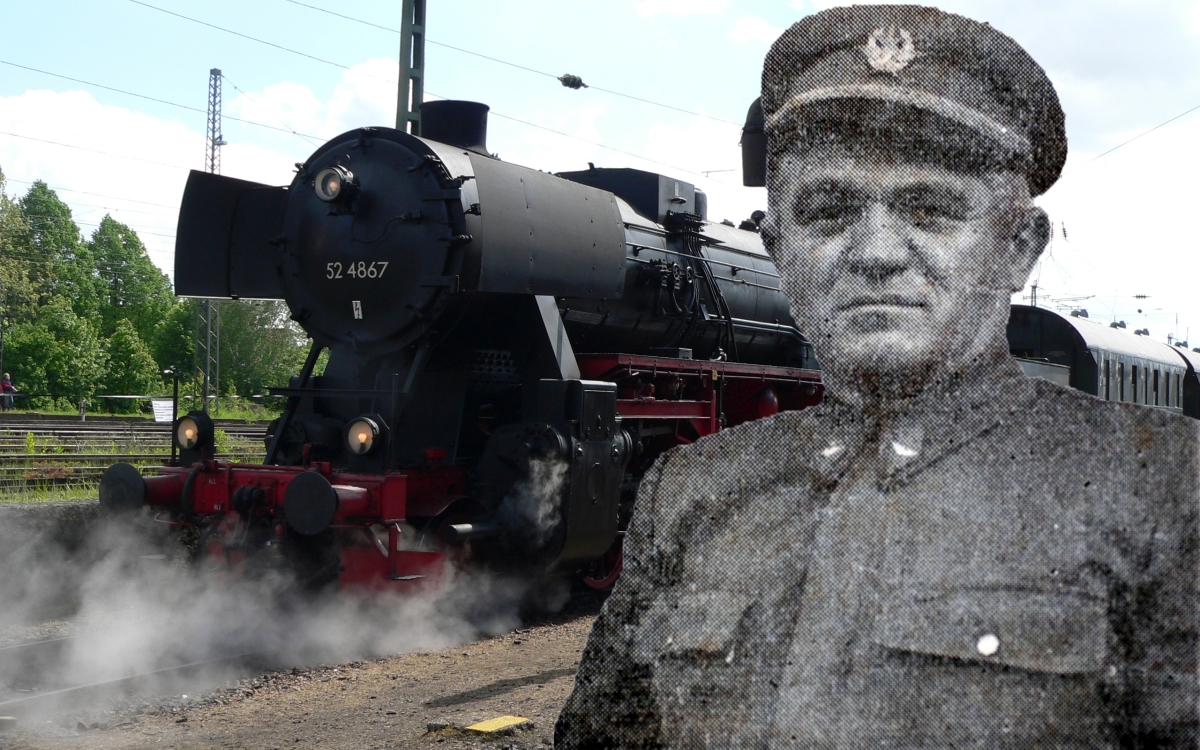
The spring and summer of 1941 could be described as the two most horrifying seasons in the recent history of the Serbian people, as that period, immediately following the establishment of the so-called Independent State of Croatia, brought a genocidal tsunami and unprecedented massacres orchestrated by the Ustasha regime.
The people fled to the forests and mountains, fueling the uprising that began to flare up throughout the NDH, but the Serbs living in eastern Bosnia and Herzegovina tried in every possible way to reach the safety of what remained of Serbia—across the Drina River.
One of the main refugee gathering points was Višegrad, a town that, under the new territorial redistribution of the Balkan powder keg, fell within the NDH’s Grand County of Vrhbosna and was connected by railway to Užice—and to some form of freedom, at least from the Ustasha knife.
The town was filled with refugees, but the greatest crowds were at the train station, where mostly helpless women with children and the elderly waited for a chance to board a train heading east. Many were deceived by smugglers—fellow countrymen looking to profit from the chaos—who promised safe passage to Serbia, took their money, and vanished. Among the unfortunate crowd was a man named Vojin Nikitović.
However, Nikitović was not a refugee. A train engineer by profession, he was stationed in Višegrad when the April War broke out, operating the Višegrad–Užice line. The Ustasha authorities left him alone, as they did with others essential to the functioning of their “state” apparatus.
Na slici je Vojin Nikitović, mašinovođa koji je 1941. u Višegradu (NDH) ukrao voz, prevezao oko 500 izbeglica od ustaške kame do Užica i sakrio oružje za partizane kojima se priključio.
— Balkan Utopia (@BalkanUtopia) February 17, 2021
Borio se na Kadinjači, bio u logoru na Banjici i preživeo da se vrati u rodno Užice.
SF/SN. pic.twitter.com/SaAsmHtGn8
He knew, however, that this safety was temporary. The liquidation of technical staff had already begun, and he realized his time would come. By July, he began forming an “exit strategy” and arranged a supposed smuggling route, but grew tired of waiting. Feeling pity for the people at the station, a brilliant idea began to form in his mind: he would steal a locomotive, attach a train, pack it with as many people as possible, and simply cross the border.
He made his move on the evening of August 10. He informed acquaintances among the refugees of his plan, telling them to spread the word and instruct others to bring as little as possible to make room for more passengers in the pre-prepared train on track seven. He told them to board just before the guard shift change and handed them the coupling pin for attaching the train to the locomotive so they could act quickly upon his arrival.
Just before midnight, he stole locomotive number 85009. The guard, who had been tipped off, disappeared to avoid implication. Nikitović shrugged when he realized that fireman Ragib Toko was asleep in the cab—he couldn’t risk waking him, unsure how he might react, but couldn’t abandon the plan either. Carefully, without waking Toko, he continued his mission.
What followed plays out like the script of an action film.
He slowly drove the locomotive to track seven, inspected the cars, saw that over 500 people were inside, ensured the train was properly coupled, ran to switch the tracks for departure, returned to the cab, and sped off toward Serbia. Toko awoke but, believing they were on an urgent transport to Šargan, began stoking the fire, unaware of the escape, and ignored all stop signals.
Nikitović stopped at Dobrun station and was told the station chief and Višegrad garrison commander were demanding he return immediately or they’d send a pursuit. Nikitović bluffed—he pushed the railway worker into the station, picked up the phone, and called all stations between Dobrun and Šargan, warning them that he had 500 armed men ready to respond to any attempt to stop them. He bet on the fact that local crews were small and major garrisons too far to respond in time. He then returned to the locomotive and pushed full steam ahead.
He raced through Vardište, Mokra Gora, and Jatare, ignoring all signals. The armed crews had taken his threat seriously, leaving all switches open. He reached Šargan Vitasi, where he stopped out of fear that the boiler might explode from the pressure and overload.
There he learned that a pursuit had been launched, the entire railway was on alert, and ambushes awaited him on the way to Užice. He ignored advice to surrender, suggesting instead that they say he threatened them with weapons to avoid retribution. He checked the freight cars, which were full of goods, and in one discovered a cache of weapons. He distributed them to the people, telling them to load and prepare to defend themselves if ambushed—to sell their lives dearly, if nothing else. He kept a few weapons for himself. It was pure chance that he had stolen that particular train—but it would later prove useful.
He sped past Kremna, Bioska, Vrutci—station after station—past terrified railway workers signaling him to stop, gesturing that he was mad and would get them all killed. But Vojin Nikitović didn’t waver. Those people had no idea what was really happening across the Drina. They might not even have realized they were collaborating with the occupiers. They were just “doing their job,” like lambs to the slaughter. Nikitović was not like that.
Eventually, he had to stop the train before tunnel 17, near Stapari station, a few kilometers from Užice, where a strong German garrison was still stationed and likely had already dispatched units down the tracks.
FIND OUT MORE:
All this time, fireman Ragib had no idea he was part of a criminal act. Naturally, he began to panic, but Nikitović calmed him, explaining there was no going back to Bosnia and that he guaranteed his safety. Then he went through the cars and told the passengers to disembark—they were in Serbia, and it was over. He directed them to nearby villages, where they soon dispersed.
Before leaving, he collected the weapons, and he and Toko hid them in tunnel niches known mostly only to railway workers—places regular troops wouldn’t think to look—as well as in a cave near the tracks. Then the two of them disappeared.
The Germans found an empty, still-smoking locomotive and cars, and one with empty crates that had once held rifles and ammunition. The pursuit found nothing—no people, no weapons. The cleverly hidden arms later supplied the free Užice Republic and the Railway Platoon of the Workers’ Battalion of the Užice Partisan Detachment, which included two local railwaymen and communists whom Nikitović had informed of the stash: Mihajlo Milivojević Minjac, platoon commander, and Božo Radaković, political commissar (the Workers’ Battalion was almost entirely wiped out in heroic fashion on Kadinjača on November 29).
A few months after the train theft, the Ustasha massacred 6,000 Serbian refugees—mostly women, children, and the elderly—in Stari Brod near Višegrad, while the hero of this story joined the Railway Platoon, was wounded, captured three times, tortured at Banjica, but always managed to escape and survive the war, apparently spending some time in Užice afterward.
His heroism was never widely known in former Yugoslavia, likely due to his modesty—otherwise, he might have ended up the star of a major partisan film. Still, newspapers in the SFRY wrote about him many times.
The fate of fireman Ragib Toko remains completely unknown.
MORE TOPICS:
VUČIĆ CHOSE: The candidate for the composition of the new Government is Đuro Macut (VIDEO)
Source: Stil; Foto: Wikimedia Creative Commons, Printscreen Twitter @BalkanUtopia