




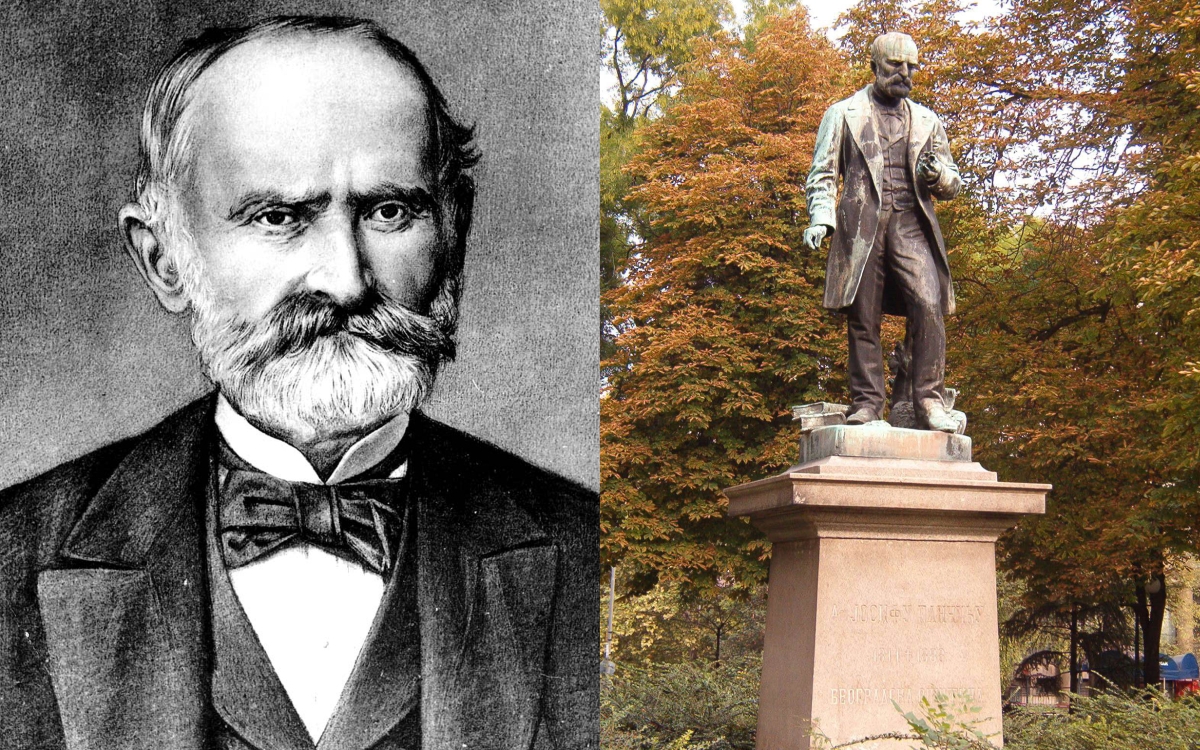
Živojin Đorđević, a professor at the University of Belgrade, gave a speech back in 1928 at the gathering of the “Alliance of the Association of Natural Sciences Students ‘Pančić'”. In his inspired address, he said, among other things:
“Josif Pančić can be considered the Nestor of Serbian Natural Sciences and he will be spoken of not only thirty-five years after his death but also after that time, whenever the need arises, as now, to raise the fallen spirits and re-guide them into the course of order and work.”
What elevates Josif Pančić among the greats?
Is it his authority gained by encyclopedic knowledge or his exceptional position in society which he achieved by tireless work on the study of nature? All this and much more. Josif Pančić, a person of exceptional intellectual abilities and creative spirit, throughout his life strived to combine the personality of a botanist, professor, doctor, pedagogue and a good man. For a long time, he was alone in his persistent and exhaustive research of the flora, in his desire for knowledge. To be a nature lover, a scientist and a doctor in the second half of the 19th century, in Serbia, was not at all easy.
Growing up and schooling
On the steep slope of the northern branches of Velebit, there is a stony village of Ugrine near Bribir where Josif Pančić was born on April 5, 1814. After the death of his parents, and under the patronage of his uncle Grgur, he finished elementary school in Gospić, and high school in Rijeka. The renowned high school, founded in 1627, had an excellent educational system in which the first four grades were grammatical, and the last two were humanistic. There Josif Pančić acquired a solid knowledge of Latin and German, while he taught himself French, English and Italian. He was immensely grateful to his uncle for enabling him, in addition to education, to enjoy the sea and the nature he was enchanted by.
When he moved to Zagreb to study at the Regia Academa Scientiarium, he thought he would learn more about natural sciences, but it was not so – for two years he studied philosophy (philosophy, ethics, logic) and he did not like it.
He learned that there was a medical faculty in Budapest and begged his uncle to help him financially again. Of course, he receives all the help. He himself earned money by giving private lessons in Italian and French. He also learned English with English workers who at that time (1842) were building a bridge over the Danube, between Pest and Buda.
At the medical faculty, he loved botany the most. It was the topic of his doctoral dissertation in Latin, which he dedicated to his uncle Grgur Pančić: Taxilogia botanica. In it, he deals with the history of botany, writes about the divisions of plant species and subspecies, about hybrids and varieties of plant species.

When the job of a doctor and the love for botany are combined
Josif Pančić became a doctor of medicine in 1843 and for some time worked privately as a doctor. But, the job did not go very well for him. He gladly accepted to be a private teacher to the children of a rich German family in Banat.
In his spare time, he got to know the flora of Banat well, the Deliblato Sands; he made excursions to Velebit, to the Littoral, walked through Croatia, collected plants and made a herbarium; he also traveled to Vienna where he wrote scientific texts on the selection of plant species in the Natural History Museum. It was there that he met the great reformer of the Serbian language, Vuk Karadžić, who recommended him as a teacher in Užice.
However, in Serbia in 1846, Vuk did not have so many supporters among the closest associates of Prince Alexander Karađorđević and his recommendation did not help. While waiting for a job in Užice, he learns that Jagodina is looking for a doctor. Pančić, without much thought, goes to the south of Serbia and in 1847 becomes a physicus. He continues to collect plants and gets to know the flora on the slopes of Ozren and Rtanj.
He marries a girl from Ćuprija and remains forever tied to this region.
He was admitted to the Serbian Society of Letters in 1850, and in 1853 he became a professor of natural sciences at the Lyceum, later at the Great School. After decades of active life and travel, he decides to accept the invitation of the Main Educational Council at the Ministry and become their regular member. He deals with issues of the school system of education and upbringing. He no longer travels, does not explore the flora and forests, and donates his herbarium to the Great School. The herbarium is kept, as an exceptional value, in the Institute of Botany in the Botanical Garden in Belgrade.
Pedagogy is the foundation
Pančić worked in two directions – he was an original researcher and he was extremely dedicated to general things: he was interested in pedagogy, scientific work and methods of popularizing science. He loved to lead discussions with the audience, always ready to discuss with colleagues and professors on the topic of natural sciences.
Pančić’s pedagogical work was an excellent reference for younger generations. He was of a bright mind and pure character and the issue of children’s education and learning was very important to him. Thus, in the article Natural Science in Elementary School in 1876, he writes very objectively and pragmatically “about school and national needs” – about the school building, equipment, libraries, about the school garden, about the importance of drawing.
The greatest value of Natural Science is the key method in teaching “that natural things must be seen with the eyes and felt with the fingers.” He appreciated the principle of perceptual teaching, he knew how to say that “a child’s mind can understand quite difficult and intricate natural phenomena by drawing and redrawing.”

Seed exchange
Pančić published his works in various journals at home and abroad. In the Viennese journal “Oesterreichische Botanische Zeitschrift” Pančić describes a trip through southwestern Serbia and includes a list of collected rare plants. In it, he writes enthusiastically about Mokra Gora and Kopaonik and concludes the floristic analysis with a presentation of the Stolovi mountain in the Ibar valley. His well-known discussion Saffron in the Herald of the Serbian Learned Society from 1865 is known, with which he wanted to “awaken sleepy heads and interest his compatriots in the cultivation and preservation of natural habitats and the botanical world.”
For each plant, Pančić strives to describe a useful share in the living world, experiences in cultivation, conservation, preparation of seedlings, about pests that attack them.
He often suggested exchanging plant seeds instead of exchanging dry grasses and leaves. The reason was the lack of a herbarium and the making of collections in conditions when traveling through villages, in bad weather conditions and over bad terrain.
He translated and wrote several textbooks on botany, but his great desire was to devise a method of visual teaching for all pupils and students. That is why he worked hard on the establishment of the “Botanical Garden”.
During forty years of work and research, he was mostly engaged in the study of basic botanical disciplines: floristics and systematics of plants. He constantly emphasized that “before a student could approach any branch of botanical science – physiology, systematics, phytography and others, it is necessary to know more plants from his environment, to acquire routines so that he can find out the name of the genus and species for each plant under which the plant is known in science.”
About the language he wrote in
Older youth learned from Natural Science for students of the Great School (1864). The book in the first part deals with the animal world, in the second part with the plant kingdom, and the mineral world is listed in the third part.
It must be admitted that Pančić thought of his readers and wrote in a folk, familiar, clear and legible language. From each of his lines it can be seen that Serbia is “unusually rich not so much in the number of species as in its monotypes or plants belonging only to it and a multitude of species that arrive from the eastern or southern sides.”
Professor Pančić realized very early that our pupils and students must have professional books translated into their mother tongue. That is why in 1866 he translated Zoology by Milne Edwards; Mineralogy and Geology by Naumann and Bedant in 1867 and Botany by Schleiden in 1868.
He wrote, among other things, Kopaonik and its foothills, On the Origin of Wheat and many other professional books. These textbooks are proof of our scientist’s intention to bring the terms, thesaurus, way of working and learning of the most famous writers closer to our people so that they can keep pace with world knowledge and science. The textbooks were intended for students of the Great School and were in use for a long time.
Botanist
We know that many travel writers wrote for Serbia that it is “a continuous forest”. For Pančić, this was an incredible challenge and field of research. The botany of Serbia until the mid-19th century was the subject of research by only a few scientists from Hungary and France who traveled to these areas and wrote something down. It was only Pančić with his first real research work that laid the foundations for organized and systematic research of the flora.
Professor Živojin Đorđević, in the aforementioned speech from the beginning of our story, points out that only a few floras were richer than Serbia at that time (Greece, Dalmatia, France, the Iberian Peninsula, and southern Italy) “due to the seacoast and the great Alps,” but that it was Josif Pančić who was responsible for Serbia’s natural wealth becoming recognized in Europe.
One of Pančić’s first important texts was written in 1856 in German for a Viennese scientific journal: List of wild flowering plants that grow in Serbia, with descriptions of some new species. This list included 1806 species of wild plants in the Principality of Serbia (excluding the Užice region). A few years later, he published On the Flora of Mosses of Banat, also in a German scientific journal. With his Italian colleague, botanist Roberto Visiani, he wrote in Latin Plantae Serbicae rariores aut novae with detailed descriptions of the finds, the growth time, reproduction, and flowering of the plant. The book Flora in the Belgrade Area had six editions in about thirty years. It thematically covered a wide area between Belgrade, Vinča, Avala, Ostružnica, and was intended for pupils and students to stimulate their research spirit. In ten years of examining flowering plants around Belgrade, Pančić described 1057 different plants within 427 genera. Of course, there were also newly discovered ones among them, such as the plant from the mustard family (Brassicaseae) that he found on Avala.
He is also the author of a very extensive study Flora of the Principality of Serbia, where he describes 2422 plant species. The book deals in detail with all known and new plant species, gives characteristics of geographical areas not only in Serbia (flora of Šumadija, flora of the Carpathians, eastern Alps…).
Pančić also visited Montenegro in the desire to create a complete map of the flora. Thus, in 1872, he published a book on the flora of this country. A few years later, he also visited Bulgaria, the slopes of the Balkan Mountains, and all the time he wrote, defined, drew, and mapped new and new plant species and genera.
Doctor
As a young doctor in Banat, Jagodina, Kragujevac, but also as a scientist, he worked very seriously, conscientiously, and studiously. He was a true role model and example of behavior and humanity. When he was employed as a “physicus of the Jagodina district,” he had great ambitions: he submitted the first report to his superiors to “open a branch pharmacy”; he developed a pathology of the inhabitants of that region; he went to the villages and pointed out the wrong ways of treatment with folk magic; he wrote about the wrong way of preparing food and warned traders not to sell any poisons (not even for gardens and estates) without permission.
All this sounds strange and unimportant to us now, at first glance, however, the fifties of the 19th century were a very real threat to the people’s health and survival. Josif Pančić was a true friend, companion, and compatriot who did not stand out in any way.
Dendrologist
Pančić published his first book, Forest Trees and Shrubs in Serbia, in 1871, published by the “Herald of the Serbian Learned Society.” Here he described 71 genera with 188 woody species from all over Serbia. This book is extremely important also because of the terminology he used: along with Latin names, there are also names in German and French, as well as a translation into Serbian. For example: Clematis vitaba L – white vine, pavitina, skromut; Waldrebe, in French clematite Tilia argentea – white linden; Ailanthus glandulosa – sour tree grows quickly in rocky places, Evonymus verrucosus – warty spindle tree grows in forest rocky areas, Sorbus domestica – service tree grows in the hills all over the country, Buxus sempervirens – boxwood, is grown in parks, gardens and planted in avenues, etc.
Omorika
Many of Josif Pančić’s discoveries have a far wider significance than that related to the territory and climate. In his letters and notes, he wrote how he searched for omorika for 20 years after he first heard about it in 1855 in the vicinity of Užice. It was not until 1877 that he managed to classify and describe several omorika trees near the village of Zaovine on Mount Tara. The folk name for this coniferous forest was Omara.
Pančić gave the conifer the Latin name Pinus omorika to emphasize the morphological features that distinguish it from other species of the genus Pinus L. In a special notebook, he wrote in 1887 a significant work: Omorika a new kind of conifer in Serbia. This was a very important discovery of an endemic-relict species of our regions.
Pančić then wrote, “And when our omorika appeared before the learned world, it was received with the greatest disbelief; Prof. Grisebach in Göttingen claimed that omorika was identical to the Erzurum spruce, and Prof. Purkinje in Bielsko-Biała that it was a Japanese species…”
Over time, his colleagues from around the world became interested in this discovery and soon proved that the closest relatives of Pinus omorika grow in North America and East Asia. Its natural habitat is around the Drina, partly in Bosnia (from Bajina Bašta to Višegrad), partly in Serbia, the Zlatibor region.

Entomologist
Josif Pančić also studied the fauna of Serbia. Pančić’s Zoology was written following the example of foreign works on this topic (first edition in 1864).
In the Herald of the Serbian Society of Letters, Pančić in 1863 writes about the topographical position of quicksand in Vojvodina and clearly categorizes some species of insects and grasshoppers in it. He titled one part of his work Zootomy, while he wrote the book about grasshoppers and other orthoptera in Serbia only in 1883.
He worked on writing this part with interruptions for thirty years and finally made a systematic presentation of everything that makes up families and species: place of residence, geographical divisions, index of families, genera, their development and how to collect material in the field. It covers four orders of insects: Dermaptera, Blattodea, Mantodea, and Saltatoria.
The Legacy of Josif Pančić
In the book “Josif Pančić” (published by the Serbian Academy of Sciences and Arts, 1976), there is an interesting quote: for his 70th birthday, Professor Pančić received a school album with signatures and a dedication “To Josif Pančić, Doctor of Medicine, State Councilor, Professor of Botany at the Great School, founder and manager of the Botanical Garden, benefactor of Serbian literature with the first scientific botany, zoology, mineralogy and geology, the best terminologist and connoisseur of the Serbian language in general among naturalists, founder of the collection of plants in the natural history cabinet of the Great School… on the occasion of the celebration of his 70th birthday, 31 years of professorial service and literary work on the day of December 21, 1884, dedicate this album of portraits and autographs of his younger colleagues, as a memento.”
He educated and trained 34 generations of lyceum students, many of whom continued his work. He received the highest recognitions in his country and abroad. Pančić was also the first president of the Serbian Academy of Sciences and Arts. He died on February 25, 1888, in Belgrade.

Institute for the Study of Medicinal Plants “Dr. Josif Pančić”
The Institute for the Study of Medicinal Plants “Dr. Josif Pančić” was founded in 1948. The Institute is a unique research and production institution. Since its founding, it has been engaged in the research, production, and processing of medicinal plants in Serbia and wider in the Balkans. For years, we have been going there to buy teas, salves, and creams. The Institute has expanded and branched out its original activities in several directions: here, plant research (laboratory and quality control), production, and sales are carried out. Sales points are located in several locations in Belgrade and Pančevo.
On the official website, it clearly states: “The Institute’s quality strategy is implemented through a continuous process of research, development, production, control and circulation of plant raw materials and products based on medicinal plants, in accordance with the requirements of the ISO 9001:2015 standard, using the hazard analysis and critical control points (HACCP) system. The Institute’s collective today consists of 144 employees, of which 17 hold a doctorate, 4 have a master’s degree, and 26 have a university education in pharmacy and agronomy, chemistry, biology, and other related fields.”
And whenever we hear about some new combinations of teas, salves, and creams, we are sure that we have chosen a quality product. In the “Josif Pančić” Institute, there is a herbal shop where we can find all kinds of tea mixtures, phytopreparations, cosmetic products, herbal drops, hemorrhoid ointment, and more.
Pančić’s Mausoleum
Pančić’s Mausoleum is the first cultural monument in the mountains of Serbia. It is in the shape of a stone sarcophagus, designed by architect Vladimir Vladisavljević. On it is a plaque with an inscription, a message from SANU and the Mountaineering Association of Serbia:
“Fulfilling Pančić’s testament, we transfer him to rest here eternally. We also publish his message addressed to the Serbian youth – that only by deep knowledge and studying the nature of our country will they show how much they love and respect their homeland.”
They say that until the very end, while he was in bed, he continued to talk about plants. The often-quoted thought he expressed at that time about the flora is: “The field for work is wide, but there are few workers on it.”
MORE TOPICS:
ANGER GROWS AT THE BLOCKADES: Police summoned more than 10 farmers for informative talks!
HORROR IN NORTH MACEDONIA: Serial killer arrested, suspected of murdering as many as five women!
Source: SamoObrazovanje.rs, Photo: Wikimedia Creative Commons