


“It’s about power and politics. It’s about greed and corruption. It’s about betrayal and idealism. And it’s about lithium, the lightest metal in the world — and the most valuable. It’s the material thrillers are made of. But this is not a novel. This story is real. It’s playing out in real life and it’s happening right now, before our eyes — even if we don’t notice it, because we aren’t looking,” writes the German conservative magazine “Tichys Einblick” (Tichy’s Insight) about the situation in Serbia.
Every thriller depicts a struggle between good and evil, writes “Tichys Einblick” and adds that the hero is not always completely good, and the villain is not always completely evil. But essentially, the roles are clearly assigned enough so that the audience is not confused, states this magazine, whose text we are conveying in its entirety:
Chapter 1: The Good Guy
Dragan Šolak is the prototype of an entrepreneur and a self-made billionaire. In 1990, at just 26, he founded VANS, one of the first film and TV production companies in what was then Yugoslavia. Ten years later, he founded a local cable television network in his hometown of Kragujevac in today’s Serbia. With foreign venture capital, he turned the small network into a rather large company: United Group. In 2003, the group became the first operator in Serbia to introduce high-speed broadband internet.
One of the most important subsidiaries of United Group is United Media. Among other things, it operates the N1 TV channel. The cable channel was founded in 2014 and broadcasts news 24 hours a day. N1 is headquartered in Belgrade and has sister channels in Ljubljana (Slovenia), Sarajevo (Bosnia and Herzegovina), and Zagreb (Croatia).
The family of channels is very popular throughout Southeast Europe — especially in Serbia, where it is practically the last source of information independent of the government. In its target area, the former Yugoslavia, N1 is available everywhere via cable (or rather: it was available; we will return to that soon).
Over the years, Šolak brought several high-caliber investors into United Group, including George Soros and, most recently, the giant US investment firm KKR (which until recently also held large stakes in the publishing house Axel Springer). There were never any problems — or at least nothing ever leaked, which speaks volumes in the international media industry.
All investors, of course, thoroughly vetted Šolak and United Group; in the investment business, this is called “due diligence.” There were never any objections. The investors invested large sums, stayed for a while, and then sold their stakes — with a profit and without a single harsh word.
It went like this for 25 years, and everyone was satisfied: Šolak, the investors, United Group, and the viewers of N1. Until now.
Chapter 2: The Villain
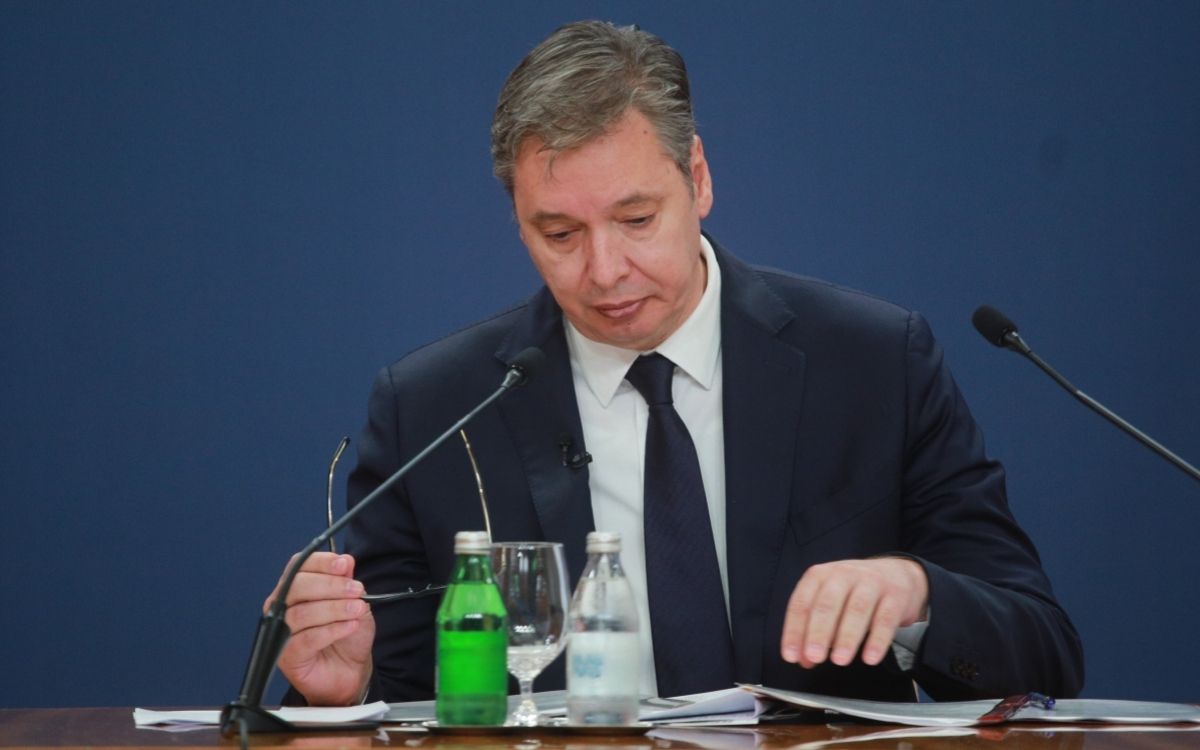
Aleksandar Vučić is an exclusively political being. At 23, in 1993, he joined the Serbian Radical Party (SRS), which is ultranationalist even by Serbian standards, and the same year he was elected to the National Assembly as a deputy for that party. Two years later, he became the party’s general secretary. After the SRS won the local elections in Belgrade in 1996, he became the well-paid director of a city sports and cultural center.
Being determines consciousness.
During the Kosovo War, Vučić became Minister of Information under President Slobodan Milošević. One of his first official moves was to introduce fines for journalists critical of the government and ban foreign TV channels. Until 2008, he was a determined opponent of any rapprochement between Serbia and the EU.
When public support for the SRS declined, he changed parties and political positions: he took a high-ranking position in the new “Serbian Progressive Party” (SNS), which advocates for Serbia’s accession to the EU. Since 2014, the EU has officially listed Serbia as a candidate country.
In 2012, then already the party leader, Vučić became Minister of Defense, then Prime Minister in 2014, and finally President in 2017. The Serbian Constitution prohibits the head of state from holding any other political function, but Vučić ignored that provision and remained president of his party for a long time anyway.
Power for power’s sake
Step by step, Vučić reshaped the country’s politics into an authoritarian regime. When an opposition leader was beaten with an iron bar almost to death in November 2018, nationwide protests erupted and lasted for weeks. Opposition parties boycotted the 2020 parliamentary elections.
The same year, Vučić passed a law restricting the activities of NGOs and independent media. Also in 2020, due to Covid, he first introduced a curfew, and then — without involving the parliament — declared a state of emergency. Whether this was unconstitutional is disputed to this day.
Even his opponents do not attribute ideological motives to him. The man is simply a technocrat of power: his goal is to maintain power. At all levels of the state and in all areas of society, he appoints loyalists and supporters. Down to the local elections in small municipalities, there should be no winners who do not come from the party — and from the President’s circle.
In terms of content, his policy is, to put it mildly, flexible. Serbia remains a candidate for EU membership. At the same time, a few weeks ago Vučić had no problem attending a large military parade in Beijing on the occasion of the 80th anniversary of China’s victory over Japan in World War II. On that occasion, he also met with Vladimir Putin and Xi Jinping.
Last year, the Serbian president quite openly stated that his government “of course” sells weapons and ammunition to both NATO countries and Russia.
Chapter 3: The Media
However adaptable he may be in his political views, Aleksandar Vučić is equally relentless in dealing with critics.
In November 2024, the canopy of the train station — reconstructed with the help of the Chinese — collapsed. Sixteen people died. The catastrophe, whose cause is widely considered to be corruption and shoddy construction, sparked the largest mass protests in Serbia since the breakup of Yugoslavia. Hundreds of thousands of demonstrators across the country condemned corruption at all levels of the state — which is largely managed by Vučić’s party.
The protests were initially peaceful. But since the summer of 2025, violence has been increasing. Opponents accuse Vučić of sending paramilitary thugs against the demonstrators.
This is where N1 enters the scene.
It is the last remaining major independent television station in the country and has long been a thorn in the side of the government. The editor-in-chief of N1, Igor Božić, explains his newsroom’s approach:
“We investigate what is wrong with the government. We deal with corruption and crime — and the people whom the government pressures and who therefore need help.”
Because of this, N1 and its staff have long been under great pressure themselves.
Editors at the station are constantly labeled as “traitors” and “foreign mercenaries” by the ruling party. President Vučić himself called them “liars” and even “terrorists.” On social media, people from N1 are not only grossly insulted daily but are regularly subjected to serious physical threats. Letters told the station that their premises would be blown up and that the journalists and their families would be killed.
When Aleksandar Vučić was in the hospital in 2019 due to cardiovascular problems, the staff of the presidential cabinet, along with the regime media, seriously accused an N1 journalist of endangering the president’s health by investigating corruption allegations. Tens of thousands of leaflets were distributed calling for N1 to leave Serbia.
Dependent Media Industry
The Serbian state apparatus is the largest financier and advertiser for the vast majority of Serbian media — which, consequently, with very rare exceptions, openly serve as the president’s megaphone.
At the closing of Vučić’s last election campaign, the seven largest daily newspapers in the country appeared with identical front pages: the initials “A” and “V” and the campaign slogan “Faster. Stronger. Better. Serbia. Vote for Vučić!”
The largest TV station in Serbia belongs to an old companion and ally of Vučić. Accordingly, “TV Pink” reports exclusively and without exception positively about the president.
A few years ago, the company Ringier took over several media brands from the publishing house Axel Springer in Serbia. The Swiss immediately showed a typical Swiss instinct for acquisition: their newspapers quickly completely reoriented themselves to the government line.
All that remains are N1, the channel Nova S, the daily newspaper “Danas” and the weekly magazine “Radar”. All of them report critically on the government, and all belong to United Media. The company is something like a small Gallic village in the media Rome of Serbia. And let us remember: it is a subsidiary of United Group.
The Serbian N1 website and application are under constant cyber-attacks. Despite this, the station continues to report daily on news in Serbia — including protests, demonstrations, and the public’s growing dissatisfaction with the government. “Not everyone likes that,” says N1 editor-in-chief Božić.
That is likely the understatement of the year.
Chapter 4: The Great Intrigue
Because in his search for a way to silence the last independent media outlet in Serbia, President Vučić has, apparently, found what he was looking for. In that process, as always in such constellations, power and money intertwine.
Power is represented by Telekom Srbija. It is the largest provider of internet, TV, and fixed telephony in Serbia, and it is majority state-owned. Critics see the company as the most important instrument by which Vučić extends control over the media landscape and stifles critical voices.
Over the past years, Telekom Srbija has bought more and more private cable operators. All of them shortly thereafter terminated their contract with N1. The critical channel can no longer be viewed through all those cable networks. Nevertheless, N1 remains hugely popular; viewers increasingly access it via the internet.
The money side also has a name: BC Partners. It is a large investment firm based in London. Franz Müntefering would probably call it a “locust” — and rightly so. Some time ago, it took over the majority share of United Group from KKR.
Unlike all other majority investors over the past 25 years, BC Partners has initiated an open war against the company’s founder and director, Dragan Šolak. The London partners have pushed him to the margins of his own company using rough methods. Šolak is fighting, wants to protect his life’s work, and has sued BC Partners. The dispute is coming before the commercial court in mid-October. But until a verdict is reached, the English are creating facts. For example, they removed Šolak and immediately appointed a new CEO at United Group.
That man certainly does not have to fear the accusation that he might be interested in independent journalism: he recently had a phone conversation with the director of Telekom Srbija. The international investigative platform Organized Crime and Corruption Reporting Project (OCCRP) intercepted the conversation, which is why we know what was discussed.
They talked about the replacement of the CEO of United Media.
The director of Telekom Srbija emphasized that President Vučić wanted the woman removed as soon as possible. The director of United Group maligned the woman (after all, she was the CEO of the most important subsidiary of his group) and promised to remove her as soon as possible — “as we agreed.” After that, he said that N1 could then be, quote, “made small.”
United Group does not dispute either the authenticity of the intercepted conversation or any quote. It only criticizes the fact that the conversation was recorded without authorization.
But why, why?
The connection is clear at first glance, while the motives may only be visible at a second.
N1 is the only remaining major independent TV station in Serbia. It belongs to the media company United Media, and the CEO of United Media protected her journalists critical of the government.
United Media is a subsidiary of United Group. Until now, it has successfully resisted political pressure from the camp of President Aleksandar Vučić. But some time ago, United Group got new majority owners from England, and they now apparently no longer support independent journalism but good relations with the regime.
It is not too bold a thesis to assume that this will pay off for the cunning merchants from London. The intercepted phone conversation also gives a hint of how this might happen. The director of Telekom Srbija showed great interest in “Shoppster.” This is an e-commerce platform, and it belongs to United Group.
Let’s imagine for a moment: how satisfied would the new director of United Group be if the state-owned and therefore practically infinitely solvent Telekom Srbija were willing to buy “Shoppster” for much more money than the platform is worth? What do you think, dear readers: would the English locusts trade an independent TV station for that? In any case, the phone conversation between the director of Telekom Srbija and the director of United Group ends with the sentence: “See you at the club.”
Everyone can now imagine for themselves what kind of “club” this is.
Chapter 5: The EU and Lithium
Lithium is the lightest metal in the world — and the most sought after. The element is extremely rare but in extremely high demand — because it is a key ingredient in batteries for electric cars.
The world’s largest lithium producers are Australia, Chile, and China. For its plans for a complete transition to electromobility, the EU needs huge amounts of lithium, but until now it has been dependent on imports. There are only a few lithium deposits in Europe; one is located in the Jadar Valley in western Serbia.
Thus, in 2024, the EU concluded an agreement with Serbia on the extensive exploitation of this metal. Overnight, this made Serbia one of the EU’s most important partners — not because of a particularly large volume of trade, but because of a particularly valuable raw material.
And lo and behold: since the signing of the lithium agreement, there has been almost no criticism of Aleksandar Vučić from official EU circles. Even his pro-Russian diplomacy, which was previously always a thorn in the side of the Ukraine-loyal Eurocrats, is now at best only formally reproached.
And they are even less interested in media freedom in Serbia in Brussels.
Epilogue
Serbia today is somewhat like the Venezuela of Europe.
In Venezuela, the ruling clan has nationalized organized crime, there are no free media, and the country has oil. In Serbia, corruption is rampant, free media are being dismantled, and the country has lithium.
Those who notice certain similarities may not be entirely wrong.
MORE TOPICS:
Source: N1, Photo: ATA Images