




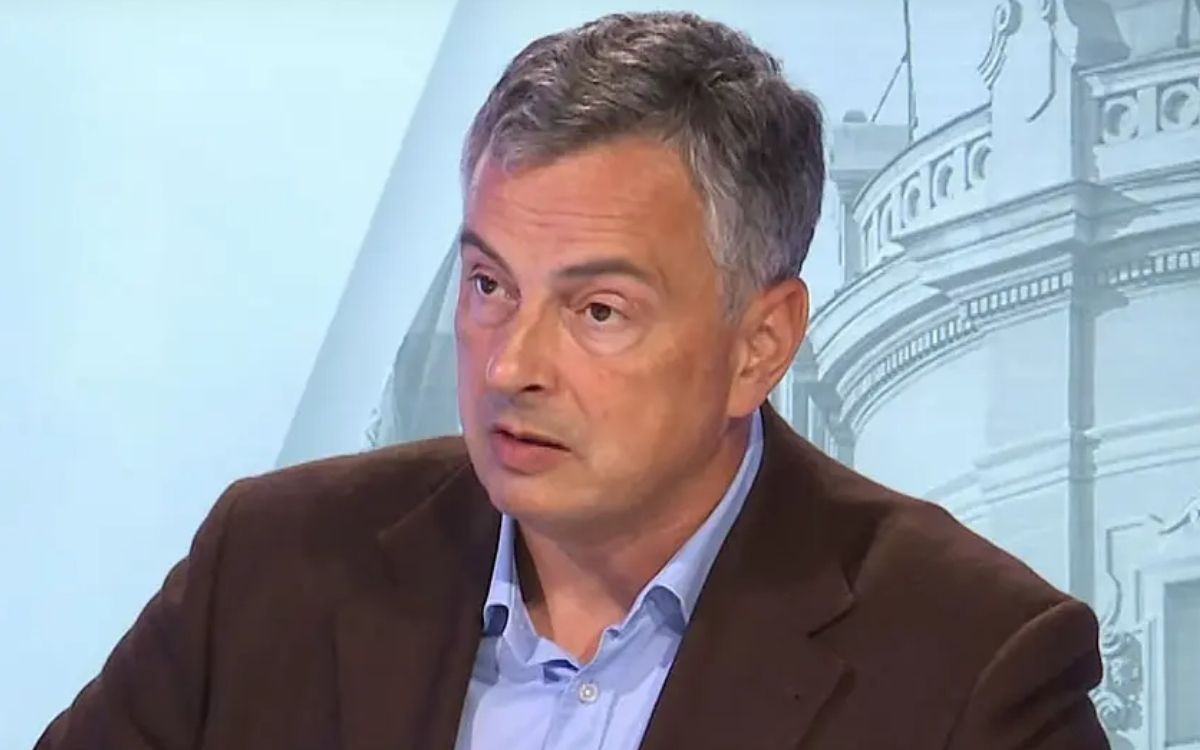
Dejan Šoškić, a candidate for parliament on the Student List, said while discussing the Alta Bank case that such a situation, in which a currency exchange office owner becomes the owner of a bank, could not have happened if the system had been functioning properly. He stressed that the National Bank of Serbia should never have allowed an “unreliable owner to enter the financial system.”
“It could not have happened. As it happens, I know this subject somewhat better through my own personal experience. I resigned in 2012 because a law was passed that allowed for a much greater degree of interference by the executive branch and politicians in the work of the National Bank of Serbia. So, the first thing we need to point out regarding Alta Bank, formerly known as Jubmes Bank, is that allowing an unreliable owner to enter the banking sector should never have been permitted,” Šoškić said on TV N1’s Utisak nedelje.
Dejan Šoškić explained that by an unreliable owner, he meant that “someone who owns a currency exchange office and lacks the necessary credibility, knowledge and experience cannot become the owner of a bank.”
“If the National Bank (of Serbia, ed. note) could not find a legal basis for intervention, but had suspicions that the owner in question might behave irresponsibly in terms of the risks posed to the institution itself and the wider financial system, it should have had mechanisms for more intensive supervision. It should not have allowed unverified individuals to join management and executive bodies, particularly those whose knowledge had not been assessed and who had no evidence of appropriate business conduct over a previous period,” he stressed.
He noted that entering the financial system, particularly the banking sector, carries special responsibilities and that “you cannot simply open a bank just like that.”
“The initial capital required for an ordinary legal entity is incomparably lower. To establish a bank, you first need substantial funds. Why? So that, in the event of losses, those losses can be covered from your own resources. Secondly, you must demonstrate that you have the knowledge, experience and business credibility required to operate in this field. These principles apply equally to bank owners, management bodies and executive boards,” he said.
Šoškić stressed that Alta Bank should have been placed under a “more intensive supervisory regime until sufficient insight had been gained to establish that the bank was operating normally, in accordance with the law, and did not pose a potential threat to financial stability.”
“Alta Bank could never have happened if the National Bank of Serbia had acted professionally and independently of the political authorities. The very fact we are now hearing about, that 20 or 25 percent of its assets were supposedly held in cash, allegedly in the vault, is absolutely unacceptable. No bank operates like that, and that alone should have been an immediate signal to launch an inspection and first establish whether the money was actually there. We still do not know whether the money existed or whether it was simply reported fictitiously.
“In other words, was the abuse carried out in an extremely straightforward manner, with someone simply coming in and carrying away cash in sacks or bags, or was documentation falsified to make it appear that a large amount of cash existed, which was then used as the basis for granting unsecured loans that were issued with no intention of repayment? That could be another mechanism of theft. All legal entities that received unsecured loans should be investigated to determine whether they had any connections with the bank’s owner, its directors or members of its management board, as well as individuals in senior positions at the National Bank of Serbia, particularly the director of banking supervision and the institution’s top leadership,” Šoškić stated.
He also questioned how it was possible for the public sector, major state-owned companies, municipalities and cities to keep their money in a bank of this kind, arguing that “party-political coercion was exercised over the prudent management of public funds.”
“They were channelled towards an unreliable bank, bringing us to the situation we face today, where the bank’s collapse is unfortunately threatening the liquidity of some major companies and local governments. In other words, there is a whole series of serious failures here, and investigative proceedings must still establish the final list of those potentially responsible,” he said.
“Corruption is not paid for with imaginary money, but with ours”
Šoškić stressed that one of the most important lessons to be learned is that corruption “is not paid for with some imaginary money, but with our money.”
“It is a structure of privileged individuals who effectively rob everyone else in the system, people who are honest and simply do their jobs, using various mechanisms. Sometimes those mechanisms are not directly visible, but that does not change their essence: we have a caste of exploiters who exploit all the rest of us, ordinary citizens.
“This system is so offensive and humiliating to an ordinary person that I personally believe we must put the entire issue up for public debate so that everyone understands what is happening. And then, when they say that ‘there will be no pensions or anything else,’ that is simply nonsense. If we free up public funds and dismantle this breeding ground for corruption, there will be more money available at every level,” he said.
Ninić: This is a system of interconnected vessels
Lawyer Ivan Ninić said, commenting on the Alta Bank case, that the damage was enormous, describing it as “megalomaniacal.”
“But why? Because someone decided they wanted their own bank, just as they decided they wanted their own television stations, their own Security Intelligence Agency, their own prosecutor, their own court and their own Belgrade Waterfront project.
“The bank was essential to them because they needed it to carry out certain operations in other countries, specifically Montenegro and North Macedonia. They needed it to buy and sell, and to issue bank guarantees to their business associates who would not have obtained such guarantees from other banks because these were fly-by-night companies, set up for a one-off purpose: to launder money and then shut down. In other words, this is a system of interconnected vessels,” Ninić said.
During the programme, Ninić also claimed that people had contacted him alleging that Dunav Insurance had operated a “bot room, or rather a centre where so-called grassroots votes were gathered for months and infrastructure was being built in parallel for the Serbian Progressive Party.”
“After the elections, certain people came in, replaced the servers and hard drives, removing traces. There are individuals with criminal records, criminal complaints against them and ongoing court proceedings serving in Dunav Insurance’s governing bodies. So who gave these people approval to serve in the management bodies of financial institutions? The very same National Bank of Serbia. I see all of this as a system of interconnected vessels and an issue that must be discussed in the period ahead,” Ivan Ninić stated.
Mališić: People are now genuinely expecting accountability
Vesna Mališić, editor-in-chief of the weekly Radar, stressed that people in Serbia are now genuinely expecting accountability following the elections and want the key pillars of society, particularly the judiciary, the economy and the media, to be put back on their feet.
“Because they are the pillars of democracy, not pillars designed to keep a particular government in power,” Mališić said.
Speaking about the media, she stressed that the profession must recover and that professionals who do their jobs properly must return, regardless of whether Aleksandar Vučić or the Student List is in power.
“That means being equally critical of the new authorities, the old authorities and anyone else. It is a major undertaking because, essentially, enormous amounts of money flowed into those media outlets from the previous government, turning them into little more than servants and pushing them out of the sphere of what traditional media should be,” Mališić said, referring to pro-government media outlets.
MORE TOPICS:
Source: N1 / Nova.rs Foto: Printscreen/NewsMax Adria
 Add Serbian Times as your Google source