




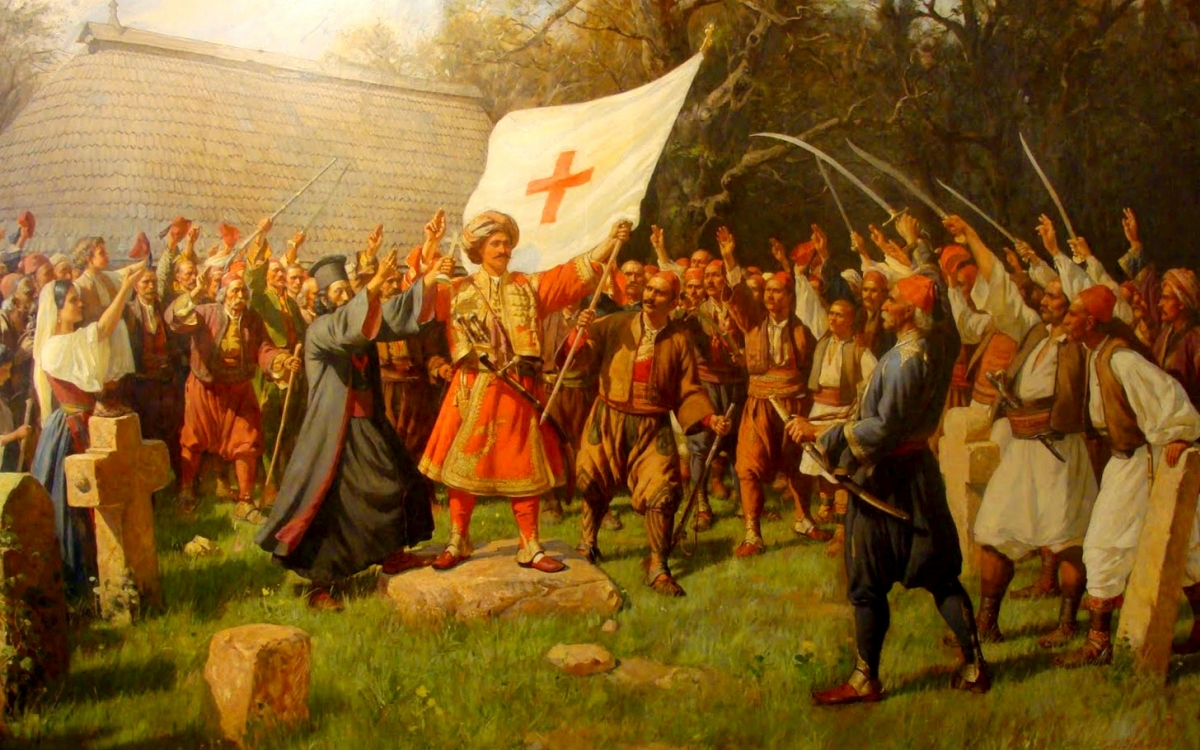
On the great Serbian holiday Cveti, in the distant year 1815, Miloš Obrenović, along with an unarmed people in Takovo, near Gornji Milanovac, set out to fight for freedom and the creation of a modern Serbian state.
Seven days before Easter, Miloš arrived at a wooden church dedicated to Saint George with his entourage, where they received Holy Communion before heading into a dense oak forest. There, near the village’s sacred tree, he spoke the famous words: “Here I am, here you are—war on the Turks!” Following this declaration, they launched into battle against a powerful force to liberate their state, as freedom had no price.

Although Miloš Obrenović was illiterate, he was skilled in diplomacy. Within twenty years, with minimal casualties, he managed to gain control over six districts without firing a single shot.
“Through three months of warfare and diplomatic negotiations, Miloš secured the foundation of Serbian statehood. Official documents confirmed that Serbia was a vassal principality within the Ottoman Empire, but politically, it was entirely independent. Serbs began collecting their own taxes and administering their own justice. In case of conflicts between Serbs and Turks, mixed commissions would resolve disputes—somewhat resembling modern diplomacy. This led to Serbia’s first constitution, adopted in Kragujevac in 1835, which established a division of power into legislative, executive, and judicial branches. This completed the process of Serbian statehood, continuing what Karađorđe had started and what Miloš finished, which is why they are considered the foundation and the roof of Serbian statehood,” said Aleksandar Marušić, director of the Museum of the Rudnik-Takovo Region, in a statement to RINA.

Under the Ottoman Hatt-i Sharif, Serbia was granted the right to have a flag, with elements derived from medieval symbols. The coat of arms, first appearing in 1830, featured the famous four “S” letters on a shield, along with a crown, a mantle, an olive branch symbolizing peace, and an oak branch representing stability and endurance.
“After the Turks insisted that four crescents be included on the flag, Miloš negotiated a Solomonic compromise—a six-pointed star. Later, when Miloš sought closer ties with Russia, he asked them what their flag looked like. They answered ‘white and blue’, to which he responded: ‘So as not to offend our Russian brothers, we will simply reverse the colors.’ And thus, we got the colors of our present-day flag,” Marušić explained.

The historical event in Takovo, near the sacred tree, was immortalized by Paja Jovanović in a famous painting. Alongside Miloš and his army, the painting features a boy standing by a cross, raising his hand, ready for the liberation of his homeland.
“When asked why he included a boy in the painting, Jovanović replied: ‘The Serbian people always perish, but they are also reborn in the fight for their statehood. There is no greater wealth than having your own country, for that means having freedom.’ Jovanović visited Takovo twice, speaking with locals to accurately depict the event, even though no living witnesses remained,” Marušić added.
MORE TOPICS:
TRANSFERRED BY THE SERBIAN ARMY: Twelve injured in the Kočani fire arrive in Belgrade for treatment!
LEST WE FORGET: The March pogrom in Kosovo was deadly for many Serbs, while thousands got expelled!
DUE TO THE UNPRECEDENTED TRAGEDY IN KOČANI: North Macedonia declares seven days of mourning!
Source: RINA, Foto: Wikimedia Creative Commons, RINA