




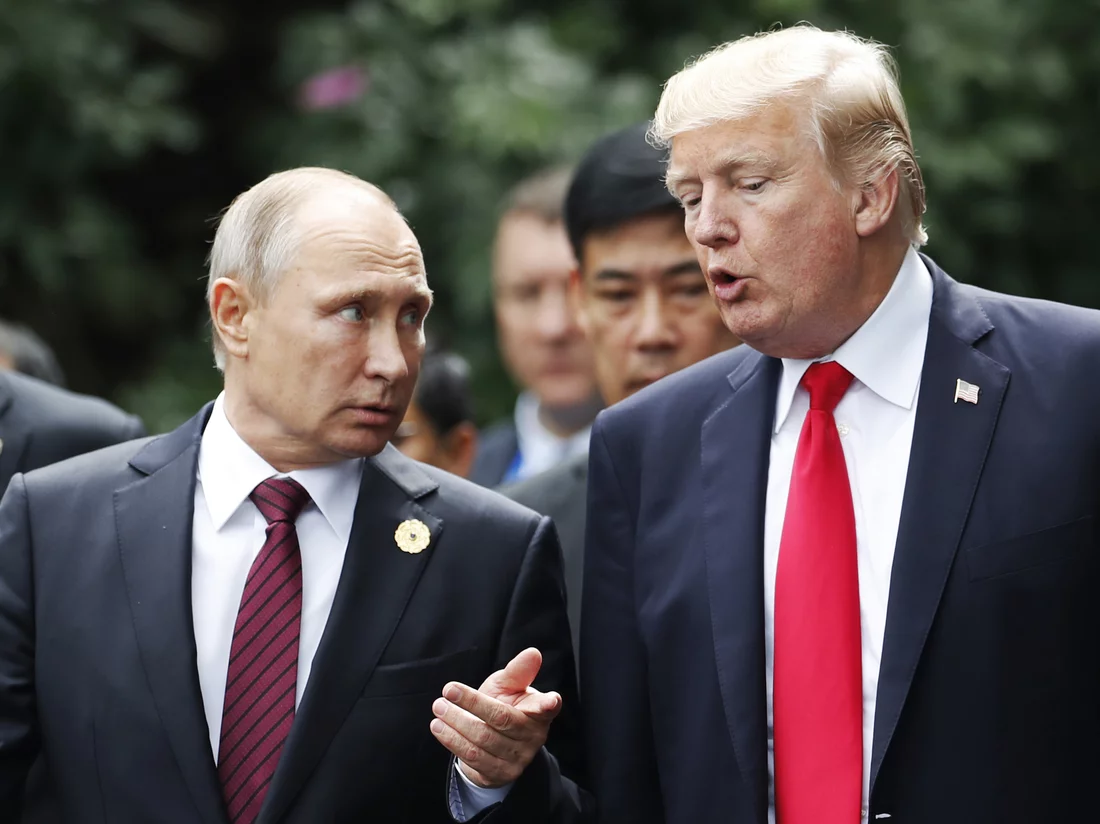
U.S. President Donald Trump has said he will meet with Russian President Vladimir Putin next Friday in Alaska, after he previously laid out the terms of a possible peace agreement to end the war in Ukraine, which could include “some territorial exchange.”
“The long-awaited meeting between myself, as President of the United States of America, and President Vladimir Putin, of Russia, will take place next Friday, August 15th of this year, in the state of Alaska. Further details to follow,” Trump wrote on Truth Social on Friday evening, as reported by CNN.
American officials, including Trump, have informed European leaders and Ukrainian officials about a plan offered by Putin to halt the war in Ukraine in exchange for significant territorial concessions from Kyiv, CNN reported, citing Western officials familiar with the matter.
The plan, which Putin presented to Trump’s foreign policy envoy, Steve Witkoff, during a meeting in Moscow on Wednesday, would require Ukraine to cede the eastern region of Donbas, most of which is currently under Russian occupation, as well as Crimea, which Russia illegally annexed in 2014.
The plan would freeze the existing front lines, but other details of the proposal were not yet clear.
It worried some European officials, who expressed fears that it was Putin’s attempt to avoid Trump’s announced sanctions, which were supposed to take effect on Friday, by offering very little in return.
However, it appears the plan was the catalyst for Trump to initiate preparations for a summit with Putin as early as next week.
Additional talks with Europeans were held over the last two days, including conversations with Witkoff and Secretary of State Marco Rubio. Witkoff spoke with several European officials on Friday to outline additional details of the plan.
It was not clear what the plan would mean for the other two regions in Ukraine—Zaporizhzhia and Kherson—where Russia controls part of the territory, other than halting its offensive there.
It was also not clear how Putin’s proposal would address other demands of the Russian leader to end the war, including a commitment that Ukraine would never join NATO or that it would limit the size of its army.
In his conversations, Witkoff told European officials that the proposal from Putin was a step in the right direction and that a broader peace plan could be negotiated once the fighting stopped. The United States is trying to convince allies to agree to this plan, one source said, although it is still not clear if that will happen.
The possibility of Russia taking control of Donetsk and Luhansk as part of a ceasefire agreement has raised concerns that such a deal could only encourage Russia to attack Ukraine again in the future.
“Officially recognizing territory seized by force with no consequences is an incentive to do more in the future,” said one European official familiar with the matter.
“It could encourage Russia to launch new attacks on Ukraine in a few years.”
Trump, who in recent months has acknowledged frustration with the Russian president over the drawn-out conflict, appeared more optimistic on Friday about the prospects for a peace deal. He stressed that his main goal is to negotiate an end to hostilities as soon as possible.
“European leaders want to see peace,” Trump told reporters at the White House.
“President Putin, I believe, wants to see peace, and Zelensky wants to see peace.”
He later added: “My instinct really tells me we have a chance for peace.”
But the possibility of Ukraine ceding any part of its territory to Russia could present a major obstacle in negotiations to end the war. Such concessions are contrary to the Ukrainian constitution, which means Zelensky would first have to get approval from parliament or a national referendum before agreeing to any change of territory.
Trump downplayed those concerns on Friday, saying he had urged Zelensky to ease the path toward an agreement.
“He goes and gets what he needs,” Trump said. “He’s not authorized to do certain things. I said: ‘Well, you’re going to have to get that fast, because, you know, we’re very close to an agreement.'”
Earlier this week, Trump had promised to impose new sanctions on Russia if Putin did not end the war in Ukraine by Friday, but on Thursday, he took a milder tone, telling reporters in the Oval Office: “It will be up to (Putin)” whether the deadline would remain in effect.
Source: N1 Photo: AP Jorge Silva