




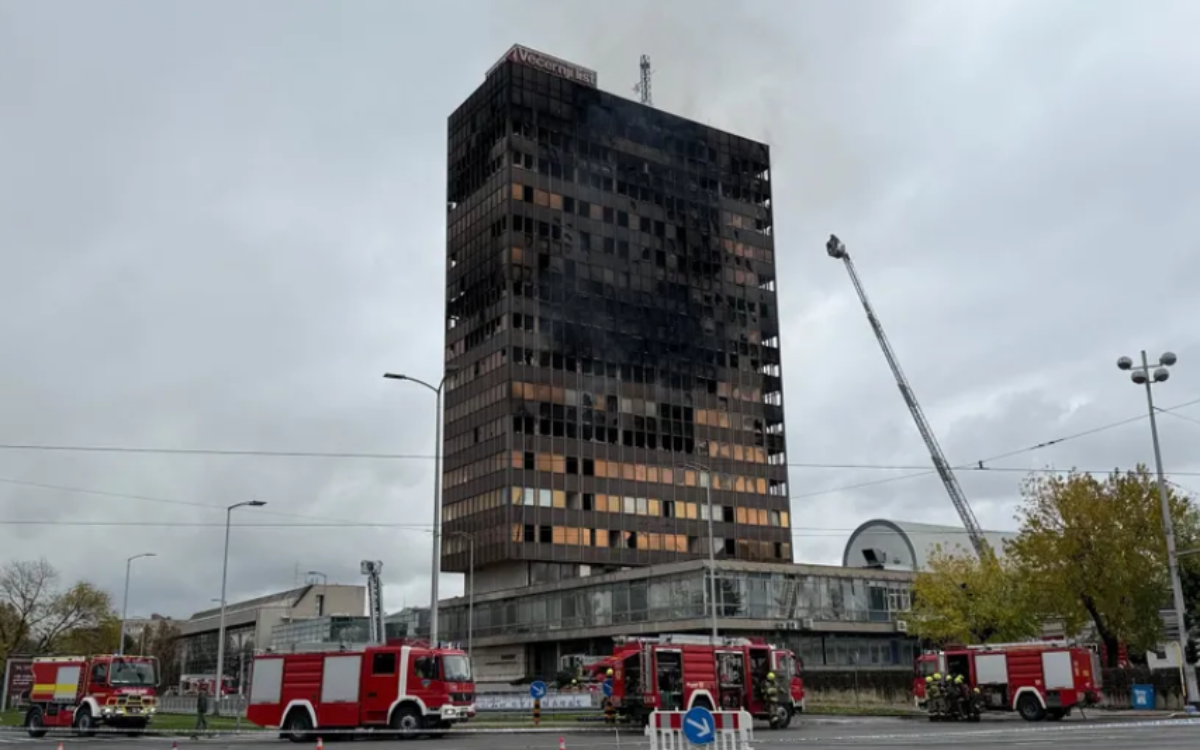
Croatian Minister of Construction Branko Bačić stated that the Vjesnik skyscraper, which burned down a week ago, must be demolished.
Mario Uroš from the Croatian Centre for Earthquake Engineering (HCPI) assessed that this must be done as urgently as possible, N1 Zagreb reports.
Branko Bačić presented a report on the condition of the Vjesnik skyscraper’s structure, which was prepared by experts from the Croatian Centre for Earthquake Engineering. “It is necessary to proceed with the removal of the Vjesnik skyscraper’s structure due to the danger of collapse and for safety, traffic organisation, and movement around the building. For the purpose of removal, it is necessary to prepare project documentation and conduct constant expert supervision during the removal. In order for us as a Ministry to be able to proceed with this removal, we convened a meeting today with experts from the Faculty of Mining, Geology and Petroleum Engineering to see, based on their proposal, which model and in what way to remove the Vjesnik skyscraper from a safety and professional standpoint. We will meet with potential contractors and designers to start the public procurement process,” Bačić stated.
He added that Slavonska Avenue and the underpass remain closed and that work is underway to widen the roadway to facilitate traffic in that part of the city.
Mario Uroš from the Croatian Centre for Earthquake Engineering said that they were afraid from the beginning that the decision would go in this direction and that they wanted to give the building a chance to be renovated.
“However, considering all the tests that have been carried out, the conclusion is that the removal of the skyscraper is necessary as urgently and as quickly as possible. All measurements and inspections we have carried out indicate that there is serious static damage to the structure; the structure is partially unsafe for several reasons. The first and main reason is the effect of the fire on the structure over a much longer period of time on parts of the structure than was anticipated. The building is tall, the fire was also on the lower floors, and those columns are quite damaged,” Uroš states.
The Longer The Structure Stands, The Greater The Danger Of Collapse
The second reason, as he stated, is that due to high temperatures, physical damage also appeared on the columns themselves – cracks, parts falling off; the eastern part of the skyscraper is quite damaged. “A structure that is bare, without protection, is susceptible to wetting, rain, and snow, which can affect such concrete so that a chemical reaction occurs that swells and expands the concrete, causing the entire cross-section to crack and fissure. The longer such a structure stands, the greater the danger of a part of the skyscraper or the entire skyscraper collapsing,” he added.
MORE TOPICS:
SERIOUS TRAFFIC ACCIDENT IN NIŠ: Bus and van collided, eight people injured!
Source: N1, Photo: Index.hr