




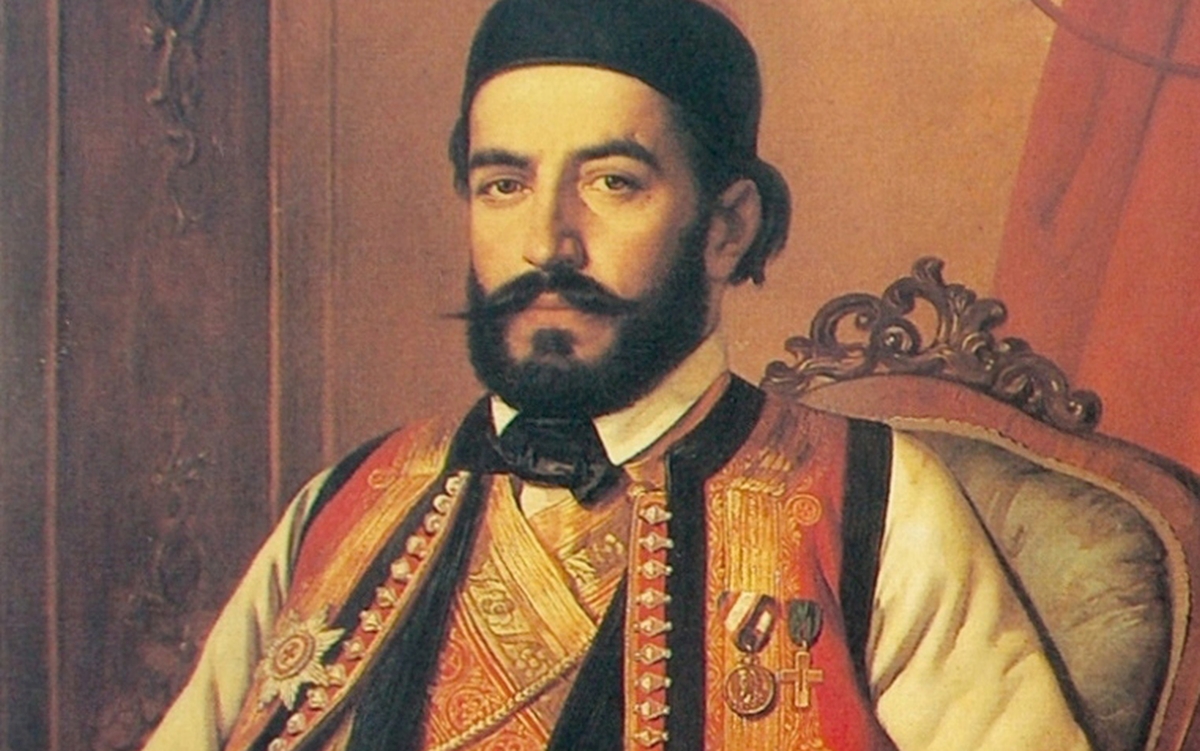
Bishop Petar II Petrović Njegoš was and remains remembered as a highly charismatic figure, a striking ruler, and a deeply enlightened intellectual, as evidenced by his renowned literary works. While his life and legacy are well known in both oral tradition and written history, certain significant details about his life remain obscure.
Even those with little knowledge or interest in Serbian history are at least familiar with the basic facts concerning Petar Petrović Njegoš and his works.
As a poet, bishop, and ruler, his legacy continues to inspire admiration, while also sparking various claims, denials, debates, and interpretations. His significance extends beyond history into literature, religion, and philosophy.
According to preserved historical sources and oral traditions—which, in this case, do not sharply contradict the available evidence—the Petrović-Njegoš family has been known for centuries.
The first records of their origins date back to the medieval period. A minor noble, Herak Heraković, a contemporary of Despot Đurađ Branković, was mentioned in 1441. However, Njegoš himself claimed that his earliest known ancestor was a subject of King Stefan Uroš III (Stefan Dečanski). Oral family history, along with many researchers who have studied the genealogy of the Njeguši branch of the Petrović family, agree that their origins trace back to central Bosnia, near Travnik. Following the Ottoman conquest of Bosnia, the family initiated a series of migrations. Before settling in old Montenegro, they briefly lived on the Nevesinje plateau.
In both Bosnia and Herzegovina, to this day, there are names and toponyms that hint at the cult and former residences of the Petrović-Njegoš family.
The future bishop and ruler of Montenegro was born in 1813 in the family home in Njeguši, as the second son of Tomo Petrović, the youngest brother of Bishop Petar I Petrović (Saint Petar of Cetinje), and Ivana Proroković.
That Njegoš’s life and legacy remain a mystery and a subject of debate is best illustrated by the ongoing uncertainty about his real name, which has not been preserved in historical memory in its original form.
It may sound incredible, but the future bishop was not given the name under which he became famous as a ruler and spiritual leader at birth.
In Montenegrin oral tradition, aside from his monastic name Petar, Njegoš was most commonly remembered as Bishop Rade (Tomov). However, his real and baptized name was completely different.
Preserved church records from that time reveal that the “wisest Serbian mind” was baptized under the name Rafael, though his close family and community called him Radivoj, and affectionately, Rade. Only after his death did science and public discourse begin referring to him as Njegoš.
A similar account was provided by Njegoš’s contemporary and acquaintance, Vuk Karadžić. In one of his writings, Karadžić noted that Petar Petrović was originally named Radoje, but that he was widely known as Bishop Rade, as this distinguished him from his uncle, Bishop Petar I Petrović.
Interestingly, even Bishop Petar himself did not emphasize his real and baptized name. He was content with being addressed as Petar or Rade.
Njegoš never used “the second” after Petar; this was only added later to differentiate him from his predecessor, his uncle Petar.
To this day, scholars have not determined why he adopted the name Njegoš instead of Njeguš, as would have been expected based on his clan and place of residence. It is assumed that he inherited this from his uncle, Bishop Petar, who occasionally added Njegoš, rather than Njeguš, to his name.
MORE TOPICS:
SERBIAN KICKBOXERS SHOW NO MERCY: Incredible 12 medals at the European Cup in Bulgaria! (PHOTO)
Source: Nportal
Foto: Wikimedia Creative Commons