




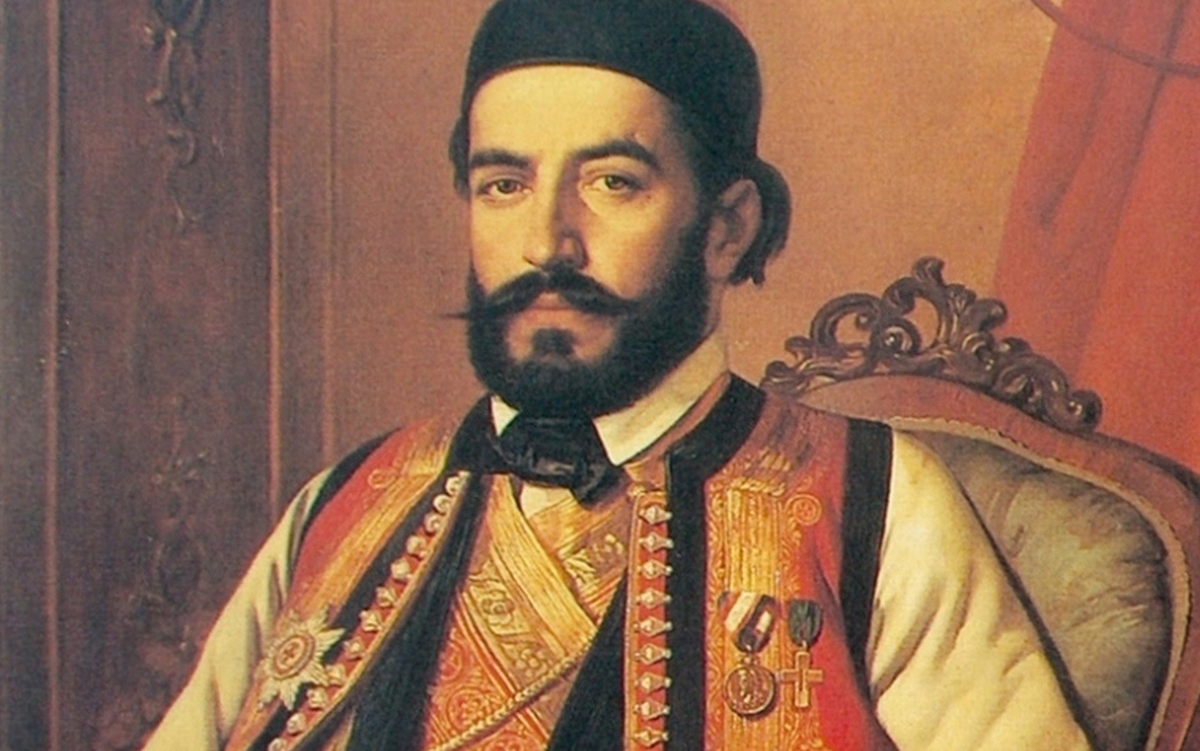
Njegoš’s mausoleum on Lovćen is today one of the most recognizable symbols of Montenegro, visited by thousands of tourists annually. Here rest the remains of one of Montenegro’s greatest spiritual and secular rulers, as well as one of the greatest Serbian poets and philosophers. However, few people know that the path of the esteemed Vladika to this place was long, thorny, and even extremely humiliating.
Near the end of his life in 1845, the same year his masterpiece “The Mountain Wreath” was printed in Belgrade, Vladika Petar II Petrović Njegoš ordered a modest chapel to be built on Lovćen, at Jezerski vrh. He dedicated the church to his uncle, Saint Peter of Cetinje, and expressed his wish to be buried there, without much pomp and ceremony.

At that time, no one could have imagined that this last wish of the great Vladika would be incredibly difficult to fulfill and that Njegoš would face a real ordeal only after his death.

Njegoš’s Testament and “Curse” Milorad Medaković, Njegoš’s adjutant and friend, recorded the words with which the Vladika obliged the Montenegrins to bury him in his church on Lovćen: “This is my last wish, which I ask you to fulfill, and if you do not give me God’s faith that you will do so, as I want, then I will leave you before a curse, and my last hour will be the saddest for me, and I place this sorrow of mine on your conscience.”

Five Graves for Petar II Petrović Njegoš Petar II Petrović Njegoš died on this day, October 31, 1851, but his testament could not be immediately fulfilled. “Although Njegoš explicitly left instructions to be buried on Lovćen, the Montenegrins feared that the Turks might reach the mountain and desecrate his mortal remains. Therefore, instead of his own chapel, Njegoš was first buried in the Cetinje monastery where the relics of his uncle, Saint Peter of Cetinje, rested,” says historian Dobrica Jovičić. Four years later, in 1855, it was assessed that there was no longer any danger from the Turks, so Njegoš’s remains were transferred to Lovćen, thus fulfilling his last wish for the first time.

It seemed that the Vladika had finally found eternal peace, but it turned out that the worst years were yet to come… “During the First World War, the Austro-Hungarians heavily bombed Lovćen and the chapel, probably knowing the importance that the Serbs and Montenegrins attached to this place. After the Battle of Mojkovac and the occupation in 1916, the Austro-Hungarians desecrated Njegoš’s grave and ordered his remains to be transferred back to Cetinje,” explains Jovičić, adding that the occupiers planned to completely destroy the chapel and build a monument on that site as a sign of Austrian conquest of Lovćen. According to some records, the exhumation of Njegoš’s bones was carried out secretly, at night, and since the grave was dug by soldiers, many bones were lost due to carelessness. The story goes that an Austrian soldier of Serbian origin later found three bones in the ruined grave, kept them throughout the war, and only then delivered them to Cetinje.
The rest of the article details the subsequent moves of Njegoš’s remains due to various historical events, including their relocation during the Second World War and the eventual construction of the large mausoleum by Ivan Meštrović in the 1970s. The article concludes by noting that Njegoš’s original wish for a simple chapel has never been fully realized, and his remains have been subject to numerous disturbances over the years.


READ MORE:
GREAT SUCCESS FOR SERBIAN FEMALE DIRECTORS: Sanja and Emilija Win Awards at Vancouver Film Festival!
SERBIAN SURGEONS – FIRST IN THE WORLD TO ACHIEVE THIS: Innovative five-bypass surgery
Source: Istorijski Zabavnik
Photo: Wikimedia Creative Commons