




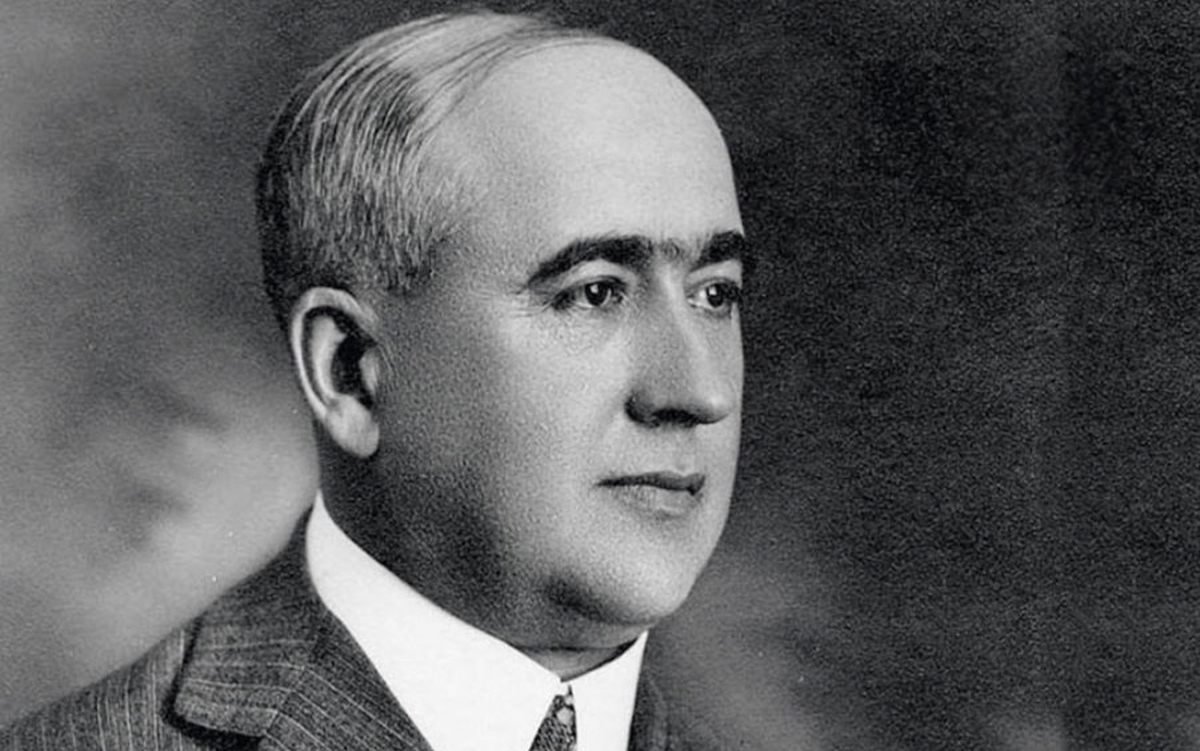
Initially, Milanković’s work was considered illegible, and it still faces numerous challenges today, but despite everything, it remained the standard for the astronomical explanation of ice ages. Here is what you need to know about Milanković’s theory.
The first hypotheses about ice ages appeared in the mid-nineteenth century. Scientists observed glaciers and the consequences of their melting.
James Croll, during 1864–1875, published papers that are considered to represent the first serious astronomical theory of ice ages, by including the change in the Earth’s orbit’s precession and eccentricity in his consideration. Croll worked with Le Verrier’s astronomical calculations for the past 100,000 years. However, the data provided by Croll’s theory did not match the times of the ice ages known at that time.
Milutin Milanković (1879–1958) worked on the astronomical theory for 30 years. In his calculations (during the First World War), he started from the assumption that the climate depends on the amount of solar radiation received by different parts of the Earth’s globe, and that this amount of radiation depends on the distance to the Sun and the Earth’s position in space (including the axial tilt). Using the mathematical calculations of orbital parameters by Ludwig Pilgrim given for the past million years, Milanković determined 3 basic elements that periodically change throughout history.
He links the changes in these elements to the change in climate. These are:
-periodic change in the position of the Earth’s axis – precession for a cycle of 22,000 years
-periodic change in the eccentricity of the orbit of 105,000 years
-periodic change in the obliquity of the ecliptic of 41,000 years
In order to process the entire project of explaining the ice ages, he had to write a quality theoretical work – celestial mechanics according to Newton’s laws for arbitrary bodies, i.e., for the Solar System. Most of the “Canon of Insolation” is actually a model of the Solar System, derivations, and abbreviations of the method of calculation. We single out a few steps mentioned in the biographies. He processed the “calculation of disturbances” or perturbations of other Solar System bodies that affect the movement of the Earth, more precisely the relationship between the Sun, Earth, and Jupiter. Introducing components for calculating the Earth’s rotation, precession, and nutation of the axis, he had to address the problem of moving mass on Earth (“telluric system”), such as the Earth’s crust and ocean. He managed to simplify the description of the process of pole shifting.
He used basic models of the atmosphere, the energy balance of the atmosphere, and heat conduction through the ground, neglecting turbulence and the complexities of the climate system.
Due to simplification, the Earth’s albedo was taken as a constant. Milanković says that the problem is non-linear in nature, and that with more ice surfaces present, the reflection of sunlight increases, and with fewer ice covers, absorption increases.
Milanković calculates insolation using the solar constant and integrating daylight hours at specific intervals. In order to perform this calculation task, and other tasks until then, it was necessary to simplify the calculation process, integrals, and develop approximate forms. By applying mechanical calculating machines, he achieved numerical results on insolation over tens of thousands of years, and then up to 650,000 years back.
Milanković thoroughly examined the history of the discovery of ice ages and all the arguments and findings. With full hope that his theory would not encounter obstacles, he presented numerical calculations of the insolation average and the graphics of the curves that became known as the insolation curves. The curves were calculated for 3 latitudes (55°, 60°, 65°), at first.
Milanković attached importance to the insolation curve at 65N latitude during the summer. He assumed that the greatest effect on glaciation is achieved if the radiation level changes during the summer. During a cold summer, not all the snow from the previous winter melts. Ice melts more easily than it accumulates, resulting in a trend of rapid melting (deglaciation), but slow glaciation. Milanković received advice on the summer assumption from the mathematician Köppen.
The insolation curves show periodic changes under the name Milanković cycles, which have become the de-facto standard for the astronomical explanation of ice ages. The curves were published in articles from 1923–1938, which today we find united in the work entitled “Canon of the Earth’s Insolation” from 1941.
The results from the Canon were compared with results from geology over the decades that followed. The first research was based mostly on large elements of the landscape, glacier boundaries, sediments left by glaciers, and the explanation of terraces. The second major wave of research was based on sediment findings – on their physical, chemical, and biological constituents. The third wave was the use of isotopic technique, which is being perfected even today. The fourth major wave was the discovery of a timescale based on newly discovered geomagnetic reversals. The key to interpreting sediments that contain evidence of ice ages was the study of isotopes, as well as astronomical and astrophysical research.
The “Canon of Insolation” was at first a “little-known and illegible work” that was mostly disputed towards the end of Milutin Milanković’s life. However, in 1976, the theory gained a modern appearance and reputation with the work of Hays, Imbrie, and Shackleton, “Variations in the Earth’s orbit: pacemaker of the ice ages.”
Milanković cycles are reflected to some extent in climate cycles. The astronomical theory of ice ages finds evidence in geology, biology, and other studies. It received final confirmation with the CLIMAP project (Climate Mapping, Analysis and Prediction) which was carried out from 1971–1976. The methods that were used are:
-isotopic study of the shells of the foraminiferal species Globigerina bulloides
-statistical analysis of the prevalence of radiolarian associations
-prevalence of the radiolarian species Cyclocladophora dovisiana, which is sensitive to climate change
-prevalence of the coccolith species Pseudoemiliania lacunosa and the radiolarian Stylatractus universus
Famous participants in the project were Imbrie, Shackleton, and Hays. Milanković’s theory was conceptually correct. Broecker, Denton, Neuvirthles, and Mezolella, and others made the first generally accepted correction, including that the insolation at 65 latitude is the most important astronomical factor influencing the climate.
The CLIMAP project presented slightly different data on the ice ages, but it practically confirmed the concepts of Milanković’s theory:
-the climate for the last 500,000 years varies periodically in cycles of 23,000, 42,000, and about 100,000 years. These cycles correspond to periods of variation of the Earth’s orbit, and affect climate change with an intensity of 10%, 25%, 50%
-the climatic component of the 42,000-year cycle corresponds to changes in the tilt of the Earth’s axis
-the climatic component of the 23,000-year cycle corresponds to changes in precession
-the dominant climatic component of about 100,000 years corresponds to the eccentricity of the Earth’s path
The CLIMAP project was succeeded by COHMAP (Cooperative Holocene Mapping Project). The SPECMAP project provides a standard chronology of ice ages (climatic epochs). In some samples, the depth scale has been converted into an age scale using the expectation of where cooling should occur based on Milanković cycles.
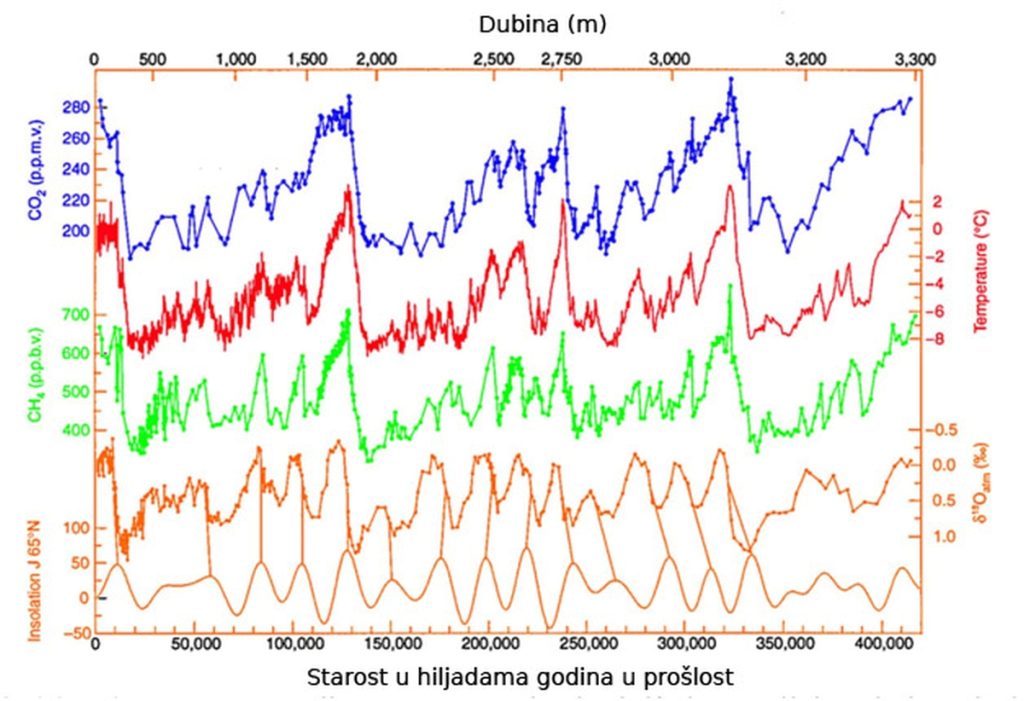
The dominant climate cycles in the last few hundred thousand years were known to Milanković. Among climatic glaciations and deglaciations, the period of 100,000 years is most often singled out, while other periods include 1,500, 22,000, and 41,000 years. Using the Earth’s insolation curve at 65N latitude, he compared the maximums and minimums, phases and frequencies of insolation with temperature changes obtained from samples.
We observe (in the picture) a very good match between the changes in carbon dioxide and methane in the atmosphere and the temperature (glacials and interglacials). Precise measurements of the size of global ice in glacial ice are based most often on deep, sedimentary cores from the ocean floor, or from Arctic, Antarctic ice (ice cores), in which climate changes are recorded by the ratio of oxygen isotopes 16 and 18, the presence of carbon dioxide, methane, and furthermore the presence of dust, remains of living beings (fossils), etc.
Milanković’s work was deterministic, but he recognized the problems of non-linearity and unpredictability. New models of the Solar System are based on more complex theories such as the General Theory of Gravity and chaos theory. The simulated planetary system is sensitive to initial conditions. The climate system, for its part, is also rich in non-linear, chaotic, and stochastic phenomena. Solving the problem of ice ages deals with enormous complexity, such as insolation at individual latitudes over several million years and feedback factors that evolve from situation to situation. The “Canon” provided a model for how the problem of ice ages can be addressed from an astronomical point of view.
Going deeper into the ice cores, each of the marine isotopic stages posed a new question – a challenge to Milanković’s theory.
Causes and consequences sometimes change places. The interglacial period we live in began abruptly 10,000 years ago, some 10,000 years before insolation became more intense.
The sudden change in climate is a major challenge for paleoclimatology. Until one million years ago, the dominant cycle was the 100,000-year climate cycle. But before that, from one to three million years, the dominant cycle was 41,000 years. Linking variations in eccentricity to this does not yield good results. Changes in eccentricity are too little pronounced for the resulting changes in insolation to explain the ice ages. The frequencies do not match. The climate record is too short to make a final assessment. Therefore, changes in eccentricity do not explain this cyclicity.
The variation of eccentricity has the energetically most pronounced period of 400,000 years, but climate records show traces of changes with that period, only within geological findings older than a million years.
The mystery of the ice ages is complex and substantial. The climate system itself records numerous phenomena, influences from terrestrial to galactic. Today, we have better samples and better models available to study the relationship between insolation and ice ages. Milanković cycles probably do not start or stop ice ages, even in the most extreme case. These cycles are far more orderly and frequent than the ice ages, but their signal is recorded within the changes of glacials and interglacials.
MORE TOPICS:
Source: Astronomija, Photo: Milutin Milanković / Wikimedia Creative Commons