




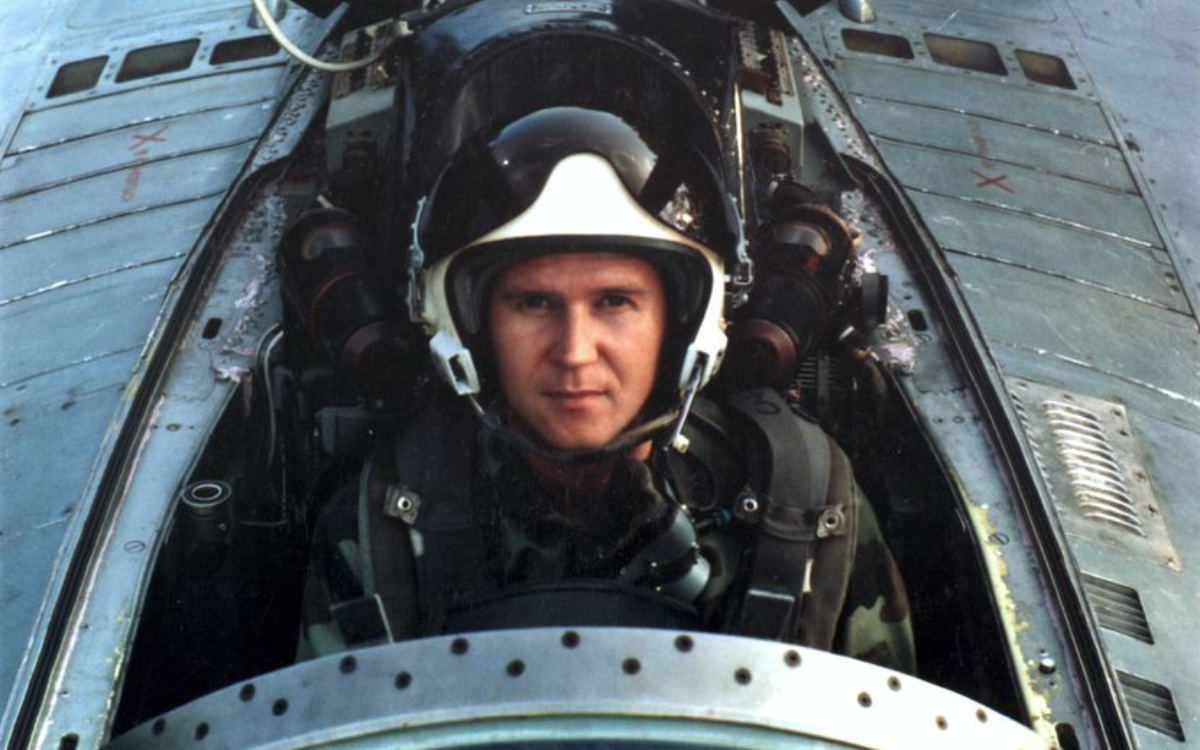
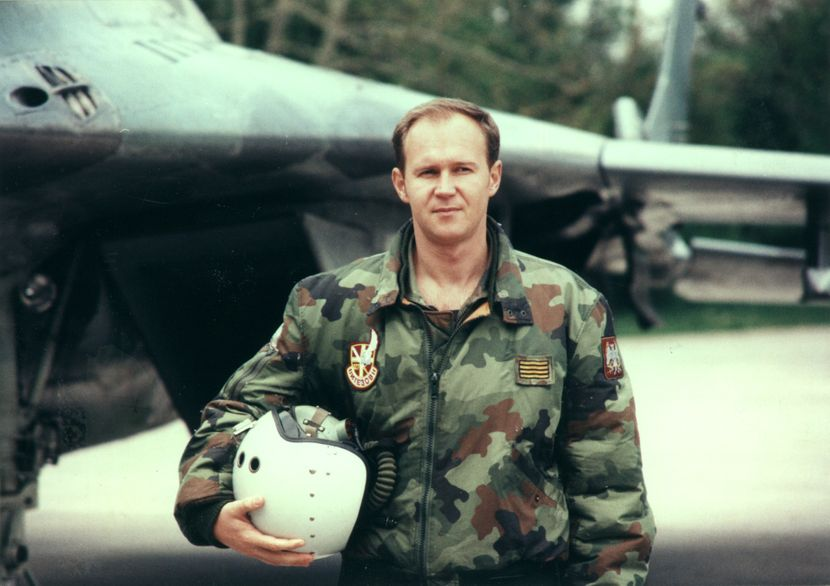
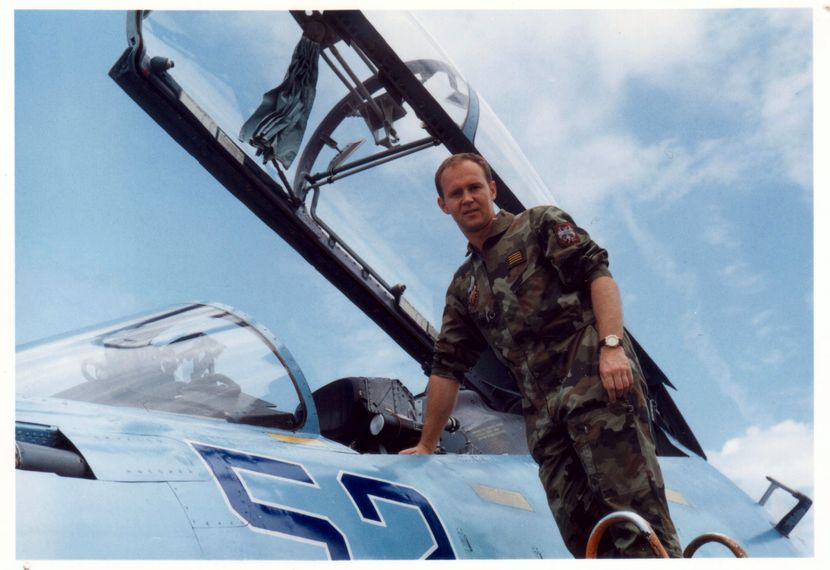
Members of the Air Force and Air Defense of the Serbian Army, even today, 26 years later, proudly remember Major Zoran Radosavljević—one of those who defended the sky from NATO aircraft in 1999 with a small number of semi-operational aircraft.
To recall, out of the 16 MiG-29s of the Air Force and Air Defense of the then Federal Republic of Yugoslavia, which had already surpassed their first decade of service, only 11 were still operational after three days of aggression. However, this was true only on paper.
On the very first day of NATO aggression, we lost two aircraft: Major Nebojša Nikolić’s plane was shot down over Bečej, while a MiG-29 piloted by Major Iljo Arizanov was downed over Kosovo. The aircraft flown by Major Dragan Ilić was damaged but managed to land. Major Predrag “Grof” Milutinović was likely shot down by friendly fire, and another MiG-29 was severely damaged on the ground at Batajnica Airport.
On the third day of the aggression, Captain First Class Zoran Radosavljević and Major Slobodan Perić took off to engage the superior enemy. Perić, an officer who had voluntarily left the General Staff Academy to rejoin his combat unit, flew alongside Radosavljević.
That day, spirits were high among the pilots because news had spread that Arizanov, who was shot down over Kosovo, had managed to reach Slatina Airport near Priština.
When the signal to take off reached Zoran’s mobile phone, the Serbian Air Force MiGs took off toward Zrenjanin, flying extremely low—only 50 meters above the ground. They knew that if they climbed higher, they would be detected by the American AWACS.
“We reached Zrenjanin when the guidance officer asked for my position. I knew that if AWACS had not detected me yet due to my low altitude, they certainly would if I responded with my position. So, I remained silent. The guidance officer understood my silence and said, ‘Blue (enemy) is to the west.’ Right over Zrenjanin, Zoran and I turned our planes and crossed the Danube. When the question about my position was repeated, there was no point in staying silent anymore—I answered that I had passed the traverse of Inđija. The officer responded, ‘Blue is to the west, high, at 50 kilometers.’ That meant the enemy was 50 kilometers away at a high altitude. I did not know how many enemy aircraft there were, and at that moment, I was unaware of my own plane’s malfunction,” recalled Perić, a retired MiG-29 pilot, in the RTS show “Svedok.”
“When you turn on your radar, you become visible to the enemy. Every aircraft has a device called SPO, which tells you if you’re being targeted, if someone is tracking you or locking onto you with their radar, preparing to fire. My radar had half the range of theirs, so I kept it off to avoid detection—this was my only chance to get close to the enemy.”
Perić decided to turn on the radar, wanting to change the beam direction, lock onto enemy aircraft, and fire missiles. “That’s when I realized I had no radar. So, I had to rely solely on visual contact. I commanded Zoran to ascend above the clouds at a steep angle. We climbed to 8,000 meters. Zoran said nothing, and I assumed his radar was working and that he would be able to engage the enemy with missiles.”
Perić continued his account: “At one moment, Zoran said, ‘Right, under 50.’ I thought he had spotted the enemy at a 50-degree angle to our course. I told him, ‘Great, go ahead, I’ll follow, you fire first.’ He responded, ‘No, on the SPO.’ The SPO is the device that tells you if you are being targeted—it is your ears in the cockpit, while the radar is your eyes. And we went in blind and deaf.”
“We managed to disappear from their radar screens, but when no ground control orders you to return, you inevitably cross the border at 900 km/h within minutes… Then, the message came: ‘It looks like someone from their group has turned toward you.’ The whole time, Radosavljević and I were in contact. At that moment, I saw four white missile trails—two, then two more.”
As long as a missile leaves a white trail, it is still accelerating on its so-called cruise phase. The moment the white trail disappears, it means the missile is close enough to guide itself toward the target.
“When the trails disappeared, I knew we were in serious trouble. I told Zoran, ‘Watch out, missiles incoming!’ He replied, ‘I’m running to the clouds,’ and I abruptly turned my aircraft back toward our country. A few seconds later, I made another hard right turn under heavy g-force—this maneuver confuses the missile, making it miss and detonate further away. According to Russian SFOR members, the first missile did miss me, but the second one tracked and hit me. After Zoran said, ‘I’m running to the clouds,’ I never heard from him again.”
The explosion set Perić’s right engine on fire. The hydraulics failed completely, rendering the aircraft uncontrollable. He decided to eject and, as his parachute deployed, he saw his hometown of Loznica, the Drina River, and realized he was descending into Bosnia and Herzegovina. “I didn’t know if I was landing in Republika Srpska or the Federation of Bosnia and Herzegovina. Then I recognized Tavna Monastery and thought, ‘This is my salvation. When I land, I’ll head straight to the monastery and figure out how to get out.’”
Upon landing, he was surrounded by 20 armed locals who believed he was an American disguised as a Serbian pilot. Without any identification, speaking Serbian did not convince them—in fact, they cursed him, thinking he had simply learned the language. Only when he called a villager from his father’s hometown (albeit mistakenly, as he couldn’t remember his own number due to probable hypoxia exposure) did he finally convince them that he was indeed a Serbian pilot.
That same night, Perić was taken back across the border and brought to Batajnica. Hoping to see his friend again, he met with General Veličković, who delivered the tragic news: “You were lucky. He was not.”

“I went to Zoran’s mother and started mumbling, suggesting he might have crashed in Bosnia and was hiding. But Rada, a wise woman, looked at me, smoking a cigarette, and said: ‘Listen, Buco, don’t lie to me. I know my Zoran is dead.’ That was the hardest moment of my life. I still dream about him. I have nightmares. After that, I never flew again,” Perić confessed in an interview with Blic.
The MiG-29s were shot down on March 26, 1999, by U.S. Air Force pilots flying F-15Cs from the 493rd Fighter Squadron, assigned to protect the airspace over Bosnia and Herzegovina. Both kills were credited to Captain Jeff Hwang, who used AIM-120 AMRAAM missiles. The F-15C, marked with two green stars and the downing date, is now displayed at the USAF Museum in Ohio. Hwang retired in 2014 as deputy commander of the 124th Wing with the rank of lieutenant colonel.
Slobodan Perić retired in 2004, opened a car wash in Batajnica, and continued to watch planes take off from the runways where he had spent much of his life. He was also known for producing rakija, which he named “Golden Knight.” He openly spoke about systemic failures that had weakened the once-modern and well-trained aviation force—without diminishing the bravery and sacrifice of its members.
He died in a car accident on the night of May 29-30, 2010, near Valjevo, close to the birthplace of war commander Milenko Pavlović, who perished in his MiG-29 over Valjevo on May 4, 1999.
MORE TOPICS:
SERBIAN EXPERT TEAM: Data indicates that NATO deliberately committed genocide in Yugoslavia in 1999!
Source: Aero.rs, Foto: Privatna arhiva