




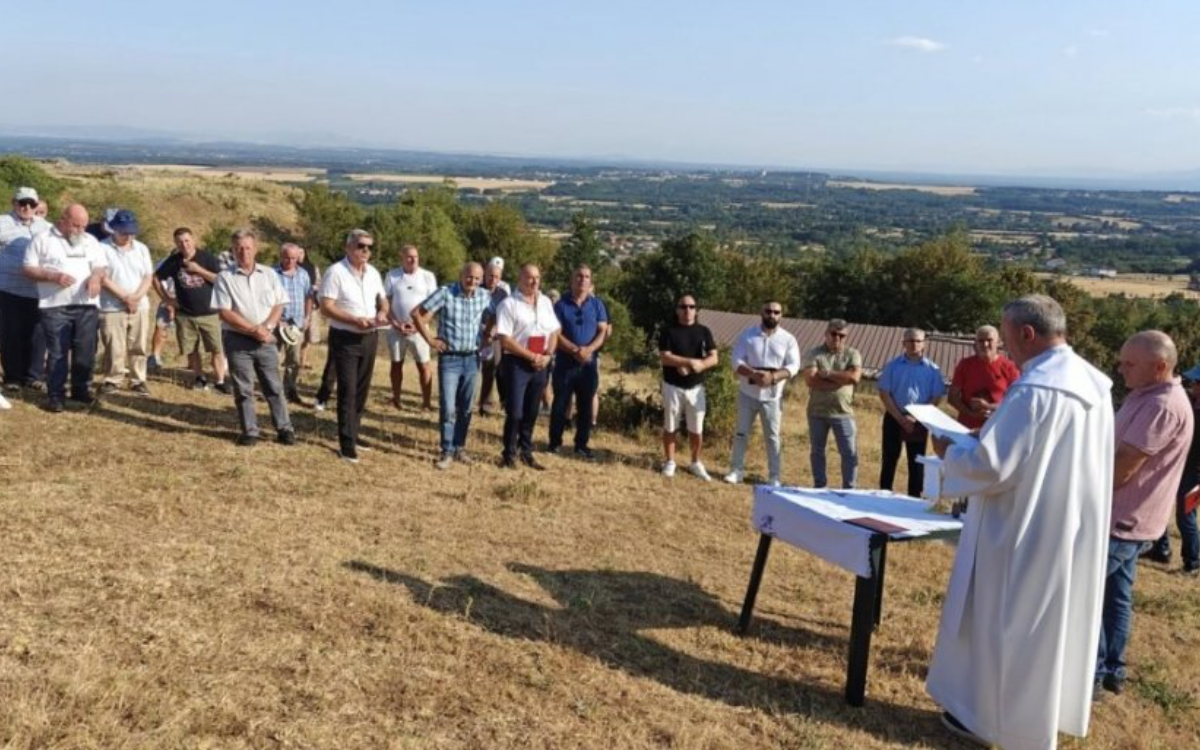
The Raška-Prizren Diocese warned that a public gathering with a religious ceremony was held on July 23, 2025, at the archaeological site of the medieval Bogorodica Hvostanska Monastery, in the village of Studenica near Istok, within a legally established special protected zone, without the knowledge or consent of the Serbian Orthodox Church (SPC).
According to the diocese, a group of Kosovo Albanians led by Roman Catholic priest from Kosovo, Fran Koljaj, performed an unauthorized religious act at the archaeological site of the medieval Serbian Orthodox Church, which, as the diocese warns, constitutes a direct violation of the provisions of the Law on Special Protected Zones.
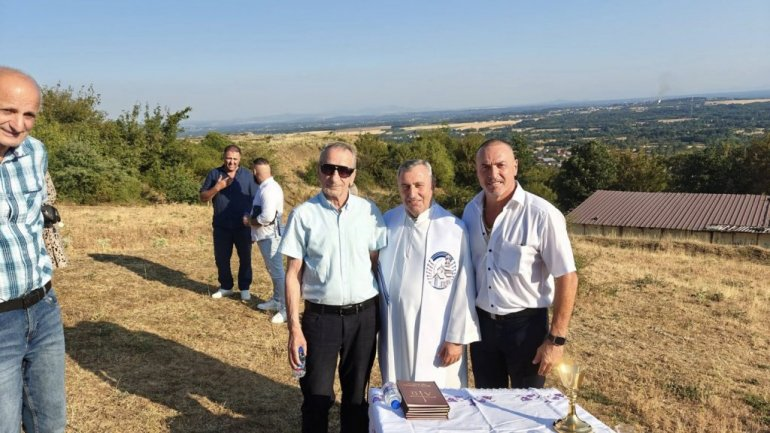
“During the ceremony, the Roman Catholic priest from Kosovo, Fran Koljaj, delivered a speech with open nationalistic messages, using inflammatory language that incites inter-ethnic and inter-religious hatred, with the clear intention of misinterpreting historically documented facts and appropriating the heritage of the Serbian Orthodox Church,” states the Raška-Prizren Diocese’s announcement, which strongly condemns this severe violation of the law as a continuation of a series of provocations directed against the SPC. The Diocese calls on representatives of the international community to actively engage in protecting the endangered religious and cultural assets of the SPC and to provide reliable international guarantees to the Church amid increasingly frequent violations of existing legal norms and the absence of adequate reactions from Kosovo institutions.
The Bogorodica Hvostanska Monastery, according to the Raška-Prizren Diocese, was reconstructed on the foundations of an older basilica during the third decade of the 13th century. It was built in the recognizable architectural style of the Raška school, after the establishment of the Serbian Orthodox Eparchy of Hvostana in 1219, an episcopal seat founded by Saint Sava. The monastery remained in continuous liturgical use by the SPC until the end of the 17th century. After that, the monastery suffered damage in turbulent historical events, fell into disrepair, and its building materials were gradually removed. Today, only the remains of the large medieval church, accompanying buildings, and fortifications are preserved at this site. The site has been thoroughly investigated by prominent archaeologists in recent decades, with extensive documentation preserved. Numerous medieval inscriptions and documents from the 13th century and later bear witness to the spiritual and historical significance of this sacred place.
MORE TOPICS:
Source: Novosti, Photo: Eparhija raško-prizrenska