




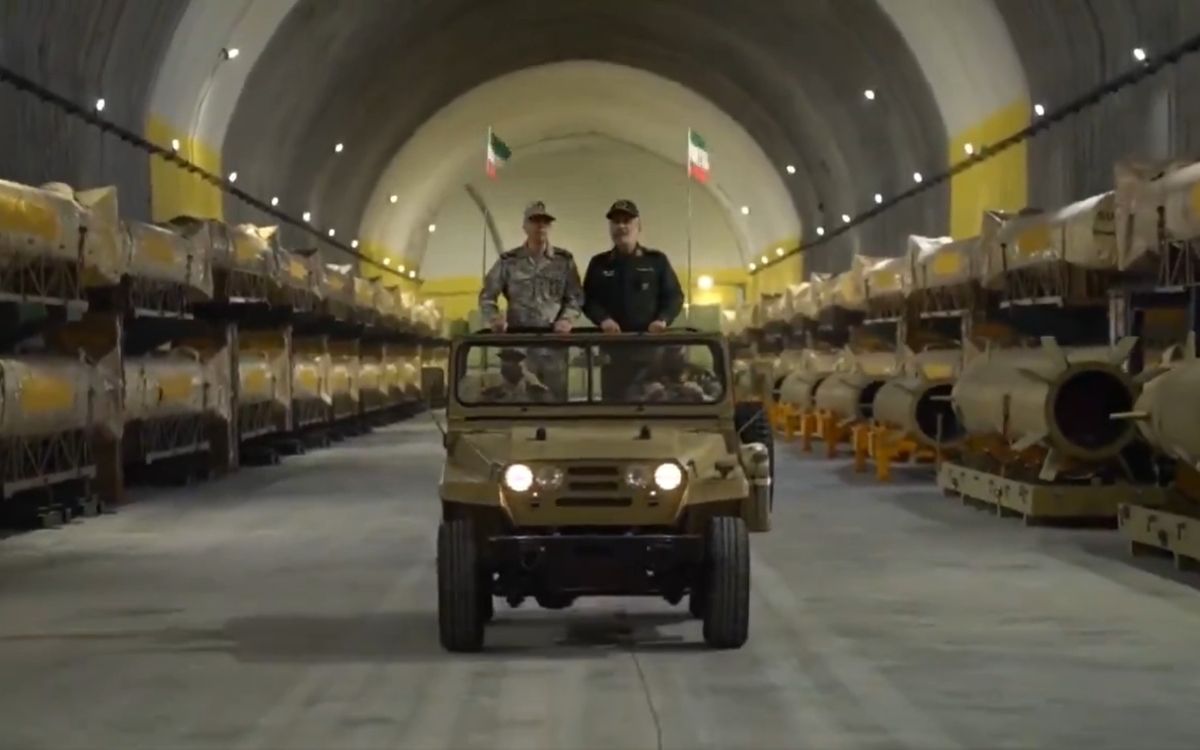
Iranian media have released images of a “deadly vault” inside an underground “missile city” used for storing drones and missiles, a massive arsenal employed for attacks and causing damage across the Middle East.
The Iranian news agency Fars published images of a vast underground city filled with missiles – a huge weapons depot containing drones and rockets – at a time when Iran is striking U.S. bases across the Middle East in response to the U.S.-Israeli attacks on the country.
The tunnels appear to stretch endlessly. Above the massive stockpile of weapons hangs a large portrait of Ayatollah Ali Khamenei, the former Supreme Leader of Iran, who was killed on the first day of the joint U.S.-Israeli strike on Saturday, February 28.
The ceiling is decorated with national flags. Below are transport trucks carrying drone launch systems for the “Shahed” drones, which cost only tens of thousands of dollars to produce and require little time for manufacturing.
🚨🇮🇷🇺🇸 Iran built massive underground “missile cities” to protect its arsenal. Now they’re being hunted.
— Mario Nawfal (@MarioNawfal) March 5, 2026
U.S. and Israeli aircraft are striking launchers the moment they leave the tunnels, while bunker-buster bombs smash entrances and support sites.
Israel and the U.S claim… https://t.co/rFpuTWByiF pic.twitter.com/JtIY3OUt9U
Defense costs in the Middle East
Meanwhile, Gulf countries supporting the U.S. are rapidly spending their national defense stockpiles amid Iranian missile and drone attacks, which are stored in the bunkers of the Islamic Revolutionary Guard Corps (IRGC).
On Wednesday, March 4, Israel acknowledged that Iran still has significant missile-launching capabilities against its enemies, amid growing concerns that counter-drone technology is “too expensive” for prolonged military operations.
Commander of IRGC aerospace Hajizadeh:
— Current Report (@Currentreport1) November 5, 2024
There are few cities in Iran that do not have an underground missile base. The missile cities of Iran are 500 meters underground.
The number of our missile cities are so large that if they are detected, the enemy will not be able to… pic.twitter.com/o7K5drKhws
For instance, production costs for U.S.-made Patriot missiles can exceed $5 million per unit, while a THAAD missile defense system could cost $13 million.
These figures do not include export-related costs. In contrast, a single Iranian drone costs only $20,000 – meaning Iranian strikes can be sustained far more cheaply.
Iran has used drones to attack targets at U.S. bases in Gulf countries, forcing defenders to spend millions to intercept these attacks.
BREAKING: 🇮🇷 Iran is launching missiles from its underground missile cities without launch pads or standard equipment.
— Radar 𝘸 Archie🚨 (@RadarHits) March 4, 2026
Virtually impossible to detect beforehand.
GAME CHANGER
pic.twitter.com/bQWidsvpBy
The United Arab Emirates intercepted 92% of 541 missiles fired at them, but at a cost exceeding $700 million.
Estimates suggest that shooting down a single drone can cost up to $4 million using expensive drone interceptors.
In contrast, Iran spent only $10 million on a drone swarm targeting the UAE, launching more than 2,500 drones daily and overwhelming air defense systems.
This has been described as a strategy designed to defeat costly defensive systems.
MORE TOPICS:
Source: B92; Foto: Printscreen X