




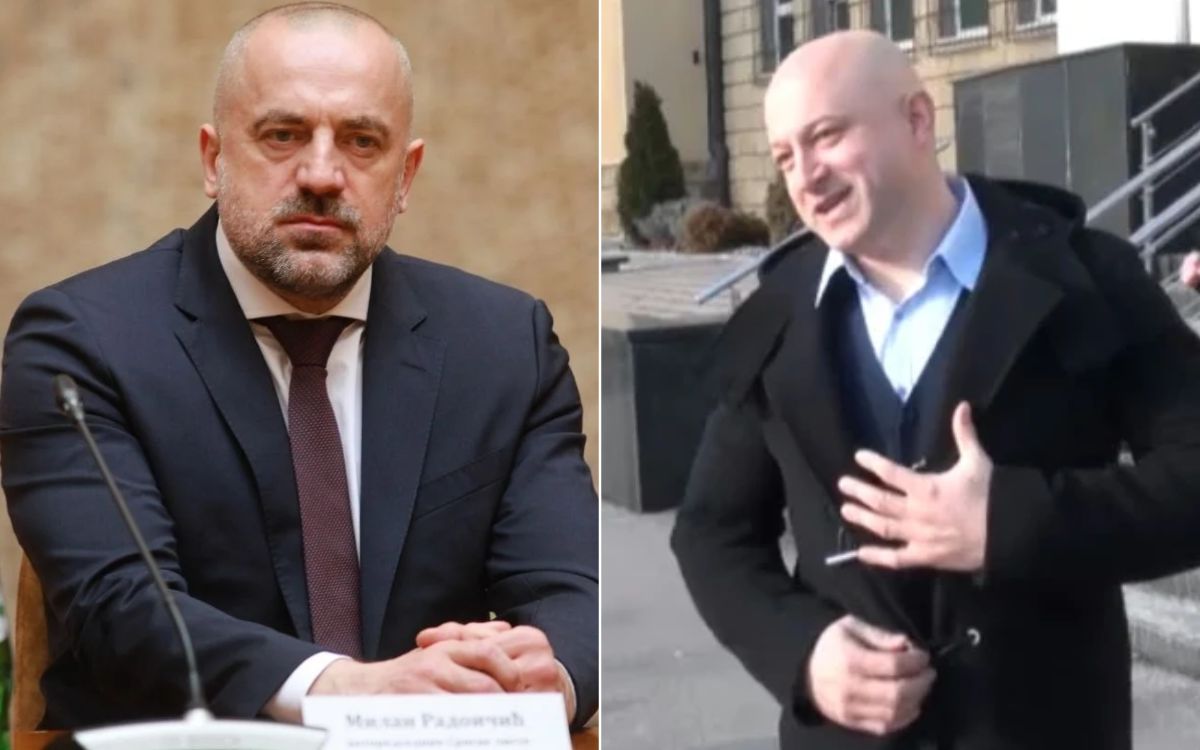
Following the entry ban imposed on Milan Radoičić and the Veselinović brothers, analysts are warning of political blockages that threaten to turn Bosnia and Herzegovina into a safe transit route for individuals wanted by law enforcement.
The decision by Bosnia and Herzegovina’s Intelligence and Security Agency (OSA) to ban Milan Radoičić and brothers Zvonko and Žarko Veselinović from entering the country, citing them as threats to national security, has once again raised questions about actual border controls and the functioning of the country’s security system, Deutsche Welle reports.
The measure came after the Belgrade-based Crime and Corruption Reporting Network (KRIK) reported that Zvonko Veselinović had travelled to Istanbul via Sarajevo earlier this month.
The case therefore goes beyond an individual entry ban and highlights a broader regional problem: how individuals under investigation, wanted by law enforcement or subject to international sanctions exploit the porous border between Serbia and Bosnia and Herzegovina, as well as political deadlocks within the country’s institutions, to use BiH as a safe exit point and transit route.
Why Is BiH a “Safe Haven” for Radoičić and the Veselinović Brothers?
Predrag Petrović, Director of Research at the Belgrade Centre for Security Policy (BCSP), believes that Radoičić and the Veselinović brothers were not merely local political and business power brokers in northern Kosovo, but also an important part of an informal system of control that the Serbian Progressive Party (SNS) maintained in the area for years.
“Their main role was to politically discipline the Serbian population (…). Northern Kosovo was practically a laboratory for establishing a model of political control that was later applied throughout Serbia, including organised groups in black SUVs that visited polling stations,” Petrović told DW.
In his assessment, their departure from Serbia at this particular moment is no coincidence. Rather, it represents an attempt to avoid potential criminal liability following changes in the balance of political power in Belgrade and the possibility that prosecutors and police could begin operating more independently.
According to Petrović, the Veselinović brothers left Serbia via Sarajevo and travelled to Istanbul, while “there is unconfirmed information that Radoičić went to Russia.”
“What is particularly significant is that the Veselinović brothers chose BiH as their exit route. Their business and political connections with Republika Srpska are well known and extend to certain structures within its authorities. This could provide them with a foothold outside Serbia, although we have no evidence that anyone from the Republika Srpska authorities helped them leave the country. This shows that the problem is not limited to individuals, but involves a broader network of political, business and criminal connections that does not end at Serbia’s borders,” Petrović stressed.
The Ministry of Internal Affairs of Republika Srpska rejected media reports claiming that Milan Radoičić was in the territory of the entity and enjoying protection from its institutions. It also pointed out that the Bosnia and Herzegovina Border Police is responsible for monitoring crossings of the country’s state border, while Republika Srpska police act on all international arrest warrants.
A warrant for Radoičić over the armed conflict in Banjska was issued by authorities in Priština and entered into Interpol’s system through the United Nations Interim Administration Mission in Kosovo (UNMIK), since Kosovo is not a member of the international police organisation.
Since Bosnia and Herzegovina does not recognise Kosovo’s independence and has no agreements with it on legal assistance or extradition, action on such warrants within the country’s security and judicial systems remains limited and vulnerable to political blockages.
A Preventive Measure That Comes Too Late to Stop Anyone
From Sarajevo’s perspective, however, the case does not necessarily demonstrate that the border is technically “porous”, but rather that the system reacts only when a formal reason emerges, instead of acting on the basis of risk assessments. Security expert Safet Mušić explains that the BiH Border Police allows anyone to enter if there is no entry ban or warrant recognised by the state in the relevant databases.
At the same time, BiH is under no legal obligation to automatically translate US or EU sanctions into entry bans. Furthermore, because it does not recognise Kosovo, warrants issued by its authorities carry little legal weight.
“People who have been under US sanctions and subject to Kosovo warrants for years have therefore been able to enter BiH freely, stay there and fly out of Sarajevo. For individuals connected to the Banjska case and the procurement of weapons from BiH, this was to be expected,” Mušić told DW.
Representatives of Milorad Dodik’s Alliance of Independent Social Democrats (SNSD) had previously strongly opposed proposals within Bosnia and Herzegovina’s institutions to ban Aleksandar Vulin, then Serbia’s Deputy Prime Minister and former head of the Security Intelligence Agency (BIA), from entering the country. Vulin is also under US sanctions. A similar political controversy erupted in 2018 when Russian writer Zakhar Prilepin was denied entry.
He was declared a security threat because of his participation in pro-Russian armed formations in Ukraine. At the time, the SNSD leadership accused BiH security agencies of acting arbitrarily and compiling “blacklists” without the consent of Serbian representatives.
Mušić notes that decisions to ban Serbian citizens from entering BiH are never treated as purely professional matters. Instead, they regularly trigger accusations of agencies being “privatised” and political pressure through the Council of Ministers and the Ministry of Security.
“In such an environment, agencies choose the safest course of action: they wait until a case becomes public, because that gives the decision legitimacy and protects them from political attacks. The result is a preventive measure that arrives when there is no one left to stop. As long as security assessments depend on who might take political offence, BiH will remain a country that is easy to pass through and even easier to leave,” Mušić concluded.
Selective Information Sharing and a 1,600-Kilometre Border
Duško Vejnović, a professor at the University of Banja Luka and president of the European Centre for Defence Studies, also warns that the problem lies in institutional deadlocks and a lack of trust.
He believes that mutual distrust between police and intelligence agencies in BiH leads to “selective and recycled information sharing”, based not only on ethnic considerations but, above all, on political, personal and economic interests.
“Combined with ineffective parliamentary oversight of the security sector in BiH, this creates an environment in which individuals and groups with criminal records can be protected, pointing to the absence of the rule of law and accountability among political elites,” Vejnović told DW.
Even when an entry ban is formally imposed, the question remains as to how effectively it can be enforced on the ground.
Security expert Vladimir Vučković points out that the border of Bosnia and Herzegovina is approximately 1,600 kilometres long, that the Border Police is chronically understaffed, and that monitoring is made more difficult by inaccessible terrain and numerous illegal crossing points.
“Formally and legally, the decision means that they will be denied entry at border crossings. However, the question is how effectively this can be enforced in practice, particularly if we recall recent cases of illegal border crossings, such as that of Zoran Galić – the former director of the BiH Border Police and deputy director of the State Investigation and Protection Agency (SIPA), who illegally crossed the border and fled to Croatia in July 2024, shortly before an announced arrest,” Vučković told DW.
A Test for the New Government in Belgrade and Institutions in Sarajevo
Precisely because political and criminal interests overlap on both sides of the Drina River, Predrag Petrović does not expect more intensive police and intelligence cooperation between Serbia and BiH at this stage.
Although the balance of political power in Serbia has changed, the police, intelligence services and prosecution authorities are still going through a period of uncertainty, while some senior officials remain connected to the previous system of government.
Petrović draws a distinction between technical cooperation in combating ordinary cross-border crime and cases involving the highest levels of political and criminal networks, which require clear political determination to resolve.
“Following the formation of a new government in Belgrade and the establishment of genuine civilian oversight of the security apparatus, cooperation with BiH should be one of the priorities. The key is to ensure that institutional cooperation does not depend on the political connections of suspects, but on the law. Otherwise, the borders between Serbia and BiH will remain more porous for criminal networks than for justice,” Petrović said.
MORE TOPICS:
Source: N1, Foto: Milos Tesic / ATAImages; N1
 Add Serbian Times as your Google source