




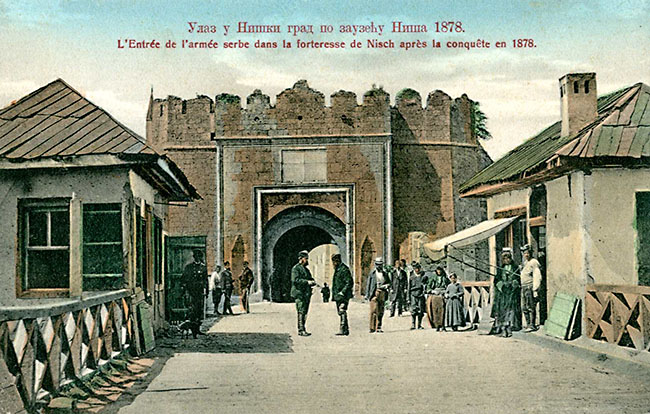
In Niš, January 11 marks the day when, in 1878, the city was liberated from the Turks. After nearly five centuries of enslavement, the city of Niš was freed from the Turks on January 11, 1878. On that day, the Serbian flag was raised on the Fortress, and Prince Milan entered the city several days later. In the fighting, 120 Serbian soldiers were killed and nearly 800 were wounded.
The battles for the liberation of Niš began in mid-December 1877, when the Ibar, Morava, and Danube divisions crossed the Serbian-Turkish border and took positions northwest of the city, approaching it to within five to eight kilometers. The Ibar Division advanced farther south and cut the connection between Niš and Leskovac. The Serbian army then captured Pirot and Bela Palanka, preventing communication between the Turkish garrison in Niš and the troops in Sofia, and reached Mount Seličevica, closing the encirclement of Niš from the south as well. The total Serbian forces numbered 15,000 soldiers and 102 cannons, while the Turkish forces had 5,000 soldiers and 267 cannons.
The main attack on Niš, under the command of Colonel Jovan Belimarković, was carried out by the Šumadija Corps from the slopes of Mount Seličevica, which was considered the “gateway to entering Niš,” since the southern part of the city was the least fortified by the Turks.
In the very first attacks, Markovo Kale, the Ćurlin Heights, and Velika Kamara were captured, and with strong artillery action and coordination with other units, the last fortifications on Gorica were also threatened.
At the same time, Serbian forces under the command of Colonel Milojko Lešjanin attacked from the northwest as well. When the first shells began to fall on the city, the Turkish city authorities, after some tactical maneuvering and hesitation while awaiting assistance, finally signed the Convention on the surrender of Niš.
In liberated Niš, during the handover of the city, the Serbian flag on the Stambol Gate of the Niš Fortress was raised by a native of Niš, Todor P. Stanković, a member of the secret liberation committee. In the battle for Niš, 120 Serbian soldiers were killed and 791 were wounded.
Prince Milan Obrenović, the supreme commander of the Serbian army, ceremoniously entered Niš just a few days after its liberation. The battles for the liberation of other parts of southeastern Serbia were soon successfully concluded, and Prince Milan and the Serbian government continued diplomatic efforts for the newly liberated territories to be annexed to Serbia, which was accomplished at the Congress of Berlin.
Prince Milan would later purchase a house in Niš, and at his request, Niš became the site of frequent sessions of the National Assembly (especially in the period from 1883 to 1886) and the Serbian government, thus becoming Serbia’s second capital.
MORE TOPICS:
U.S. SENATE CONSIDERS BILL TO IMPOSE 500% TARIFFS ON COUNTRIES CONTINUING TO BUY RUSSIAN ENERGY
“TOTAL ECONOMIC COLONIZATION”: Venezuela will buy exclusively products made in the USA!
TUCKER CARLSON WARNS: America is preparing for a World war, this Trump decision proves it! (VIDEO)
Source:Jugpress, Foto: Wikipedia