




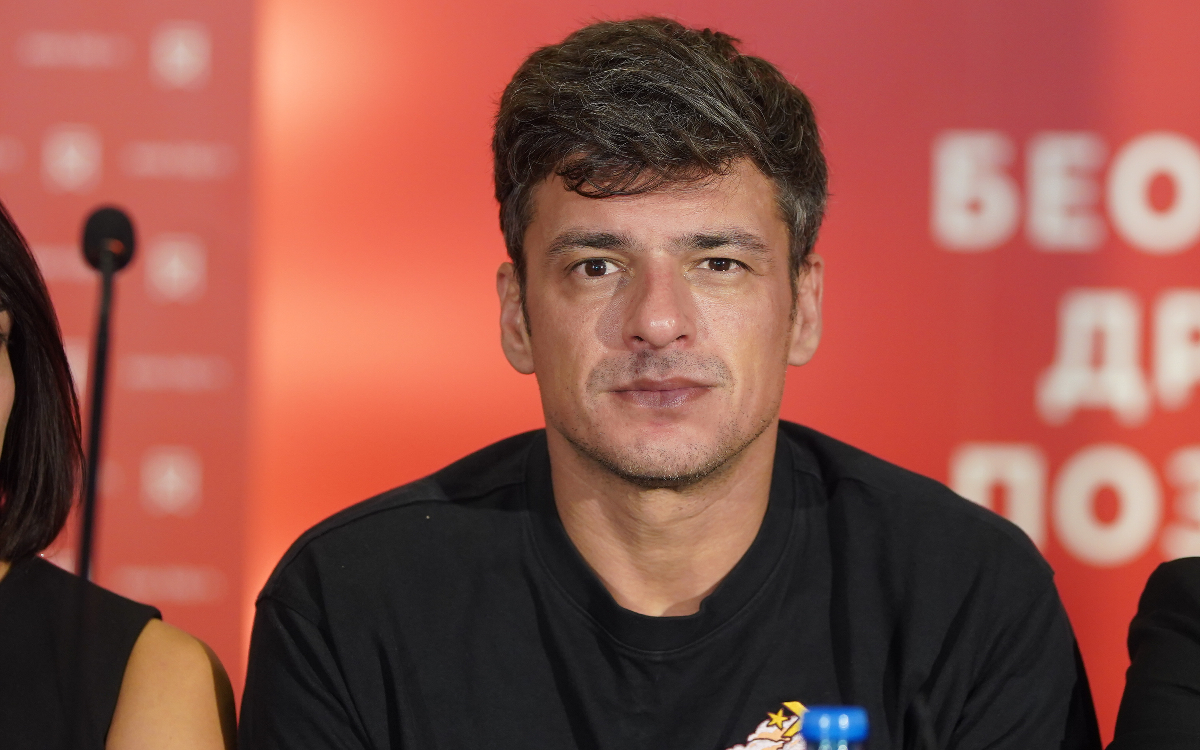
Andrija Kuzmanović, who was recently named the best actor, dedicated the Heart of Sarajevo award to the students. “The director Vlada Tagić also wore a student badge, and of course we dedicated the success of our film Yugo Florida at the Sarajevo festival to them. They are a generation of wonderful young people who are fighting for their future because they do not want to live in a state like this. I was taught that the future belongs to the young, so I am with them with all my heart,” Kuzmanović told Danas.
The actor gave the interview to Danas during the Herceg Novi Festival at Kanli Kula, where he came to support his friend, actor and director Milivoje Mišo Obradović, whose film 15 and a half was screened. Besides the premiere, Kuzmanović also watched the Slovenian drama White Washes at 90 by Marko Naberšnik, in which Anica Dobra played a notable role.
Kuzmanović, one of the most popular actors in the region, also talks about his role in Yugo Florida, a society of broken values, and student protests: “This role is completely different from anything I have done so far. I pulled all my ‘aces’ that I use in film, television, and theater and let the acting go quietly, on its own. I watched great actors who do nothing, and it is precisely in those moments that they create unforgettable characters.”
Since the first announcements, especially when the trailer for “Yugo Florida” was published by the prestigious British portal Screen Daily, it was emphasized that we would see a “new,” “unrecognizable” Andrija Kuzmanović, which was confirmed by the Best Actor Award at the recently concluded 31st Sarajevo Film Festival. How did you experience this role?
—It is completely different from anything I have done in film so far, and on stage, I had the opportunity to do something similar, “unrecognizable” once – at the Belgrade Drama Theater, in the play “The Green Cloth of Montenegro”, in which I played the role of Osman – Pasha Sarhoš. There, I had that “lower pitch” in terms of acting sensibility, habitus, or whatever. I pulled all my “aces” that I usually use on television, in film, and in the theater, and I completely let that acting go somehow quietly, “on its own,” as if it wasn’t there.
I have watched some great actors many times, for whom we would think they do nothing in their roles, but it is precisely when they are the calmest, when their acting “is not noticed” and when it emerges from the very sensibility, that they achieve unforgettable characters. And “Yugo Florida” is something I have truly never done; I don’t think we have had such roles in our cinema so far – it is typically dramatic, without a hint of charm, which is what I have relied on so far. The jury in Sarajevo recognized that, and I am very happy about it.
Although there were people there who knew my previous works, they were also surprised. And I myself said to Vlada Tagić: this is not me. Of course, I’m not crazy to think it’s not me, but, for example, Anthony Hopkins and Daniel Day-Lewis, when watching themselves in movies, know that it’s them, and yet it’s as if it’s not. I’m not comparing myself to them, but I have truly never done anything like this before.
On the other hand, how much does the fact that you received your first significant award in your career at the Sarajevo festival, where just being in the competition is a great success, impress you?
—We call the awards in Sarajevo the Balkan Palme, I have been there before with some series and a film, but never with a leading role as now, and I saw how much public interest there is for the festival. There was a “downpour” at the premiere of “Yugo Florida”, but people were still patiently waiting in line with tickets in the rain, no one gave up on watching the film. They were practically sneezing, all wet, during the screening, and the applause at the end lasted for almost fifteen minutes; we were getting a little embarrassed by how long they were applauding. I think with this film, we created “their life,” what we all generally live, what we have experienced, or what these situations will still bring us. And when you give people back and show them their life on screen, which they feel and recognize as real, then they reward it.
In a “sketch,” Zoran, the hero you play, leads a “meaningless” life, he is unsuccessful both professionally and intimately, but also lethargic and without the strength to try to change the situation. What was personally the most exciting thing for you in his character?
—He is a film editor by profession, but he had a job working on cameras at night, and stocking and emptying the refrigerator in a reality show. And without strength, the most exciting thing for me was precisely that – to explore his stagnation, that reconciliation with a stale life, which comes after a person gives up on himself and becomes more an object than a human being. He was not even aware of what life was, which we see at the end of the film; he allowed life to flow past him, and he got so stuck in a routine that it seems he is not living – in the morning he washes his face three times, at a certain time he eats lunch, he sees his friend at such and such a time, he answers when someone needs him, he doesn’t have a girlfriend…
He is also interesting to me because he is a person we surely pass by two or three times a day in real life, and it would be my greatest joy for one of those people to watch this film, to recognize themselves, and to decide to at least try to do something with their life. I think that’s what “fired me up” the most in the script, even though Zoran is the main protagonist through whom we watch the whole film, because I was driven by the idea of waking someone from their lethargic dream. Personally, nothing in this character is close to me, because the moments in which I “reconciled with life” have always lasted a maximum of a week for me.
Unlike that lethargic generation of thirty-somethings, which Tagić also talks about in the series “Morning Will Change Everything” in which you also played, our students are not reconciling with life in such a broken and destroyed society. What are you particularly delighted with in their struggle?
—The students are determined and uncompromising, and that refusal to compromise is a logical consequence of their entire upbringing – they are aware of where they are and in what kind of society they grew up, they don’t like such a life; they want to live in a society without violent police, in a society where the best doctors, the best professors, teachers, workers, and all other best in their professions will be employed and in some key positions.
I think that today no one can even practice a craft without a political connection, and that’s why, for example, I’m glad I received the first award in Sarajevo, where no one knows my brother, my uncle, or my aunt, or whether I am politically “suitable” or “unsuitable.”
That’s why I dedicated the Heart of Sarajevo Award to our students, Vlada Tagić also wore a student badge, and of course we dedicated the success of our film “Yugo Florida” at the Sarajevo festival to them. They are a generation of wonderful young people, uncompromising, brave, smart, who are fighting for their future; these children are sincere, honest, uncorrupted in every sense, and I was taught that the future belongs to the young, so I am with them completely with all my heart.
How much does the increased violence against students disturb you, and the fact that our president encourages and calls for his thugs, every police officer, and every street bully to be able to “legally” beat them up and be absolutely unaccountable for it?
—Of course, that situation disturbs me a lot, and of course I am angry about it and I fear that nothing terrible will happen to those children anymore. But the violence of the authorities does not stem from nine months ago and these protests; we have been in a violent and corrupt system for a long time. The place where we live is no longer a state, it is a private political company. I agree that a state can be a good company, but it must generate income equally for all its citizens, regardless of their political affiliation, because the laws guarantee them that.
Some people and their children cannot be hungry, people cannot lose the roof over their heads because they haven’t paid three electricity bills, there cannot be “blacklists” on which the greatest experts are, you cannot acquire billions if you are with the authorities, and at the same time barely have any education. This situation escalated nine months ago with the death of people in Novi Sad, and it is only a consequence of the violence we have been in all these years.
My generation, when I was a student, just like the previous one, did not do what today’s students are doing, and it should have and had to be done. Now the glass that has long been full has overflowed; these brave students simply do not want to live in a state like this, they do not accept compromise, they plan to create a fairer society in which both they and all other citizens will be happier, and that is why they have the strong support of all normal and honest people in our country, and beyond.
Do you believe that the students will realize their plan?
—I absolutely believe in the victory of the students; for me, they were winners the moment they started the blockades and protests. I believe there will be elections, and that this youth will succeed in creating a much better society – living conditions that are equal, or at least approximately equal, for all people.
MORE TOPICS:
HISTORIC MOMENT IN HALIFAX: The entire Protestant church in England converted to Orthodoxy!
Source: Danas, Photo: Antonio Ahel / ATAImages