



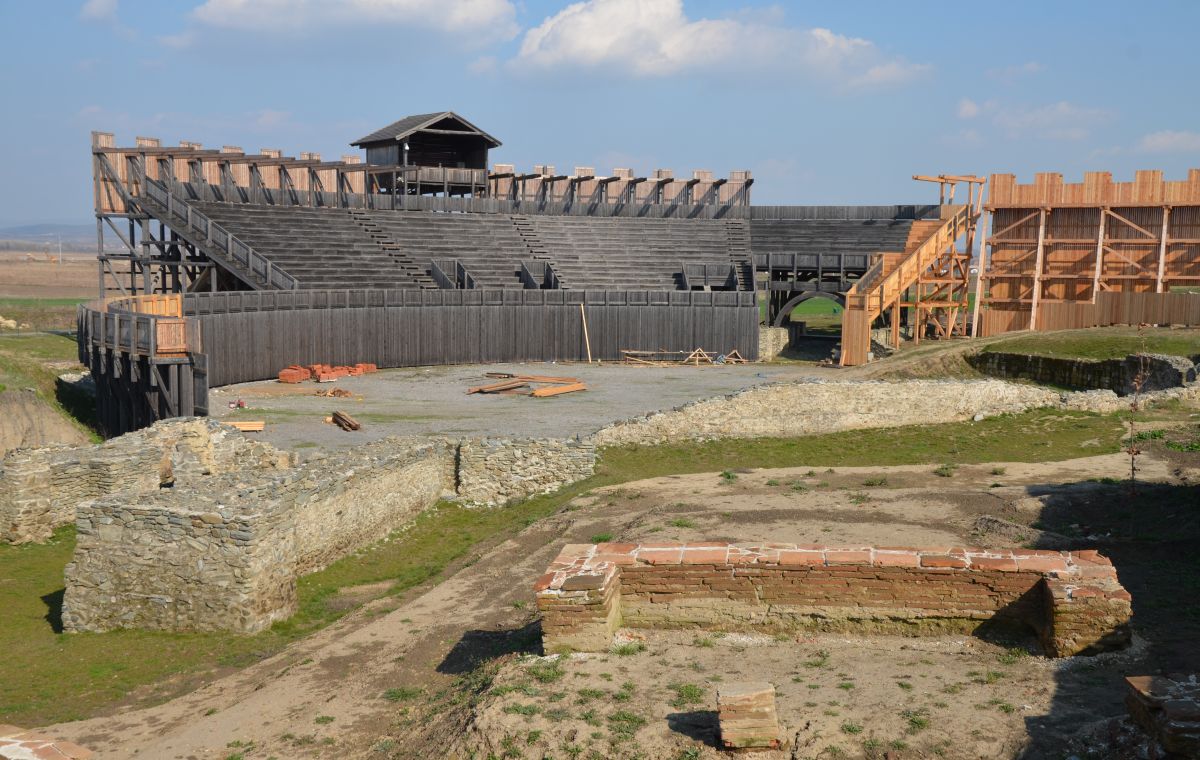
The Viminacium archaeological site near Kostolac, the ancient port of Ostia Antica in Italy, Casa di Arabe in Spain, and the Roman villa in Izola, Slovenia, should soon, in order to reach especially the younger audience, Generation Alpha born after 2011, find their place in the popular video game “Minecraft”.
Senior research associate at the Archaeological Institute, Jelena Anđelković-Grašar, told the Beta agency at the European House, where projects implemented within the “Green Heritage” project of the “Creative Europe” program were promoted, that the latest generations no longer communicate even on social networks, but via “Discord” in the virtual world of video games.
“For us, the only way to reach that generation with a quality message is through video games. That’s why we opted for Minecraft, because Minecraft has no weapons, no shooting, it’s not violent. It is deeply educational and it very often teaches about sustainability in nature. That’s why we want to transfer Viminacium, Ostia, and these cultural heritage sites of ours into that virtual world of Minecraft,” said Anđelković-Grašar.
She said that they have the Italian “Makers Camp” as a partner, which works on developing video games, but added that the idea is not for them to create the Minecraft world themselves, but that they want to co-create it with young people.
“We are now entering a process of workshops and creating a pilot program, where we will invite young people to tell us how to make the game. We will technically provide it, we as heritage experts will say what the correct and accurate information is, so that we don’t fabricate history. But, creativity is not up to us. We allow each young generation, individually from the countries that are members of our consortium, to contribute so that this Minecraft world is as close as possible to that young generation,” she added.
She stated that the Archaeological Institute has been managing Viminacium for 20 years and that they often have school visits, but that these usual tours are not very interesting for children.
“Young people like changes, their main movement is with their thumb, they scroll, and information must be fast, accurate, precise, and reach them in an interesting way. You don’t have much time for elaborate explanations, you have to learn to be concise, but also interesting, because that young person will not read you even if you are short, you have to be effective,” said Anđelković-Grašar.
She added that the “Green Heritage” project includes these different examples of cultural heritage from Roman to Arab culture, precisely to show how climate change and various effects affect cultural heritage.
FIND OUT MORE:
“We want to see what conservation methods can be applied in order to make our heritage more sustainable, resistant to climate change, but also an inseparable part of natural heritage, because most of these archaeological parks cannot, and should not, survive without the natural heritage that surrounds them,” said Anđelković-Grašar.
At the European House in Belgrade, the “DAH” theater project was also presented, which, according to the co-founder of that theater, Jadranka Anđelković, is dedicated to trees as one of the basic elements of climate balance.
Anđelković said that the whole project started from their idea “Dancing Trees”, which in the meantime grew into the European project “Trees”, whose goal is to raise ecological awareness through performing arts.
She added that this includes creating plays about trees, together with other partner countries from Europe, including Germany, Spain, the Netherlands, Greece, Ireland, and others.
Co-founder of the “DAH” theater, Dijana Milošević, added that their play, for which admission is free, is most often performed in Student Park, but has also been performed in the Botanical Garden and other places they were invited to.
“Every country (participating in the project) has the same problem – and that is the problem of the destruction of trees and the entire eco-system. It is a major social and political problem, which mostly happens due to rampant capitalism and the need to earn as much as possible and make a profit,” said Milošević.
It was announced that within the “Creative Europe” projects, festivals will be held this summer – the first “Dancing Histories” from June 1st to 8th in Viminacium, and then the Art and Human Rights Festival in Belgrade from June 10th to 13th.
Bojan Milosavljević from the “Creative Europe” Desk of Serbia said that around 950 projects applied to the competitions of that program at the European level in 2024, of which 159 were approved, including nine from Serbia, which makes it the non-European Union country with the most approved projects.
“We may have different opinions about culture in Serbia, but these statistics show that Serbia has a quality and competitive culture at the European level,” said Milosavljević.
MORE TOPICS:
“THE DECEASED USUALLY HAVE NO RIGHT TO VOTE”: Students in blockade called for a voter list check!
Source: N1, Photo: Wikimedia Creative Commons