




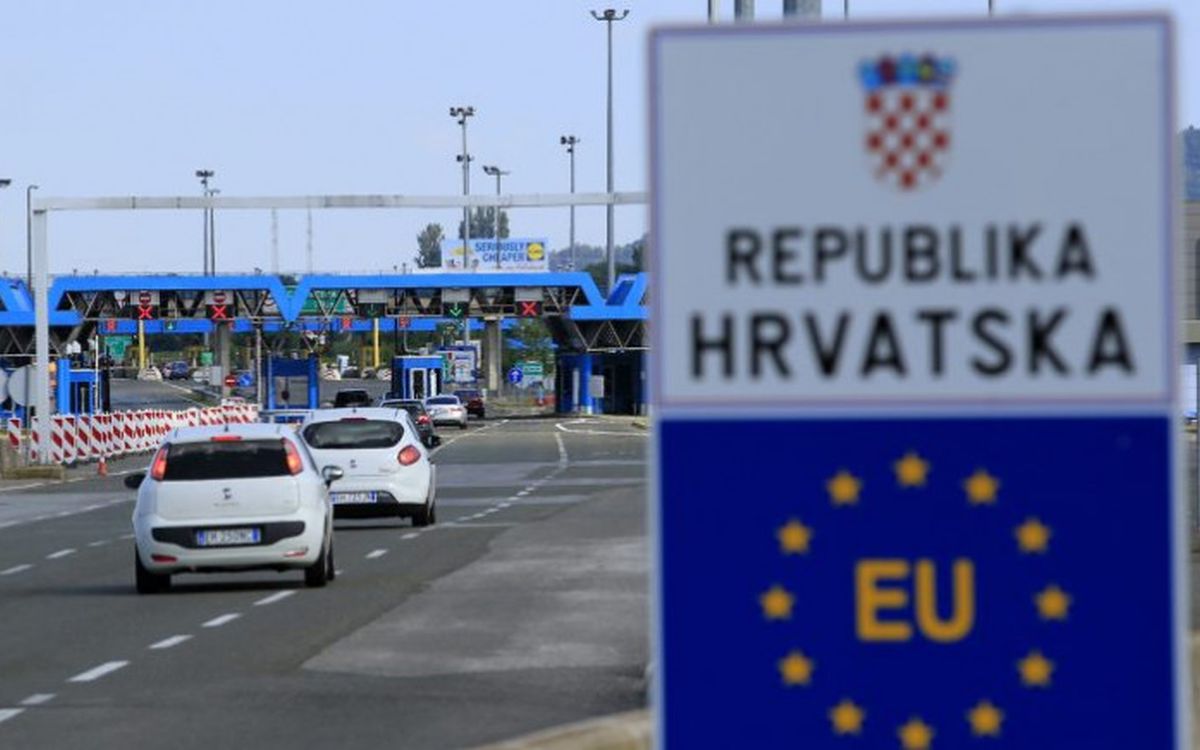
A new system for checking the entry of third-country nationals into the Schengen Area (EES) will start operating on October 12. This means that from then on, all Serbian citizens traveling to Croatia, Greece, or any other European Union country that is in the Schengen Area will have to comply with new, more rigorous entry rules.
Here’s exactly what that means and how it will affect the travel of our citizens to these countries.
The EES will replace manual passport stamping at the border and will allow for more precise tracking of entries, exits, and any overstays. The system is being introduced to increase security, prevent illegal stays, and reduce congestion at borders.
Less congestion will especially please everyone traveling to Croatia, especially during the summer season. And let’s remember, this year at the Batrovci border crossing, on the way out of Serbia to Croatia, multi-hour delays for passenger vehicles were recorded almost daily.
For now, it is known that all travelers crossing the border for the first time after the introduction of this change will have to provide their fingerprints, and their photograph will also be saved. This data will be used for border checks at every subsequent entry, which means that such a procedure will only have to be completed once.
In practice, this will mean that when this change comes into effect, travelers with Serbian documents will have to get out of their vehicles at the area on the Croatian side where the cameras are and where face scans and fingerprints, i.e., biometric data, will be taken.
What is the EES and what travelers need to know
The EES – Entry/Exit System, is a new electronic system being introduced by the European Union to improve border control and monitor the movement of third-country national travelers entering the Schengen Area.
In the context of the EES, a “third-country national” is a traveler who does not have the citizenship of any European Union member state, nor the citizenship of Iceland, Liechtenstein, Norway, or Switzerland.
Therefore, this system is intended for all who travel to Europe for a short stay and who are not citizens of the mentioned countries, including travelers from countries such as Serbia, the U.S., Great Britain, Canada, Australia…
A “short stay” means a stay of up to 90 days in any 180-day period. This period is counted as a single period for all European countries that use the EES.
Which countries will require the EES
The EES will be applied by 29 European countries:
-25 EU members (all except Cyprus and Ireland): Austria, Belgium, Bulgaria, Croatia, Czech Republic, Denmark, Estonia, Finland, France, Germany, Greece, Hungary, Italy, Latvia, Lithuania, Luxembourg, Malta, Netherlands, Poland, Portugal, Romania, Slovakia, Slovenia, Spain, and Sweden.
-4 non-EU countries that are part of the Schengen Area: Iceland, Liechtenstein, Norway, and Switzerland.
-The EES system will also apply to citizens of the Republic of Serbia.
About the introduction of the EES system and the application through which data will be entered
Aleksandar Seničić, the director of YUTA, previously told “Blic” that the EES system will be introduced gradually depending on which countries are most ready.
– They need, constitutionally speaking, that technical support, i.e., those scanners for taking fingerprints and cameras for recording faces – Seničić explained.
According to him, the application through which travelers will enter data is not yet active, but it should be, and very soon.
–At that time, travelers will be able to enter all their data themselves, except for the biometric data. Although there was talk that the application itself would be able to allow the taking of biometric data, we still don’t know that – he said earlier for “Blic.”
Thus, the obligation of travelers, including those traveling as early as October 13, if the application is available then, will be to register, enter all the necessary data, and most importantly – state the planned dates of entry and exit from the EU, in addition to personal data.
–All of that is entered into that form; it will be checked at the border itself, of course, if there is a deviation from what was announced, it will be noted through the system at the borders – he said then for “Blic.”
MORE TOPICS:
VIDIĆ SUPPORTED THE STUDENTS: The state will be led by educated young people, not thugs!