




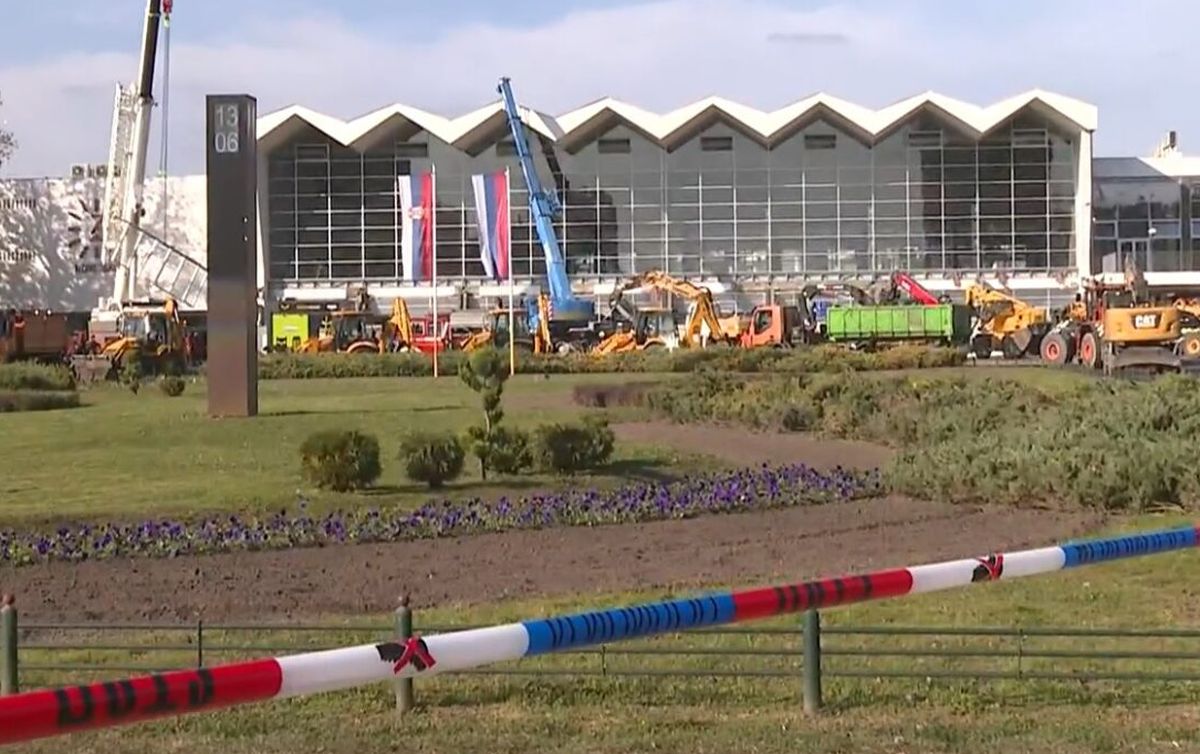
The arrested manager at the Serbian Railway Infrastructure company, S.K., was questioned yesterday at the Higher Public Prosecutor’s Office in Belgrade. While it remains unknown what defense she presented, some clues might be drawn from her first appearance before the Higher Public Prosecutor in Novi Sad in early December, when she testified as a witness.
At that time, she stated that on July 5, passengers should not have been allowed to use the vestibule of the Novi Sad station but claimed she took no action because it was not within her jurisdiction. She also said she was unaware of anyone within the company indicating that the facility had neither completed a technical inspection nor obtained an occupancy permit.
She insists that neither she nor her colleagues made any mistakes.
Although she was arrested two days ago alongside four members of the technical inspection commission, in her testimony, she spoke significantly less about the technical inspection itself and more about the so-called internal reception of the vestibule, based on which the station was opened in July 2024.
Construction Not Completed
S.K. emphasized that the work at the station had not been completed and that the station could not have received an occupancy permit because it was still a construction site.
“The reconstruction work at Novi Sad railway station was not completed because there is no confirmation from expert supervision that the work has been finished. Likewise, there is no report from the technical inspection commission stating that the station is fit for use, and there is no occupancy permit,” reads her statement, which Forbes Serbia has reviewed.
She repeatedly stressed that they had never received confirmation from expert supervision that the work had been completed.
The Station Was Still a Construction Site
She claimed she learned from the media that the station had been put into operation but was not present at the opening ceremony, as she was out of the country on vacation from June 26 to July 12 (the station opened on July 5). She became aware of the station’s opening the day after the ceremony.
“It is unknown to her how the opening ceremony was organized, nor does she have any knowledge of the usual procedure in such situations. She does not know under what circumstances the Novi Sad station building was put into operation. After learning that it had been opened, she took no action because it was not within her jurisdiction. She cannot say whether anyone was supposed to react to this or who that person might be. She has no knowledge of any other facilities being put into operation without an occupancy permit in the same manner,” S.K.’s statement reads.
Forming the Internal Reception Commission
S.K. confirmed that she was the one who formed the commission for the internal reception of vestibule wing B. However, she stated that “it was neither intended nor its purpose to allow passengers to use vestibule wing B after the inspection was completed.”
“Passengers were only supposed to be allowed to use the vestibule after the handover of the facility, that is, after a signed confirmation of receipt in accordance with the contract provisions,” she noted in her statement.
According to her, the commission’s visit to the site did not mean that the ticket offices were approved for transfer from wing A to wing B, as such a move would require an official confirmation of completed work and facility handover, which did not exist.
Another important point in her statement is that she repeatedly stated that the task of the commission—composed of representatives of Serbian Railway Infrastructure and Serbia Train—was to inspect the interior of the vestibule and identify deficiencies in the completed work. She explained that these deficiencies were to be documented to have a record at the time of the formal facility handover, but only after expert supervision confirmed that the work had been completed according to the construction permit project.
On the other hand, while she claimed that only the interior of the facility was inspected on July 4 (as she learned from the minutes upon returning from vacation), she also stated that “the contractor’s guarantee for passenger safety, as noted in the minutes, applied both to the interior and exterior of vestibule wing B and the entire Novi Sad railway station building.”
FIND OUT MORE IN ENGLISH:
No Orders Were Given
S.K. also stated that no one explicitly ordered her to form the internal reception commission; rather, she did so at the request of the contractor, who notified Serbian Railway Infrastructure on June 12, 2024, that the work was completed.
She added that similar commissions had been formed at other sections of the railway line to inspect ongoing work.
Another noteworthy point is that she confirmed receiving the minutes from the internal reception commission but “did not forward them to anyone, did not inform anyone that the inspection had been carried out, nor did she send it as confirmation to the contractor.” She explained that the minutes were sent to all commission members, but she does not know if they were sent to anyone else, as she was on vacation. “She personally had no obligation to inform executive directors or the general director about this or to report that vestibule wing B had been handed over, as all mail is distributed by the Investment Sector,” her statement reads.
Technical Inspection
Regarding the task of the Technical Inspection Commission, some of whose members were arrested two days ago, she said that the commission is responsible for assessing whether a facility can be put into trial operation or issuing a report confirming that the facility is fit for use.
She emphasized that she “does not know whether trial operation was approved for the Novi Sad Railway Station, and if it had been, she would have been aware of it.”
She also stated that on November 1 (the day the canopy collapsed), they were informed that a technical inspection report for the Novi Sad station had been prepared and was in the process of being electronically signed. However, “to this day, they have not received the inspection report for Section 9, which includes the Novi Sad railway station.”
S.K.’s Supervisor: She Was Not Obliged to Report to Anyone
Among the witnesses was Milan Novović, one of the executive directors of Serbian Railway Infrastructure and S.K.’s direct supervisor. In his testimony, he stated that he had no authority or role in the implementation of the Novi Sad to Hungary railway reconstruction project, as S.K. was overseeing the project on behalf of Serbian Railway Infrastructure as the manager for development and investments.
“She was designated to coordinate and monitor the project, and no one was directly above her in executing the project. She was not obliged to report on her activities and actions to anyone, not even to me. As for the general director, I have no knowledge,” his statement reads.
MORE TOPICS:
SERBIAN KICKBOXERS SHOW NO MERCY: Incredible 12 medals at the European Cup in Bulgaria! (PHOTO)
Source: Forbes, Foto: N1