




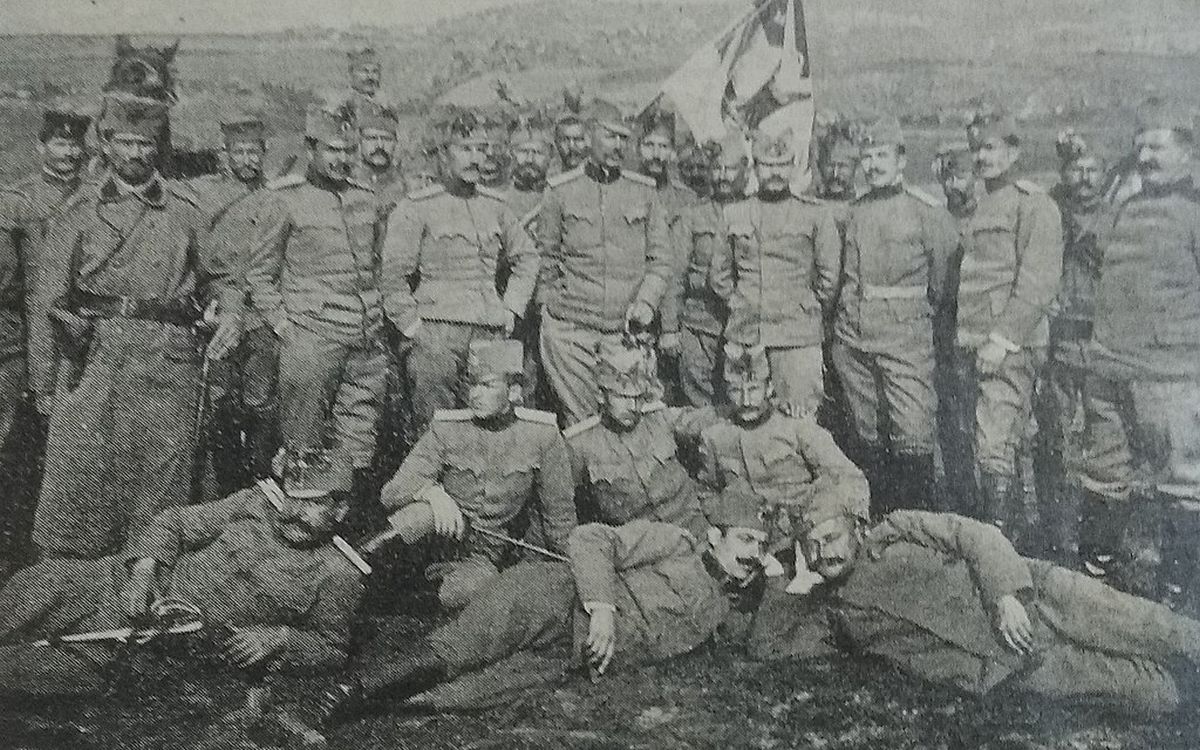
The First Balkan War began on October 8, 1912, when Montenegro declared war on Turkey. It lasted less than eight months, more precisely – until May 30, 1913. This war was fought by Montenegro, Serbia, Bulgaria, and Greece (members of the Balkan League) against Turkey for the liberation of parts of the Balkan Peninsula that were still under Turkish rule. For more than five centuries before the beginning of that conflict, the Turks had conquered the Balkans. This was the beginning of a tough life for the Christian population, who had to pay taxes to their new masters, do forced labor, and endure terrible terror. Four centuries later, the Balkan people managed to liberate a small part of their territories and, with the permission of the great powers, including Turkey, gained independence. However, the Turks still held most of the Balkans under their rule.
The Ottoman Empire was significantly weakened at the beginning of the 20th century. When the Turks emerged defeated from the war with Italy, the Balkan countries saw it as a sign that the time had come to expel the enemy from the Balkans. An alliance was formed between Serbia, Montenegro, Bulgaria, and Greece to achieve that. All four countries were kingdoms and had partially separated from the Ottoman Empire several decades earlier, i.e., to obtain separate territories. This war was also an opportunity to expand their borders significantly.

The Founding of the Balkan League
In the spring of 1912, Serbia, Montenegro, Bulgaria, and Greece founded the Balkan League (which collapsed when its members quarreled over the division of territories conquered in the First Balkan War). Ostensibly created to limit Austrian power in the Balkans, this military alliance was finally made at Russia’s instigation to expel the Turks from the Balkans. Austria-Hungary and France, which feared the strengthening of Serbia and the other members, were the primary opponents of this alliance. Everything was ready for the start of the First Balkan War, and the only thing that was bothering was the discord between Bulgaria and Serbia, as both countries wanted to annex Macedonia to their territory.
Montenegro was the first to declare war on Turkey on October 8, 1912, and on the same day, attacked the Turkish positions near Skadar. Five days later, the other countries issued an ultimatum, which the Turks, of course, did not accept. Serbia and Bulgaria declared war on Turkey on October 17, and a day later, Greece did the same, thus starting the First Balkan War.

As the Balkan people are, in principle, not very united, it was similar in this war, as each member, in a way, fought separately and on a separate front. Only the Bulgarians and Serbs joined forces in the Second Army. They headed towards Stracin, under the leadership of Stepa Stepanović. Still, the Bulgarians regularly disobeyed and always waited for orders from their military command. However, they would unite on several more occasions during the war.
Each member of the Balkan League acted in a different direction. Serbia wanted to expand to the west, but Austria-Hungary did not allow it, as it had annexed Bosnia and Herzegovina only a few years earlier. So, the Serbian army headed south. Kosovo and Metohija were back in Serbian fold for the first time in more than five centuries.

The Battle of Kumanovo
This was a time when Serbia produced some of its greatest heroes: Radomir Putnik (chief of staff of the Supreme Command of the Serbian Army) and, then his assistant, Živojin Mišić, Petar Bojović (commanded the First Army, which headed towards Skopje), Stepa Stepanović (commanded the Second Army, which advanced towards Stracin), Božidar Janković (led the Third Army, which liberated Kosovo and Metohija), and many others.
The Bulgarians, who had by far the largest army, operated along the Tundzha River south of the city of Yambol, then in the direction of Edirne and across the Strandzha Mountains. In addition to having a large army, the Bulgarians could boast of sound equipment, and they even had a small navy.

Unlike them, the Greek army was the weakest. Still, it was more than necessary because the other allies relied on its strong navy. Since the Ottoman military was in the minority, the Greeks had to prevent any reinforcements that could arrive for the Turks from Asia. They set out to capture Ioannina and Epirus and participate in the capture of Thessaloniki.
The Montenegrins also had a small army, but as they were considered experienced warriors, they contributed significantly to the fight. Under the leadership of King Nikola, Montenegro advanced towards Skadar and operated near Novi Pazar.

One of the main events in the First Balkan War occurred on October 23, 1912, near the Macedonian city of Kumanovo, during the capture of the Ovče Pole location. This event is remembered as the Battle of Kumanovo. The First Serbian Army was joined by the Third, which arrived from the liberated Kosovo.
The Turks, under the command of Zeki Pasha, attacked on the morning of October 23. The battle lasted until the following afternoon and ended in the defeat of the Ottoman army, which began to retreat towards Prilep, where another major struggle would occur a few days later. In addition to the conflicts near Prilep and Kumanovo, the battle of Bitola (from October 16 to 19, 1912) was another significant event in which the Serbian army participated in that war.

The Treaty of London
The First Balkan War ended with the conclusion of peace in London (the so-called Treaty of London) on May 30, 1913, under the watchful eye of the great powers. Serbia and Montenegro received some privileges but also had to renounce some of their merits. Thus, Serbia and Montenegro divided the Sanjak but were not allowed to occupy the territory of present-day Albania. Bulgaria received part of Thrace and Greece – Crete. The territory of present-day Macedonia remained questionable, but in a way, under Serbian rule, which caused great dissatisfaction among the Bulgarians. A few days later, due to dissatisfaction, Bulgaria declared war on Serbia, which began the Second Balkan War. Turkey had to withdraw from Europe, below the so-called Enos-Midiya line, which is roughly where the territory of that country is today.
Serbia had the opportunity to conquer even more territory. Still, that idea was abandoned (Vojvoda Radomir Putnik participated in that decision) because it was known that many other countries would rebel, especially Austria-Hungary.
SIMILAR TOPICS:
Izvor: Opšte obrazovanje
Foto: Wikimedia Creative Commons