




It was night, and a line of cars was waiting to cross from Hungary into Serbia. Sitting calmly in one of the vehicles were former owner of Jugoskandik Bank Jezdimir Vasiljević – known as Gazda Jezda – his lawyer Stevan Protić, bodyguard Ciga Cokić, and one of the greatest chess players of all time – Bobby Fischer.
Around midnight, they arrived in Belgrade at a villa in Dedinje where Fischer would stay during his visit. It was 1992, and the “world champion,” as he liked to call himself, was preparing to return to the global stage after 20 years in deep hiding.
Fischer stayed in Serbia much longer than planned, as U.S. authorities were on his trail. As a precaution, he changed locations several times – mostly near the Hungarian border – so he could leave quickly if necessary.
One of these locations was Banja Kanjiža, a quiet place by the Tisa River that drew no attention to itself.
One sunny September day, the phone rang in the office of Dr. Ferenc Agošton, then director of the Kanjiža Spa, a special rehabilitation hospital. A voice on the other end told him that a world-famous chess star would soon be arriving and would stay for several months. Not long after, Fischer appeared in front of the Hotel Aquamarin, accompanied by his personal secretary, 16 leather suitcases filled with books, several paintings, and two bodyguards who never left his side for even a minute.
That year, inflation in Serbia was among the highest in the world, with poverty and hardship visible everywhere. People were starving, yet paradoxically, the Kanjiža spa was full.
“Bobby Fischer stayed with us for three months – September, October, and November 1993. Our employees were earning five or six German marks a month at the time, while full board for Fischer, his secretary, and his two bodyguards cost 400 marks per day. We agreed that they would exchange money every morning and pay the daily sum based on the current exchange rate. That’s how it was. We never had the slightest problem. Everything was financed by Jezda,” recalls Dr. Ferenc Agošton at the start of our conversation.

NIGHT WALKS
Fischer came to rest and escape the flood of journalists and intrusive “admirers.” He also wanted to straighten his spine, which had curved from years of playing chess.
He was 49 years old when he accepted an invitation to play a tournament in Belgrade and Sveti Stefan against Boris Spassky. They had last met in 1972 in Reykjavik, where Fischer won and became world champion. Later, he fell out with the World Chess Organization and disappeared from tournaments and public life.
By the time the Sveti Stefan tournament took place, Fischer had been completely forgotten.
Of the $5 million prize fund, two-thirds went to the winner. The U.S. Internal Revenue Service notified Fischer that his participation was illegal due to sanctions against Yugoslavia. After the match, a warrant was issued for his arrest. Fischer won the match with 10 wins, 5 losses, and 15 draws.

Before arriving in Kanjiža, Fischer stayed at Banja Junaković near Apatin. However, loud explosions from the nearby Croatian battlefield deeply disturbed him, so he was moved to Kanjiža.
For Dr. Agošton, who had been director for only a few months, ensuring Fischer’s complete satisfaction was a priority. Fortunately, the chess star wasn’t very demanding.
“He loved to walk at night, often all the way to Horgoš and back – a 30-kilometer round trip. He was incredibly tall and walked fast, while his two bodyguards had to run to keep up with him. Every other day, one of them would travel to Szeged, Hungary, to buy foreign newspapers. Fischer wanted to stay informed about world events,” Dr. Agošton recalls.


TIME STANDS STILL
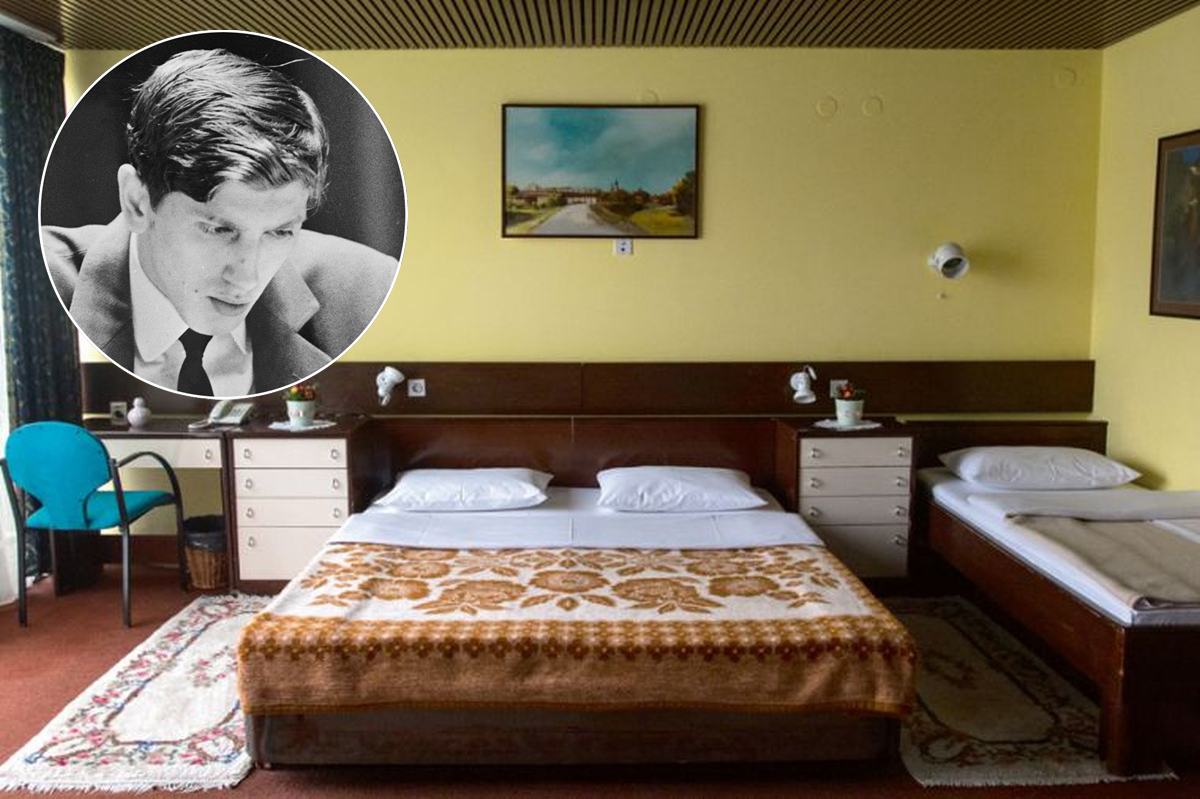
Suite 219 looks almost exactly the same as it did 25 years ago, except for the addition of a flat-screen TV, air conditioning, and a built-in hairdryer. The furniture remains unchanged – the same worn, faded upholstery but meticulously clean. Even the double bed, where Fischer slept, is still covered with the same brown-patterned synthetic blanket that evokes the past.
“Nothing has changed since the hotel was built 36 years ago,” says Borsoš Jene, the hotel maintenance worker who showed us around Suite 219.
In this time capsule, one can almost picture Fischer’s piles of chess books, the late afternoons when he struggled to wake up, lying diagonally across the bed for comfort, his unusually large size 48 feet dangling off the edge.
“He never made excessive demands, but he loved when locals brought him blueberry juice and fresh cow’s milk. He would warm the milk on the hot plate and drink it any time,” recalls Jene, who worked at the hotel pool and remembers Fischer’s late-night swims.
“The director allowed him to use the pool after closing. He came with his bodyguards and stayed for about an hour. The first time I saw him, I was shocked by how big he was – like Schwarzenegger, with enormous feet. Like two riverboats.”

In the hotel restaurant, Fischer had a reserved table and always sat in the same spot. But he drove the waiter crazy with his eating habits.
“We make amazing sour soup here. Everyone eats it with a spoon, but Fischer dipped bread into it. After every bite, he wiped his hands on the tablecloth, which infuriated the waiter. But he left big tips and never caused any real problems,” recalls Balaton Šandor.
Fischer paid no attention to fashion, often wearing the same clothes for days. His shoes had to be custom-made, and he wore one pair until it fell apart.
Before leaving Kanjiža in late 1993, Fischer had already transferred his prize money to Hungary and moved to Budapest. He later lived in Japan, where he was imprisoned for eight months, awaiting extradition to the U.S.. After diplomatic negotiations, he was granted Icelandic citizenship, where he lived until his death in January 2008.
There are no photographs of Fischer’s time in Kanjiža, as he hated publicity. The only tangible traces of his stay are three chessboards signed with his autograph.
MORE NEWS:
Source: Želimir Bojović, Nikola Jekić (Newsweek, no. 77, april 2017.)
Foto: Danilo Mijatović