




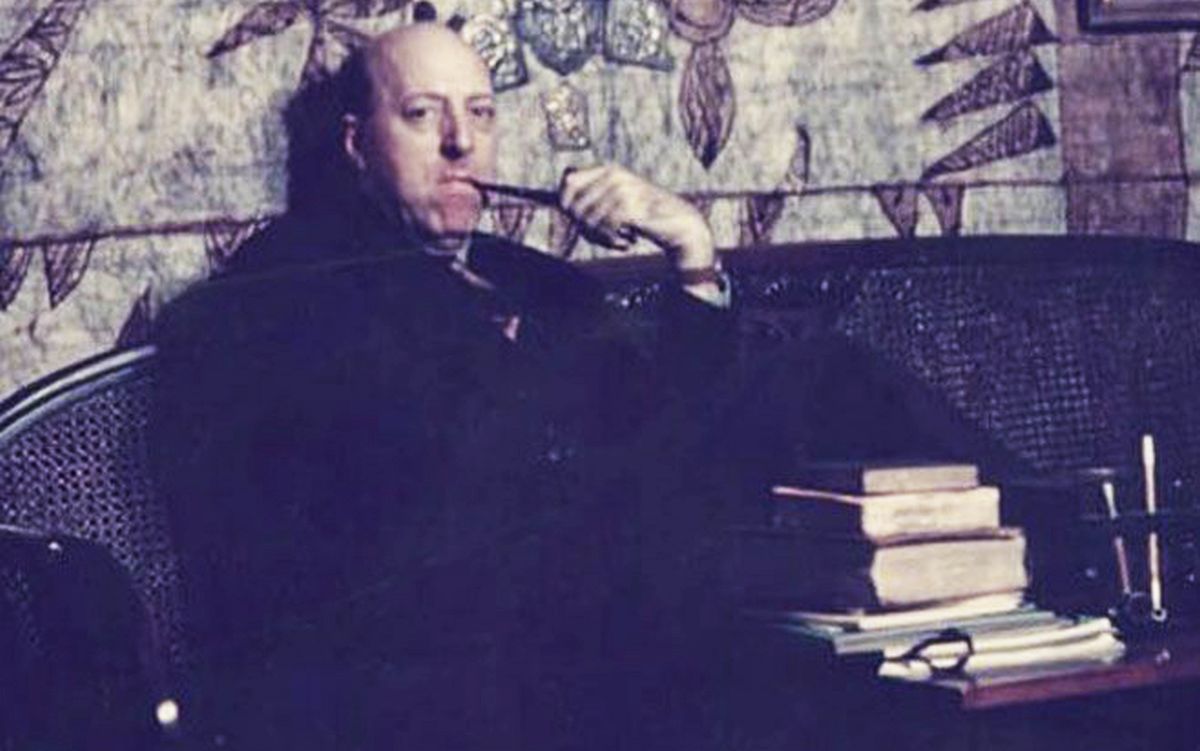
Rastko Petrović was one of the most prominent representatives of the Serbian avant-garde. He belongs to the group of writers who emerged immediately after the First World War and formed the core of Serbian modernists. One of the most innovative authors of modern Serbian literature bravely, gifted, and originally conceptualized his thematic corpus, eclectically combining various sources of inspiration as well as genres, playing with form and language.
He was considered one of the most educated and gifted writers of his generation. He had an excellent knowledge of Serbian, primarily folk, as well as world literature, and also modern tendencies in European art. He wrote novels, short stories, lyrical poems, epics, travelogues, and essays. He began his literary journey as one of the most agile and prominent representatives of the avant-garde, advocating for modern expression, new forms, and unusual content, the interweaving of genres, and the rejection of classical pure genres and mixing of styles. He was part of a group of Serbian modernists who dominated the literary scene from 1920. This group included Miloš Crnjanski, Stanislav Vinaver, and Todor Manojlović.

FIND OUT MORE IN ENGLISH:
The Birth of a Modern Author
Rastko Petrović was born on March 3, 1898, in Belgrade, the youngest of nine children. His sister Nadežda Petrović was the most significant painter of Serbian Impressionism. During the wartime turmoil of 1915, he crossed Albania with the army and the Serbian people, and the following year he continued his education in France, in Nice. He then enrolled in the Faculty of Law in Paris as a French government scholarship holder. At the same time, he studied literature and art history.
In Paris, he befriended famous contemporaries – Picasso, Salmon, Breton, Éluard… There he began to write his first book, “Burlesque of Mr. Perun, God of Thunder.” He also wrote a large number of poems and short stories, which he would publish in the early 1920s in Belgrade literary magazines such as Zenit, Misao, and Srpski književni glasnik, as well as in various daily and weekly newspapers. Petrović also published his works in the magazines Putevi (1922) and Svedočanstva (1924), in which the modernist movement was affirmed and the seed of surrealism was born.
After graduating in law, Rastko Petrović came to Serbia and toured its regions. He traveled through Serbia, Dalmatia, Macedonia, and Montenegro, publishing poems, travelogues, essays, and reviews of painting exhibitions. At the end of 1924, he was employed by the Ministry of Foreign Affairs, and in 1926, he was appointed as a diplomatic official in Rome, a clerk at the Royal Legation to the Vatican. In Rome, he met Milan Rakić, a poet, then the envoy of the Kingdom of Serbs, Croats, and Slovenes in Rome. He socialized intensely with him and his wife Milica, visiting Italy, Spain, Turkey, and France. At the end of 1928, he also embarked on a major trip to Africa. He returned to Belgrade in 1930 and continued his service at the Ministry of Foreign Affairs.
Rastko Petrović’s life, in addition to his creative work, was marked by numerous travels – he traveled to Paris, London, Venice, Cologne… He went to the USA in 1935 when he was appointed vice-consul in Chicago, and then in 1936, when he was appointed secretary of the legation in Washington. During this period of his life, he traveled throughout America, visited Canada and Mexico, and went to Cuba. He also spent World War II in America. When he wanted to return to Serbia in 1945, he could not – state support and assistance were lacking. As an émigré, Petrović continued to live in America, relying on the help of friends. He died suddenly in 1949. He was buried in Washington, and his remains were transferred to the New Cemetery in Belgrade in 1986.

In the Footsteps of the European Avant-Garde
What characterizes the European avant-garde in the first decades of the 20th century in Europe is also present in the work of Rastko Petrović. This includes a fractured and fragmentary structure, the use of different genres and styles, associative connections between parts of the text, and the flexibility of spatial and temporal movement. In addition to these formal features, Petrović’s work is also characterized by thematic innovation – he introduced new themes into Serbian literature, a new understanding of life and the world, as well as a new understanding of the function of art.
Critics stated that the heterogeneity of Rastko Petrović’s literary opus is a consequence of his constant search for new expressive possibilities of language. Rastko Petrović was enthusiastic about older, original forms of artistic and spiritual expression, which he found both in Serbian folk literature and in the primitive creativity of African and American indigenous peoples. He was interested in the belief in the unlimited possibilities of language – he incorporated ritual songs, counting rhymes, incantations, legends, and traditions into his works. In other words, a type of poetry based on the belief that natural and supernatural forces can be overcome by the magic of words.
Petrović published his first poem in the Krfski Zabavnik in 1917. During his student days in Paris, he began to intensively engage in literature. He wrote and published poems, short stories, and reviews of painting exhibitions. In this period, his first novel, “Burlesque of Mr. Perun, God of Thunder,” was also created, which he published in Belgrade in 1921. This novel was not accepted by the wider reading public and traditional criticism, but Ivo Andrić, Miloš Crnjanski, Stanislav Vinaver, and Isidora Sekulić recognized in it the expression of avant-garde tendencies and currents.
The novel is built on the intertwining of different styles and genres, prose and poetry, fiction and documents, encompassing a very large time span, from pagan to modern times, and then the most diverse themes. In his first novel, Petrović writes about old Slavs and their gods, Christian hell, the Proto-Slavic hero Nebor Devolac and his descendants.
Even today, this prose has not been genre-defined in literary history and literary criticism. At the time it was published, it was modern in structure, content, and applied artistic procedure. For the first time in Serbian literature, a documentary technique of shaping content was applied. That is, the incorporation into the novelistic structure of various genre forms — excerpts from apocrypha, excerpts from the work Slovo ljubve by Despot Stefan Lazarević, legends, as well as historical material. Rastko Petrović was innovative and ahead of his time – the procedure he first applied later became a regular practice in contemporary postmodernist prose.

Thematic Innovations in Serbian Poetry
The collection of poems “Revelation,” published in 1922, is characterized by fragmentation, diffuseness, a tendency towards defamiliarization, and blurred meaning. The book was poorly reviewed and little read. It contained 12 poems in which Petrović intertwined motifs of everyday life in a big city with motifs from Old Slavic and Christian mythology, reflecting on sexuality, corporeality, youth, and the renewed mystery of birth… All of these were thematic novelties in Serbian poetry. Rastko Petrović passionately explored mythical and archetypal elements, reconstructed them, and used them in his work.
Jovan Deretić stated that the collection Revelation was Petrović’s poetic peak. He added: “Petrović is a poet of a strong Dionysian feeling of life, which moves between painful and destructive extremes, from the cheerful, sensual debauchery of the Slavic pagan paradise in Burlesque to the dark atmosphere of destruction, violence, and death in certain poems of Revelation.”
Critic Zoran Mišić, in his essay, stated that in the collection Revelation, the lyrical subject wanders through space and time, identifying with always new self-determinations: the Sun (solar myth, sacred wedding of sun and dawn), the old Slav (mythological layer), Jesus and Judas (New Testament layer).
“Within the lyrical subject, a whole cosmos arises; it encompasses the entire history of mankind, from the origin of man to the apocalypse, and the only firm support in self-definition is the awareness of one’s own corporeality. A specific relationship to Christianity, the tension between faith and disbelief, and the need to re-evaluate some of the basic postulates of Christianity also characterize this collection. Rastko Petrović’s boldness in contemplating these themes is both an avant-garde provocation and a brave personal act, but also the questioning of modern man who, after the teachings of a Nietzsche or Freud, faces the death of God and the dissolution of all previously unquestionable values.”
Mišić added that Rastko’s “Revelation” is an exaltation of the instinctive nature of man, from whose flesh all beauty and all knowledge—poetry, religion, and morality—emerge.
A Unique Trilogy
In 1927, Rastko Petrović published his second novel, “With Immeasurable Forces,” which is closely related to his later novel, “The Sixth Day” (the main character of “The Sixth Day,” Stevan Papa-Katić, is the son of the main character from “With Immeasurable Forces”). This novel by Petrović explores the purpose of life and the possibilities of human fulfillment. In it, what is predetermined happens, and the heroes do not decide their own fate and cannot change it.
“The Sixth Day,” Petrović’s last work, was written in the 1930s in America. It was published only in 1961. It is noted that Geca Kon refused to publish this novel due to its gloomy tone – depicting the retreat of the Serbian army across Albania. The novel is compositionally divided into two parts: the first follows the journey of seventeen-year-old Stevan Papa-Katić across Albania, and the second part depicts his life in America twenty years later. And since the novel “With Immeasurable Forces” tells about events before Stevan’s birth, these two novels by Petrović are often referred to as a kind of trilogy.
Critics have stated that it is one of the best Serbian novels about the First World War and a very complex work. By following a large number of characters, their fates during the war and the Albanian Golgotha, and by bringing the narrator’s perspective closer to the characters’ perspective, through defabularization and fragmentation of structure on one hand, and its associative connection on the other, Rastko Petrović, critics emphasized, created a modern work that occupies a central place in the historical development of the Serbian novel.
The Eternal Traveler
Rastko Petrović loved to travel, to explore unknown areas, to get to know foreign countries and people, and their cultures. Constant movement, changing environments, immersing himself in new landscapes, and discovering new cultures and worlds were an essential need for the great writer. And the theme of travel logically appears as the basis of his entire creative work. Petrović’s interest in non-European cultures, primitive, or authentic forms of living, thinking, and creating also led him to the wilds of Africa. He described his experiences from this trip in the travelogue “Africa” in 1931.
Africa is not the only travelogue Rastko Petrović wrote. In various magazines, he left a large number of descriptions of his travels through Macedonia, Dalmatia, Serbia, Spain, Turkey, Libya, and Italy.
His third novel, “People Speak,” from 1931, a relatively short work, quickly found its readership and remains Petrović’s most widely read work to this day. The novel has a complex structure and represents an avant-garde and autopoetic experiment. “People Speak” is composed of dialogues and short replies and actually represents an encyclopedia of spoken genres. This work can also be defined as a travelogue – it is a story narrated by a traveler about the inhabitants of a small island, and who, through storytelling about human destinies, brings a deep tragedy and frustration of human existence.
Reflections on Art and Life
Throughout his life, Rastko Petrović collaborated with a large number of domestic and foreign magazines, writing essays of the most diverse content – art criticism and reviews of painting exhibitions, cultural and historical discussions, and autopoetic texts. During 1924, he collaborated in the surrealist magazine Svedočanstva, writing some of his best and most famous essays: “The Youth of the National Genius,” “Our Folk Poetry and Today’s National Life,” “Words and the Power of Development,” “The National Word and the Genius of Christianity,” “General Data and the Life of the Poet,” and “World War in Foreign and Our Literature.”
MORE TOPICS:
“THE DECEASED USUALLY HAVE NO RIGHT TO VOTE”: Students in blockade called for a voter list check!
Source: P-Portal.net; Foto: Printscreen YouTube