



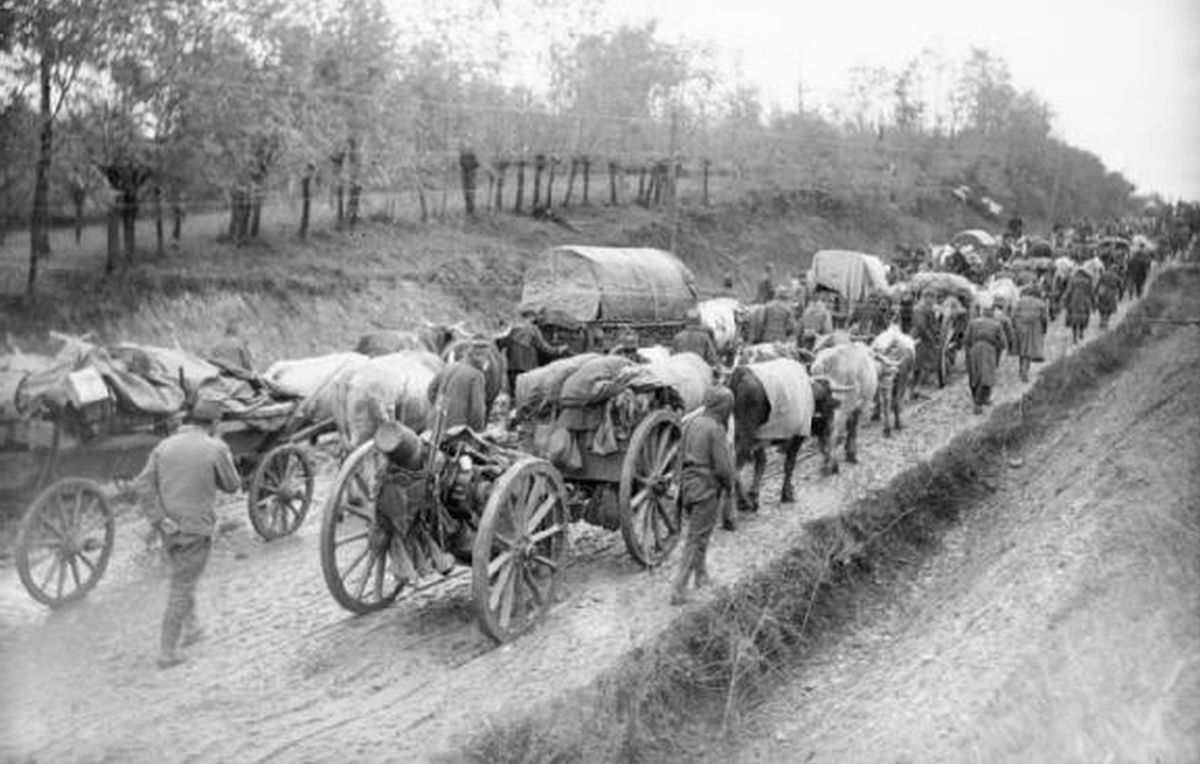
The King, the Government, and the diplomatic corps, followed by the people. That was the scene on the night of November 26 and 27, 1915, when the retreat through Albania began. In history, it is called the Albanian Golgotha, known as one of the most painful sufferings of the Serbian people. Important testimonies about the First World War have arrived at the Museum of Books and Travel.
The fate of the fifteen-year-old boy Sreten Šljivić, from the village of Rabrovica near Valjevo, is similar to that of several thousand of his peers who retreated through Albania in the winter of 1915 and 1916. Sreten was lucky – he survived the Albanian Golgotha. He was educated and obtained his doctorate in France, becoming one of our most respected physicists. His war textbooks were recently found and arrived at the Museum of Books and Travel.
„This collection is primarily interesting as a collection, you usually find one, two, three books from that period in some library. But Sreten initially kept the entire war library he used while studying in Beaulieu, so about twenty of his textbooks“, explains Viktor Lazić from the Museum of Books and Travel.
And there are Sreten’s textbooks in physics, chemistry, but also in history, and geography. Many were written and copied in unskilled French.
„Because the largest number of our students were in France, and secondly, our intellectuals translated books into French or already wrote directly in French, so that the largest possible audience would be familiar with history, geography, and literature“, says librarian Svetlana Mirčov, who processed this collection.
During the war years, it was a real struggle to get an education in a foreign country, and an even greater difficulty was finding a textbook.
„First, an extremely large number of dictionaries were published because they were intended for students and young people, but also for soldiers. They were even taught to read and write during the war, and they were also taught in hospitals“, Svetlana states.
„You can even see how they moved from individual textbooks. He writes Bizerta on some of his textbooks, so he studied in Bizerta, then he writes Algiers, and finally, he finished in Beaulieu. Imagine that journey across Albania, Corfu, Thessaloniki, who knows where, across Algiers, Bizerta, and finally ending up in Nice“, Lazić points out.
That is why all these textbooks, more than 100 years old, many of them with dedications, are a precious testimony. They provide a new picture of student life in the First World War.
More than 2,000 bibliographic units about the First World War are located in the Museum of Books and Travel. There are numerous Serbo-French dictionaries, grammars, but there are also numerous textbooks here. For example, the history of the Serbian people, which is a textbook for the fourth grade of primary school, and was printed in Bizerta in 1918, is interesting.
Besides Sreten’s legacy, there are also textbooks of other children, war diaries, letters, photographs, and various student and military literature here.
„Our soldiers, while waiting for a battle in the trench, read both Đura Jakšić and Bora Stanković and Turgenev and Tolstoy. That is something unbelievable, but you also have agricultural literature. That surprised me the most. Imagine a soldier who, in the trench in 1918, doesn’t know if he will reach his fields alive, has the need to print a book of instructions for plowing with tractors“, Lazić recounts.
The Museum of Books and Travel continues to expand its collection on the First World War. They hope that one day it could be declared a cultural asset and believe that it will grow into something special. Because of the documents that testify to destinies like Sreten’s at the beginning of the story, this collection is already special.
MORE TOPICS:
COURT OF JUSTICE OF THE EUROPEAN UNION DECIDED: All member states must legalize same-sex marriages!
„EL SERBIO“ IS DANGEROUS AND ARMED: Caribbean state issued a warrant for Serbian Marko Popović!
VUČIĆ ON THE SITUATION WITH NIS: Banks, food supply, and security are endangered, we have 5 days!
Source: RTS; Photo: Wikimedia Creative Commons