




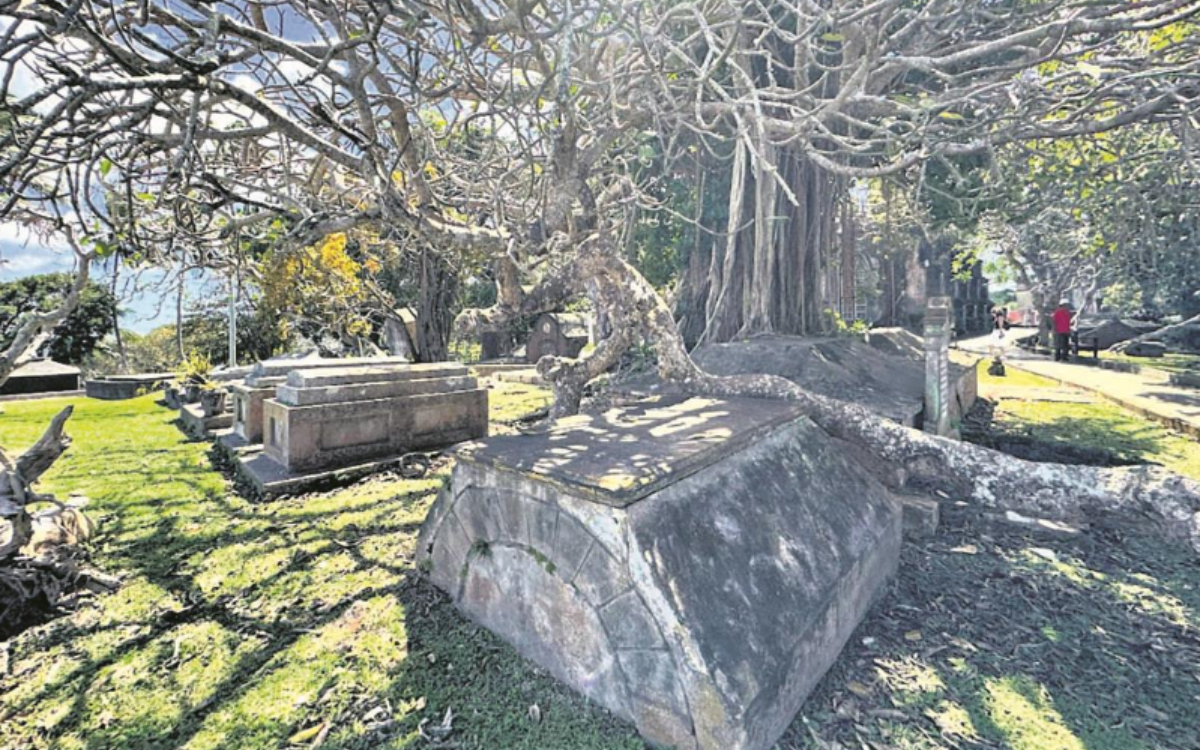
Next to the Church of St. John lies the tomb of Ferdinand Paleologus (1619-1670), likely one of the last known descendants of the Byzantine emperors, the Serbian medieval Dragaš family, and Serbian King Stefan Dečanski.
In distant Barbados, amidst palm trees and tropical vegetation, near some of the world’s most beautiful beaches, I found the tomb of one of the last known descendants of the Byzantine emperors and — the Nemanjić dynasty! My surprise was boundless as I learned facts from the thrilling lives of the last scions of the imperial line – they lived as pirates and hired killers, but in the state service of the most significant and cruelest rulers of Europe in their time. The forgotten historical connection to Serbia unfolded before me where I least expected it, near beaches, among palms and sugarcane fields of distant Barbados.
Wooden Labyrinths
Next to the Church of St. John, under the sprawling canopy of a tropical tree in eastern Barbados, I visited one of the oldest and most significant tombs on this island, a sacred place of pilgrimage, the tomb of Ferdinand Paleologus (1619-1670), probably one of the last known descendants of the Byzantine emperors, the Serbian medieval Dragaš family, and Serbian King Stefan Dečanski.
Trees of similar age have grown out of the tombs erected centuries ago, spreading leafless branches, as if indistinguishable wooden labyrinths had risen above eternal homes. The most beautiful of all such natural monuments over a monument to human transience soared into the sky above the sacred tomb. Because of it, I headed to this part of Barbados, while buses full of tourists hurried to the surrounding beaches. I was interested in learning more about the labyrinths of life that led the last descendant of such significant families to the other side of the world, for his bones to remain at the equator, for his grave to be visited mostly by accidental passers-by who know very little, if anything, about Byzantium and Serbia. I also wished to pay homage to the imperial descendant and an entire era that bestowed culture and faith upon my people.
“Greek Prince from Cornwall”
The tombstone reads: “Here lies Ferdinand Paleologus, a scion of the imperial line of the last Christian emperors of Greece, churchwarden of this parish from 1655 to 1656, a member of the parish council for twenty years, died October 3, 1678.”
Ferdinand was known in Barbados as the “Greek Prince from Cornwall,” as he moved to this remote area from England. Tourist brochures rarely mention this tomb, and when they do, they state that it is one of the oldest preserved tombs in Barbados. I learned about it through persistent reading and studying the history of this island. In the museum of the Barbados Historical Society, I also found this information: “When Greece was liberating itself, during the Greek War of Independence (1821-1829), the provisional Greek government sent a delegation to England and Barbados with a request to investigate if there were any surviving heirs of the Byzantine emperors… They hoped that perhaps someone was still alive and would be willing to lead the Greek people in the fight for freedom.”
The tomb is most often visited by historians and history enthusiasts, but even they do not know that Serbian blood also flowed through Ferdinand’s veins. I confirmed this after finding an American professor near the tomb, with whom I briefly spoke. The Paleologus family attracts tourists because they were the last and most resilient dynasty in the history of the Byzantine and Roman empires. They ruled for two hundred years – from 1259 to 1453 and the fall of Constantinople.
Serbian Roots of Byzantine Emperors
It is known that Serbs gave several princesses to Byzantium, but it was also not uncommon for Byzantine princesses to end up at the Serbian court, as was the case with King Milutin’s underage wife Simonida, depicted in the famous fresco in Gračanica. But few know that the last Byzantine emperors, John VIII (1425-1448) and Constantine XI (1449-1453), were Serbian on their mother’s side and that their native language was Serbian. This refers to the wife of the Byzantine Emperor Manuel II, Jelena Dragaš, daughter of the famous magnate Konstantin Dragaš Dejanović. Her mother was the daughter of King Stefan Dečanski. Thus, Jelena is a direct descendant of the Nemanjić dynasty, and so are her sons and their descendants. Furthermore, the two last Byzantine emperors were named after their Serbian grandfather and great-uncle – Konstantin Dragaš and Jovan Dragaš, and the last emperor Constantine XI Palaiologos added his mother’s surname Dragaš to his own. He died during the Fall of Constantinople in 1453, showing great bravery, and was declared a saint. In Greece, he is considered the immortal emperor, who will someday return to Earth. His heroism contributed to the magnificent end of one of the most glorious empires in human history.
Constantine had no heir, but his brother Thomas did. This is claimed by the inscription on the tomb of Theodore Paleologus (1560-1636) in southern England, in a place of honor next to the altar, where the male ancestors who separate him from the last Byzantine emperors are explicitly listed. However, historians have not been able to find information about Thomas’s youngest son, John, through whom this family traces its origin. Experts who support the authenticity of the tomb inscription emphasize that this lineage is known to have arrived in England from a small Italian town where the brother of the last Byzantine emperor, Thomas, lived, and that this lineage publicly presented its origin for several generations, which no contemporary disputed, although at that time there were many legitimate heirs of the imperial line through various collateral lines. The fact that John has not yet been found in historical sources does not mean that information about him is not hidden in dusty archives and among forgotten museum exhibits.
A Place of Pilgrimage
Theodore’s eternal resting place is a Greek pilgrimage site, where Orthodox services have been held over the tomb, and the tomb has been visited by members of the Greek royal family, as well as Queen Elizabeth II with Prince Philip (who also belongs to the Greek royal family), as recorded in the Cornwall tourist guide. If the Greek church and the English queen do not doubt their origin – neither would I.
Professor Ljubomir Maksimović, secretary of the Department of Historical Sciences of the Serbian Academy of Sciences and Arts, one of the most significant and respected Serbian Byzantinists, says: “After the fall of Constantinople, the Palaiologos scattered throughout Europe, and many ended up in Italy. We do not know how many heirs they had and how many are still alive today, and we do not know that for the Nemanjić dynasty either. If the inscription on the tomb of Theodore Paleologus in England is accurate, then members of this family could indeed be distant descendants of the Nemanjić dynasty.”
I was intrigued by the turbulent life of the distant descendants of our and the Byzantine imperial line.
Theodore was a professional soldier and mercenary tasked with finding and eliminating condemned traitors. He is first mentioned in Italian archives, after which he fought and carried out dark deeds across Europe for the most famous and ruthless rulers of his time. There is a plethora of historical evidence about his unusual business engagements. Even letters from employers recommending his (lethal) services have been preserved.
Noble Lineage
Fate led him from the Netherlands, where he worked for rulers whose torture devices are now main exhibits in Torture Museums, across France to England – where he arrived fleeing justice and avengers. There he entered the service of one of the most hated and brutal aristocrats in British history, Earl Henry Clinton, known for kidnappings, extortion, murders, and arsons, whose misdeeds contributed to most of the inhabitants abandoning the county he governed. Theodore stayed longest in Clinton’s service and, despite a turbulent life, died a natural death in old age.
Theodore is the archetype of an adventurer, a vagabond of royal blood, and is a frequent subject in literary works – several novels and even a thriller have been written about him. He was a brave man, tall in stature. In old age, he wore a long white beard. He had six or seven children, but it seems that only his son Ferdinand gave him grandchildren. Ferdinand, with his brother John, sought fortune in distant Barbados, where their mother’s relatives lived.
The monument to Theodore’s son Ferdinand, with the inscription before which I stand, was erected next to the old tomb in 1906. However, the year of death is not accurate. In distant 1819, a hurricane destroyed the cemetery where his bones lay. They were found in a large lead coffin with his feet facing east, indicating that the Orthodox burial custom was respected. Witnesses noted that they found the skeleton in perfect condition, that those present were surprised by the height of the man, and also by the complete equipment of the coffin, and they recorded that the deceased enjoyed high status among the locals and was of noble birth. The coffin was opened once more, on May 3, 1844, when the bones were immersed in quicklime, which was often done at that time to ensure complete decomposition of tissue and prevent the spread of infection.
MORE TOPICS:
Source: Kurir, Foto: Viktor Lazić / Adligat