




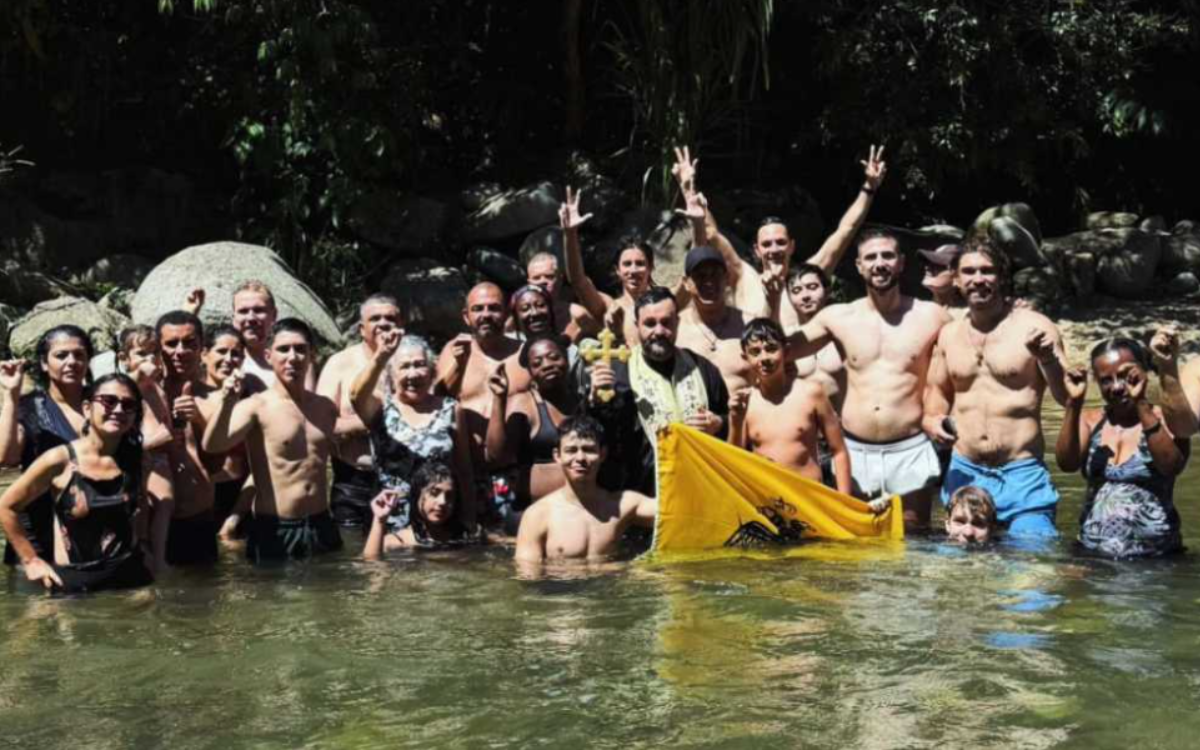
Orthodoxy is a faith that welcomes those who, after searching, knock on its doors. This is the message from Protosyncellus Simeon (Simon) Lopez, a native Colombian and head of the Holy Trinity Serbian Orthodox Parish in Medellín. On Epiphany, six young Colombians embraced Orthodoxy.
In an interview with the RTS online portal, Father Simeon explained that more baptisms will take place in the South American country and shared how he personally found the faith, what it is like to practice it in a city synonymous with Pablo Escobar, and the challenges he faces in his daily duties as a Serbian Orthodox Church missionary in Colombia.
On January 19, Epiphany, the Serbian Orthodox Church welcomed six new believers in South America. At an altitude of 1,310 meters, in the town of Bello near Medellín, Antioquia province, one young woman and five young Colombians received new names and, as they stated, found peace in the faith and tradition “preserved like a treasure for centuries.”
During the baptism, one young man took the name Justin, after Serbian Saint Justin Popović; two took the name Esteban (after Saint Stephen the First Martyr); others received the names Ana and Hoakin, after the parents of the Virgin Mary, and Santiago (Saint James), after the first bishop in Jerusalem.
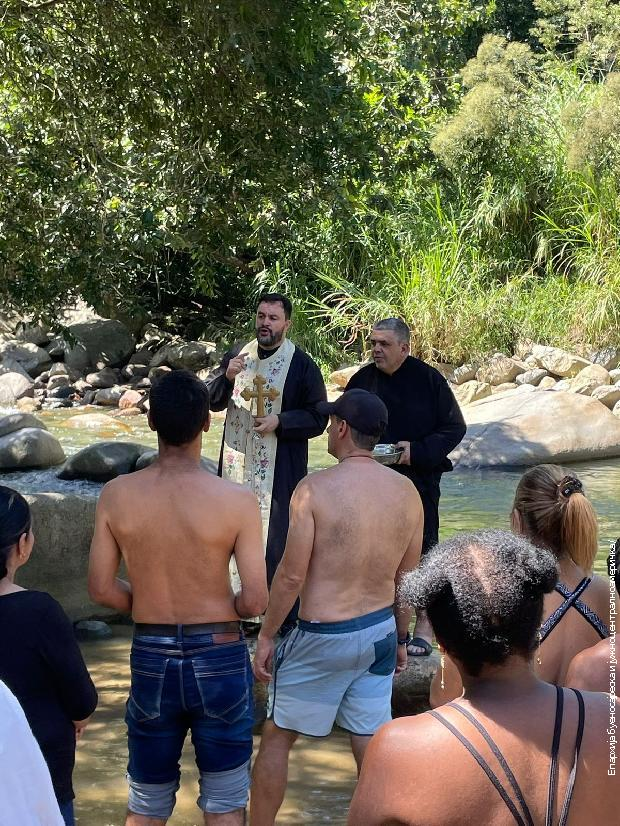
“This was Orthodoxy in dialogue with the Colombian landscape. Prayers in Spanish rose and mingled with the mountain air. Their journey does not end in the baptismal font—it only begins. Their arrival is the clearest proof that the light of Epiphany continues to shine, attracting those whose hearts sincerely seek the truth,” said Protosyncellus Simeon Lopez, the only Serbian Orthodox missionary in Colombia.
All six newly baptized youth came to the Church through their own search. “They began searching online. Some visited other churches claiming to be Christian but which were sects, and they sought in different ways where they could recognize or nourish their faith. They came to our Church,” Father Simeon said.
Weekly Catechism Classes
He explained that the catechumenate—the preparation for baptism—lasted six to eight months, with weekly Thursday classes on Christianity.
The first six baptized are part of a group of 18 young Colombians preparing for this sacrament. “These are young people who already understand what the Orthodox Church is, who already practice fasting, one of the hardest things for us Westerners. Other rules and liturgical norms include prayer, obedience, active participation in liturgical services, frequent confession… All are signs and symbols of a way of life that makes us true Christians and reflects the practices of our Orthodox faith,” the priest emphasized, noting that he himself converted to Orthodoxy at age 22.
A trained psychologist, Father Simeon discovered Orthodoxy “purely by chance.”
“I wanted to begin a search for a faith I could believe in and practice. A Russian traveler introduced me to the faith through stories about the desert fathers, and I superficially learned about the Orthodox Church. That began a small ‘calvary’ for me,” he recalled.
Seeking more knowledge, he contacted Orthodox communities in South America and received a response from a Serbian Orthodox priest in Argentina. Soon he visited the country and spoke with Metropolitan Amfilohije, founder of the Buenos Aires and South-Central American Diocese of the Serbian Orthodox Church.
“With him, I began to discover and learn about the beautiful faith that is the Orthodox Church,” Father Simeon said.

He then traveled to Montenegro, staying at Petar Cetinjski Monastery for his monastic tonsure and receiving his first monastic rank at Ostrog Monastery, where he served.
“I returned to Colombia in July 2014 as a hieromonk to open a Serbian Orthodox mission of the Serbian Patriarch here, in my hometown of Medellín,” he revealed.
From Pablo Escobar’s Legacy to a Focus on the Future
Bello, the town of half a million near Medellín where the six Colombians were baptized, has historically been associated with one of South America’s most powerful drug lords, Pablo Escobar. Escobar was killed in 1993, and Father Simeon recalls the violence of that period but notes that “history” is increasingly forgotten.
“Unfortunately, our country and city carry a stigma, a label connecting us to Pablo Escobar. He was a figure of the 1980s, and that’s all,” he said.
Born during Escobar’s peak, Father Simeon remembers the violence in Medellín’s streets and the day Escobar was killed. However, he emphasizes that the city has moved past this history and turned toward the future.
“Some still remember him, mostly foreigners who come seeking references to Pablo Escobar. But in Medellín, the culture and society no longer recognize him much,” he noted.
Father Simeon added that Colombians know little about Serbia, its culture, tradition, or history. “Their concept of Serbia is mostly tied to wars, NATO conflicts, internal divisions, and somewhat to Kosovo, though they have little reference to it,” he said.
Challenges of Missionary Work
The small Serbian community in Colombia poses challenges for spreading Orthodoxy. Social and economic factors are key obstacles. Many Colombians see the Orthodox Church as a “garage church,” meaning a small or newly established church.
Economic difficulties are significant. The parish operates from a rented house, and parishioners cannot cover all expenses to support the priest and the community. “Many hardships arise, as the Church always faces when establishing missions or bringing the Gospel to new lands. One must confront the reality of the time,” Father Simeon said.
Even seemingly minor tasks, such as obtaining icons, become complicated. “It is challenging, but rewarding to see that despite all difficulties and obstacles, there are always people who connect, learn, and stay. Some visit and stay; others visit and leave, but become friends of our Church,” he added.
Since 2014, the Holy Trinity Parish in Medellín and Protosyncellus Simeon Lopez, together with the “Dignified Colombia” foundation, have assisted the poorest families in Medellín. It has become a tradition to give gifts to children during Christmas through the “Christmas with Children” campaign.
MORE TOPICS:
Source: RTS, Foto: SPC