




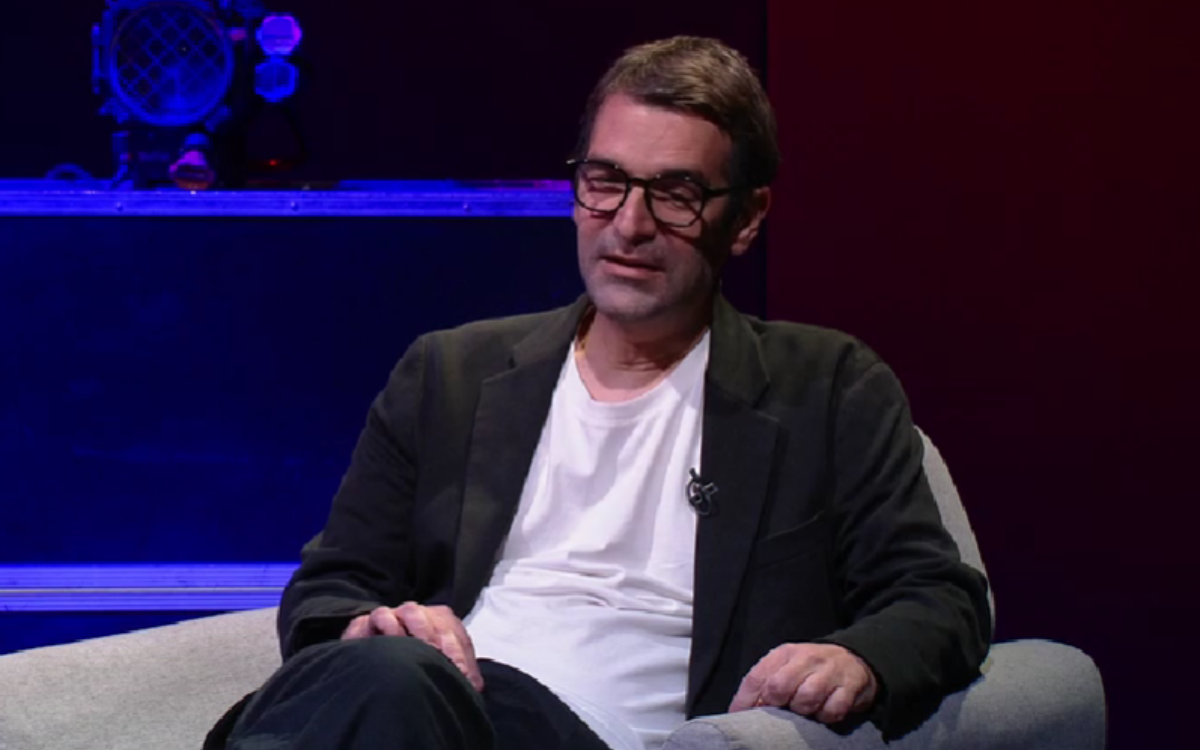
From the very first day, Professor Vladan Joler has been with his students, and due to police repression and the violation of the University’s autonomy, he resigned after 20 years of working at the Novi Sad Academy of Arts. He is part of the team that created a database of testimonies about the use of sonic weapons, as well as police brutality in Novi Sad on September 5th and 6th. He received the Silver Lion at last year’s Venice Biennale for his work on artificial intelligence, but he says – the question is who will control it in the end.
Professor Joler resigned from the Academy of Arts in September of this year. This decision was preceded by events and processes over the past year, and the resignation is “just the final drop” at the end of that process.
“On the one hand, everything that has happened over the past year was a very traumatic experience, but on the other hand, it is one of the most exciting experiences I have had in my life. What happened at the Academy is for me just the end of a process that contained various struggles, attempts, and adventures that we had. From the first attempts to organize a different union at the Academy, to the demands for the dismissal of the rector and the first joint organizations within the University of Novi Sad, where we connected horizontally,” he explains.
As he says, it is known that faculties are “closed” within their departments, and that networking is horizontal, but the student struggle has shown that a different way of acting, associating, and organizing is possible.
“One is that vertical way where you now go through those departments, make decisions, and then as a faculty you ask for something. That is the same system that we have known for years now. And when a space opened up for that horizontal networking among those different professors, in our case at the University of Novi Sad, it was completely unbelievable. In the sense that – you now work and meet people you’ve never met before, you create some processes together, informal networks. That was really a transformative experience, at least for me,” he states.
Because of this, he says, professors suffered pressure – on the one hand for supporting the students, and on the other because they tried to network in a different way.
“All of this led to a breakdown, and the peak of that repression happened on September 5th, when, after several weeks of occupation of the Faculty of Philosophy and DIF, force was used, and the rector entered the Rectorate after a year at the moment when 150 or 200 people were inside, the largest number of whom came there because they were seeking help and taking shelter from the tear gas,” he points out.
The entire night, which he witnessed at the Rectorate, was “extreme,” and he adds that the police officers held them as hostages.
“We took shelter in the Rectorate because it was unbearable outside from the amount of tear gas. On the other hand, at that time it was a space of safety, where we could provide assistance to other people. We inside practically watch what is happening outside, and from the inside it looks like a state of war. There are armored vehicles, tear gas is flying everywhere. We are inside, and somewhere around midnight we see how the police literally surround the entire building and then enter by breaking down the doors,” he states.
The first aid workers who were inside represented a “buffer,” while the others present in the building retreated to the amphitheater under the police onslaught, he describes.
“That moment where they stand, armed, scanning us with their eyes. Literally like a hostage crisis. They filmed us and individually checked our IDs. They searched us. All this time, we see our rector Madić passing by and smiling. Because of that repression, I wondered, ‘Is this really my company?’ ‘Is this really my director or rector?’ And when is the red line when you say this has gone too far,” he recalls.
When they recovered from the traumatic events, as he says, they started creating a database of testimonies about police brutality.
MORE TOPICS:
STATE DEPARTMENT SAYS: “Removing Russian control over NIS increases Serbia’s energy security”
Source: N1, Photo: Printscreen N1