




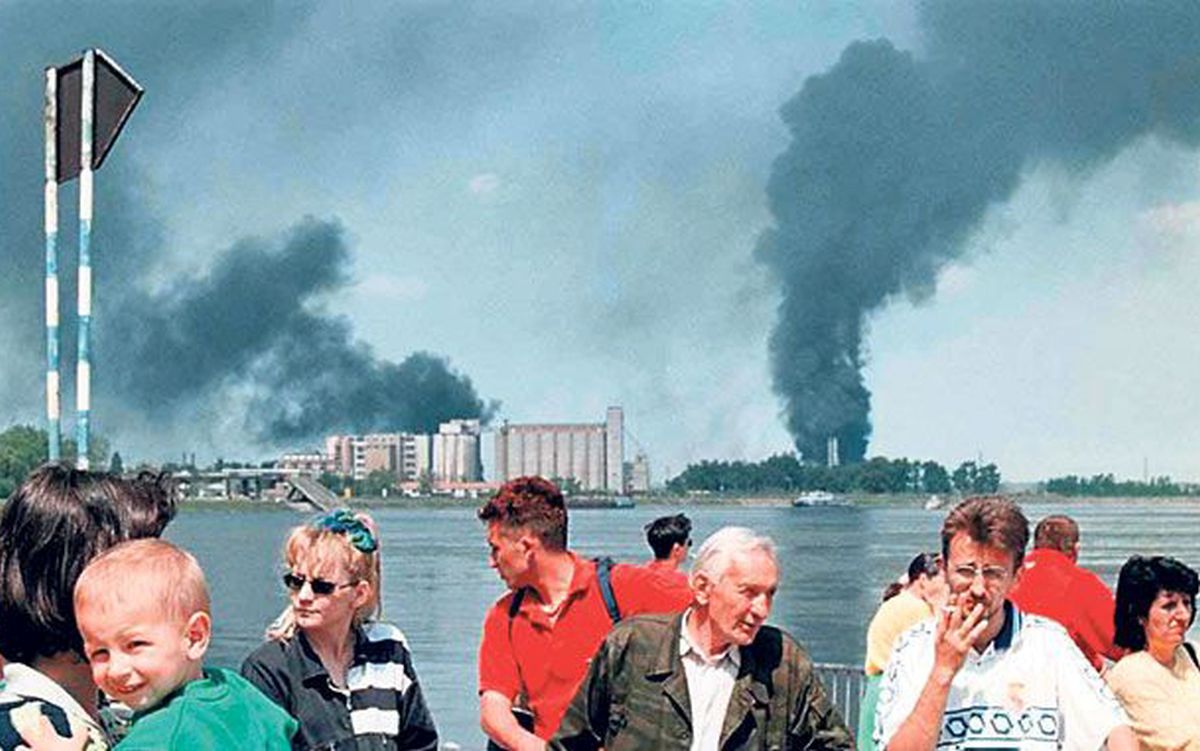
Exactly twenty-seven years have passed since the beginning of the NATO bombing of the Federal Republic of Yugoslavia; witnesses of that period still speak with sadness, but also pride, about the time when the people were at a great historical turning point. One of them is Ilo Mihajlovski, who kept a personal diary of all events during exactly 78 days of bombing.
-This diary was kept chronologically, by the minute, where the projectiles fell, what was happening every day. On the small territory of one sovereign state, over 800 tons of projectiles were dropped, Mihajlovski says for RINA.
As he points out, the bombing led by 19 of the world’s most developed countries, headed by the United States of America, was not just a military intervention, but an attack on the economy, infrastructure, and everyday life.
-Factories, hospitals, kindergartens, bridges, roads were targeted… And yet, the people then showed what they know best – how to unite when it is hardest. Citizens protected bridges and factories with their bodies; we showed enormous resistance, says Mihajlovski.
He particularly warns of the long-term consequences of using depleted uranium in bombs, which even today, according to experts and military reports, contaminates certain territories.
-Three strategic points still have high radiation today: Svetilija Hill above Vranje, the refinery in Pančevo, as well as the entire territory of Kosovo and Metohija. That will not disappear in the next hundred, or even 400,000 years, which is how long the presence of depleted uranium is estimated to last,” states Mihajlovski, relying on data from the former ABH unit from Čačak, which dealt with the analysis and research of the consequences.
In the end, he says that, despite everything, the spirit of the people was not broken.
-They did not manage to destroy what we had in our hearts. Even today, our people remember, but also endure.”
In Čačak, during the bombing, two kilograms of explosives were dropped per inhabitant, and the city on the Morava found itself a target of the aggressor more than 10 times, acting on targets with planes and cruise missiles. A total of 215 projectiles fell on the city area, six civilians were killed, while 22 were injured, and over 3,000 residential buildings were damaged.
According to data obtained from the local Inter-municipal Historical Archive, the first attack on Čačak was carried out as early as March 25, when one household was damaged in Katrga. The following day, three projectiles were shot down over the city, and the anti-aircraft defense acted against enemy planes, damaging one on that occasion. Material evidence was found near Zdravljak on Jelica.
In the territory of the Moravički District, 273 projectiles fell, of which 215 fell on enterprises in Čačak, Lučani, Ivanjica, and Gornji Milanovac, and 58 on buildings, meadows, and forests.
MORE TOPICS:
FORMER PORTUGUESE KFOR GENERAL: NATO violated law and its own principles by bombing Serbia!
SERB KIDNAPPED GREEK PROSTITUTE IN SWITZERLAND: Accused of multiple rape and abuse!
27 YEARS SINCE THE BEGINNING OF THE NATO AGGRESSION: Day that changed Serbia forever! (PHOTO, VIDEO)
Source: RINA; Photo: EPA / Viktor Vasin