




During the reign of Stefan Dušan Nemanjić, the Serbian state was the largest and most respected in its history. On the anniversary of his death, we remind you of the facts from the life of the greatest Serbian ruler that everyone should know.
A hero, a military commander, and a lawgiver, Stefan Dušan Nemanjić died today, December 20, 1355. Some consider him a conqueror, others a liberator. Historians claim that Serbs have been present in the Balkans for thousands of years before the founding of the Roman Empire, and that Dušan actually liberated Serbian territories from the Roman occupier, while others argue the opposite and classify this Nemanjić as a conqueror. One thing is certain: history will record that in the first half of the 14th century, the greatest Serbian ruler lived and was on the throne (1331-1355) at the time of the greatest European rulers – John of Luxembourg, Charles the Great, John V Palaiologos…
Dušan the Mighty died on December 20, 1355, still young and in the prime of his life, when he was preparing for a campaign to conquer Constantinople. The cause of death was never established, but there was talk of poisoning, stroke, and even epilepsy. In his eternal glory, we have singled out just some of the facts that every Serb should know about the controversial ruler of the Nemanjić dynasty.
EXILED TO CONSTANTINOPLE AS A BOY
Stefan Dušan Nemanjić was born around 1308 as the second son of Stefan Dečanski, the son of King Milutin. After Stefan was defeated in a conflict with his father, Milutin ordered in 1314 that he be blinded and sent into exile in Constantinople.

GOVERNED ZETA AT 14
Upon his return to Serbia, Dušan was practically a hostage at his grandfather’s court. After the death of King Milutin and the coronation of his father Stefan Uroš III (January 6, 1322), Dušan, at the age of 14, was given the region of Zeta to govern and was proclaimed prince. The nobility gathered around Dušan constantly urged him to rebel against his father and seize power.

DISTINGUISHED HIMSELF IN THE BATTLE OF VELBUŽD
Even as a young king, he commanded part of the army in the main attack at the Battle of Velbužd (1330), in which Serbia secured a leading role in the Balkans. Relations between the old and the young king deteriorated in January 1331. The nobility gathered around Dušan constantly urged him to rebel against his father and seize power.

TOOK POWER AFTER A CONFLICT WITH HIS FATHER
Stefan himself fought on almost the same spot with his father, King Milutin, for the same reasons as he was now with his son, only with the roles reversed.
Dušan attacked Stefan’s court in August 1331 while he was hunting near the fortress of Peterco with a few servants. Stefan on horseback flees with a few of his nobles, forgetting even about the queen and children, and Dušan’s pursuit catches him without resistance in the fortress of Petrič and imprisons him together with his entire family in the fortress of Zvečan.

LEGEND OF THE CURSE
Immediately after Dušan’s coronation, Stefan Dečanski died on November 11, 1331, and was buried in his endowment, the Visoki Dečani monastery. According to Danilo’s disciple, he died a natural death, while other sources claim that Dušan yielded to the pressure of the powerful nobility and approved, if he did not order, that Stefan be executed.
The death of Stefan Dečanski is also linked to the legend of the curse on Dušan’s later descendants, and later the entire Serbian state. Namely, when people came to kill him, Stefan cursed his son and his descendants. The curse did not come true on his son, but fell on his grandson Uroš, who lost the empire. This legend lasted for many centuries, and everyone remembered that curse when Prince Lazar and his warriors fell at Kosovo, and Serbia fell to the Turks.
ELEVATED THE SERBIAN KINGDOM TO AN EMPIRE
Seeing that the Byzantine Empire had weakened, Dušan decided to build an empire of a young nation full of strength on the ruins of Byzantium.
After all the conquests, Stefan Dušan decided to proclaim himself emperor. He made an agreement with Mount Athos, which had always considered the Byzantine emperor to be its only and legitimate ruler. King Stefan Dušan proclaimed himself emperor around Christmas (December 25, 1345) in the city of Ser. According to established customs, the Patriarch of Constantinople crowned the emperors in the East, and the Pope crowned the emperors in the West. Since he could not hope to be crowned by either of these two, the Serbian archbishopric was raised to the rank of patriarchy. Archbishop Joanikije became the first Serbian patriarch.
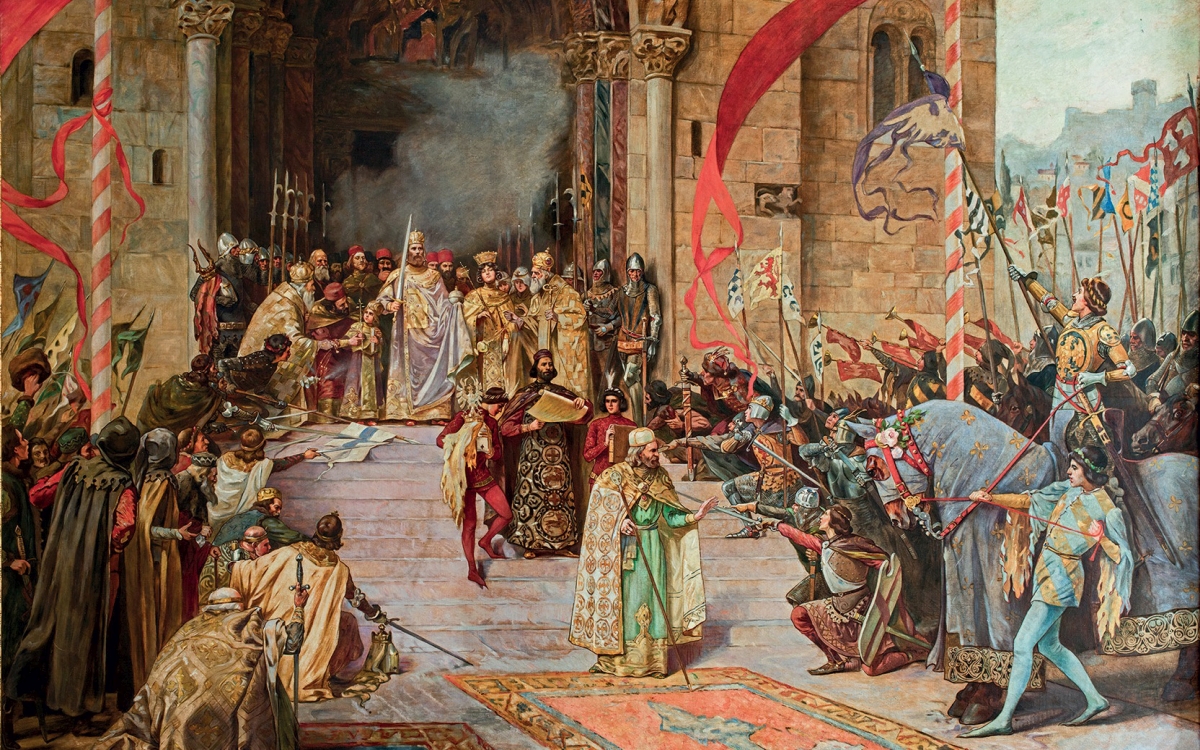
Stefan Dušan was crowned Emperor of the Serbs and Greeks, Bulgarians, and Albanians on Easter (April 16, 1346) in the Kale fortress in Skopje. The coronation was performed by the Serbian Patriarch Joanikije and the Bulgarian Trnovo Patriarch Simeon, with the co-celebration of the archbishops of the autocephalous Ohrid Archbishopric, which was once a patriarchate, as well as all the abbots of Mount Athos.

NOT EVERYONE RECOGNIZED HIS TITLE
The Ecumenical Patriarch Callistus excommunicated the Serbian emperor, patriarch, and hierarchs, thus excluding them from the Orthodox world. John Kantakouzenos recognized Dušan’s imperial title, but it was limited only to Serbia and that was the greatest recognition that the Byzantine emperor could give. Dušan’s imperial title was also recognized by the monks of Mount Athos, but on the condition that they mention the Byzantine emperor first and then the Serbian emperor in their prayers.
The Dubrovnik and Bosnian dignitaries addressed Dušan as emperor in letters sent to Serbia, but not in letters sent to Hungary. Hungary did not recognize the change in title and addressed Dušan as King of Raška. The same was done by the Pope. The Republic of Venice addressed Dušan and Uroš as emperors, but also as kings, adding the epithet Raxie et Grecorum (of Raška and Greece).
ENACTED A SEVERE CODE OF LAWS
One of the hallmarks of Dušan’s reign was his extensive legislative activity. A large number of charters were issued. The first part of the Code was proclaimed in May 1349 in Skopje and consists of 155 articles. The second part was adopted in 1354 and consists of 66 articles. The compilers are unknown, and probably came from the circle of courtiers whose service was connected with the judiciary.
The content of the Code tries to cover almost all areas of life, but different areas are given different attention. Serbia had a long legal tradition behind it, so some areas were relatively well regulated by law. The Code continued its life long after Dušan’s death.

WAS NOT A SAINT
Unlike the other Nemanjićs, he was not canonized by the church.
There are several possible reasons for this: because there is a suspicion that he ordered the murder of his father, because he was cruel, because he turned to Rome with the intention of neutralizing the Hungarian threat from the north and the Serbs were close to converting to Catholicism, or because he brought his wife Jelena to Mount Athos, which is strictly forbidden even today.

RESTS IN THE CHURCH OF SAINT MARK
He was buried in his endowment, the Monastery of the Holy Archangels near Prizren. After Dušan’s death, he was succeeded by his son, Emperor Uroš V, and the Serbian Empire gradually began to disintegrate. When archaeological excavations were carried out at the site of the monastery in 1927, a marble tomb was found in the southwestern part of the church, which was determined to be the emperor’s. The bones found in the tomb were scattered and, to the despair of the then regime, were transferred on May 18, 1968, to the Church of Saint Mark on Tašmajdan, where they rest today.
MORE TOPICS:
CENSUS RESULTS RELEASED FOR KOSOVO: Serbian and Orthodox population figures revealed!
“IT’S IMPORTANT THAT THEIR VOICES ARE HEARD”: Novak Djokovic supports the Serbian student protests!
Source: Mediji, Media: Wikimedia Creative Commons