




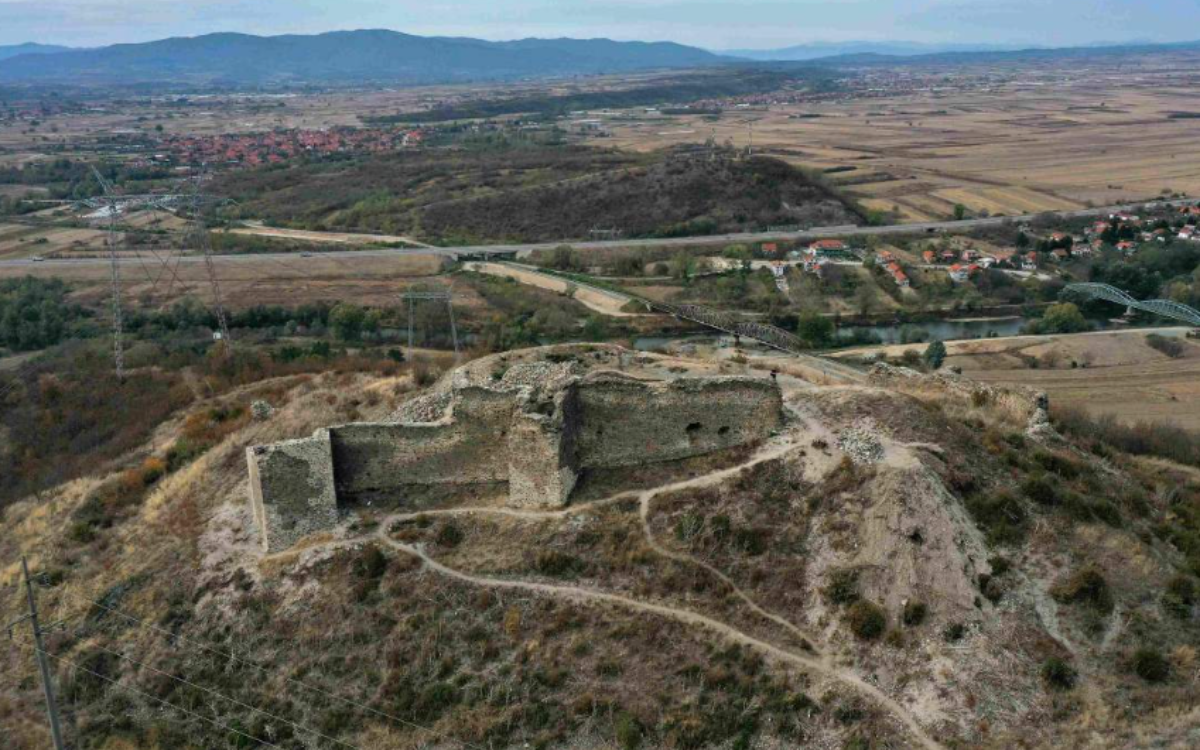
The remains of a previously unknown church structure were discovered during archaeological research of the medieval fortress of Koprijan (Kurvingrad), near Doljevac. The walls are made of stone bound with mud, which suggests that it may have been a log church, reports the Sve o arheologiji portal.
The Koprijan fortress is located on the slopes of Mount Seličevica, above the right bank of the South Morava River, not far from the confluence of the Toplica River. Thanks to its strategic position on the southern edge of the Niš Basin, it played a key role in controlling communications along the Morava Valley and in defending the approaches to the north during the late Middle Ages.
Plaster cross discovery
The most significant result of the research so far is the discovery of the church during the 2025 campaign. The remains of the structure were uncovered within Sector 5, in the area of the Upper Town. The walls of the building were constructed of stone bound with mud, which indicates the possibility that this is the substructure of a log church – a type of sacral architecture known in the late medieval context.
Particular attention is drawn to the finding of a cross made of red plaster, discovered in the central part of the central apse, which further confirms the sacral character of the building and indicates a clearly defined liturgical space.
Research conducted during 2025 also indicated the existence of several phases of use of the space within the fortress, testifying to its long-term and dynamic use, especially during periods of intense military conflicts with the Ottomans.
READ MORE:
Late 14th and early 15th century, the period of most intensive use of the fortress
Archaeological research at Koprijan has been carried out since 2022, organized by the Archaeological Institute, with financial support from the Ministry of Culture of the Republic of Serbia and the Municipality of Doljevac. In parallel with the archaeological works, a project for the conservation of the eastern rampart of the Upper Town is also being implemented, carried out by the Institute for the Protection of Cultural Monuments from Niš.
The research began in the zone along the eastern rampart, where it was confirmed that the fortress had been significantly devastated over the centuries, both by the extraction of stone for the needs of the local population and by illegal digging. Massive layers of debris material were recorded in the interior, reaching a thickness of up to two meters in some places.
During the excavations, a fire layer rich in soot and ash was identified, appearing more intensively along the ramparts and most likely representing the remains of a burned roof structure. Beneath this layer, a horizon rich in medieval archaeological material was discovered, dated to the late 14th and early 15th century, the period of the most intensive use of the fortress.
Site under state protection since 1947
The medieval fortress and town of Koprijan, also known in the literature as Kurvingrad, are located in the village of Malošište, in the municipality of Doljevac. The site has been under state protection since 1947, and in 1979 it was proclaimed an immovable cultural property of great importance.
The existence of the Byzantine city of Komplos is assumed at this site, which is mentioned in the chrysobull of Emperor Basil II from 1119/1120 as one of five places in the Niš eparchy. The city was restored in 1372, during the time of Prince Lazar, as a border fortress. According to an inscription that once stood above the city gate, Koprijan was built by Nenad, the son of kaznac Bogdan.
During the struggles for the Ottoman throne in 1413, the city was captured and destroyed by Sultan Musa, but was soon returned to Despot Stefan Lazarević. The fate of Koprijan during the 15th century was extremely turbulent. The city frequently changed rulers, until it finally, most likely in 1451, fell under Ottoman rule, after which it was no longer restored.
Long-term goal is partial restoration
Koprijan is a fortress of a regular rectangular layout, covering an area of about 30 ares, surrounded by a moat. Towers of square base were arranged along the ramparts, while the walls, especially on the eastern side, have been preserved to a height of more than 10 meters. In the eastern part of the fortress, the remains of a cistern are also visible. Although archaeological research is still in its initial phase, the results so far, especially the discovery of the church, confirm the exceptional scientific potential of this site. The long-term goal of the project is for Koprijan to be fully researched, protected, and partially restored, so that it can take its deserved place among the most significant medieval monuments of Serbia and become more accessible to the wider public.
MORE TOPICS:
PACT AGAINST SERBIA? Croatia, Albania and so-called Kosovo held a meeting on “defense cooperation”!
Source: Sve o arheologiji, Foto: P. Marjanović, nasledje.gov.rs