




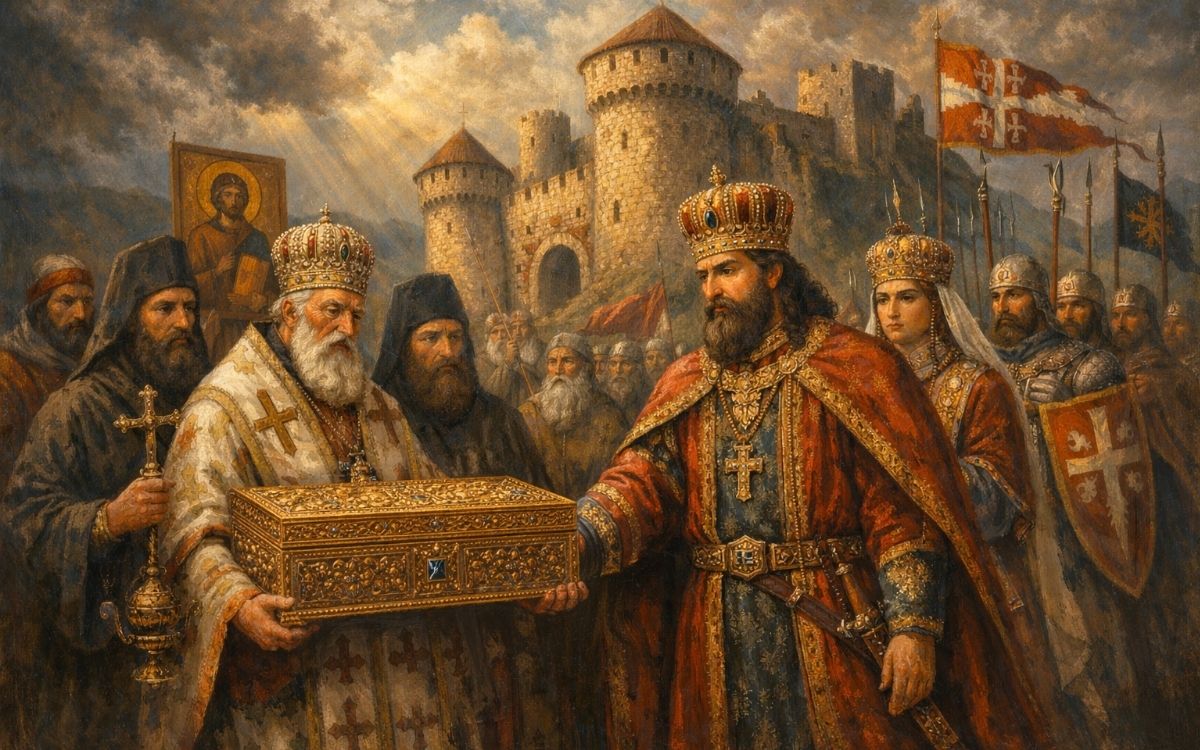
How Despot Đurađ came into possession of the relics of Saint Luke, with the goal of providing Serbia with a powerful heavenly protector
In the middle of the 15th century, the Serbian Despotate was in mortal danger from the Ottoman Empire, which was advancing from the southeast. Smederevo had already fallen in 1439 but was reclaimed in 1444 during the Long Campaign, led by the Polish-Hungarian King Vladislav and the Hungarian nobleman John Hunyadi. Đurađ was an active participant until the signing of the Peace of Szeged, which Vladislav and Hunyadi violated, continuing the war against Turkey and suffering a catastrophe at Varna.
In such a situation, and with the goal of providing the Serbian state with a major heavenly patron, Despot Đurađ brought the relics of Saint Luke—apostle, evangelist, and the first iconographer—to Serbia in 1453. How the relics were obtained, and the ceremony that accompanied their arrival in the country and the capital of Smederevo, is one of the most interesting among those little-known stories of Serbian history.
Saint Apostle Luke, who passed away at the fine age of 84 in Boeotia, central Greece, rested in Thebes until the year 357, when he was transferred to Constantinople, along with the relics of the holy apostles Andrew and Timothy, during the reign of the semi-Arian Emperor Constantius II. He remained there for the next eight and a half centuries.
When the Crusaders captured Constantinople in 1204, a French knight claimed Luke’s relics, boarded them onto a ship, and set off for his homeland. A powerful storm caused a shipwreck off the coast of Lefkada, in front of the then-Epirote city of Rogos, so the knight, respecting the will of the saint, left the relics to the master of the city, Karlo, in exchange for 600 ducats and some other expensive gifts.

The miraculous relics guarded Rogos and brought it prosperity for 250 years. Word of this reached the Serbian Despot at the beginning of autumn 1448, during the time of the Second Battle of Kosovo fought between the Hungarians and the Turks, while Đurađ and his son Lazar were apparently busy with a short-lived war with Bosnia. At that time, an angel-like old man appeared to them and advised them to obtain Luke’s relics in order to save themselves from God’s wrath.
Đurađ first dedicated himself to verifying the authenticity of the relic, which was of crucial importance, especially after 1204, when a truly large number of items of dubious provenance flooded the western half of Europe. In favor of Luke’s relics was the fact that after that shipwreck, a scroll was allegedly found with them—a type of certificate guaranteeing authenticity—but that was not enough.
From a letter by Đurađ’s granddaughter Marija, the widow of King Stefan Tomašević of Bosnia, sent in 1463 to Duke Ivaniš Vlatković in reaction to the Venetian challenge of the relics’ authenticity, we learn that the Despot turned to the Patriarch of Peć, Nikodim II. Receiving a positive response from him, as well as a referral to the Protos of Mount Athos as the most authoritative instance on the matter, he sent Metropolitan Atanasije of Smederevo to Athos.
Having received confirmation there as well, the matter could proceed. The Despot sent an embassy to Adrianople to ransom the relics from Mehmed II. It is believed that the success of this undertaking was aided by “Sultana Mara,” the Despot’s daughter and the Sultan’s stepmother, but even she could have done nothing if the Sultan had not been satisfied with the ransom: from a letter by the Prince of Split, Andrija Veneri, sent to the Venetian Doge in 1463, which cites Marija of Bosnia, we learn that it involved 30,000 ducats.
But from the already mentioned letter by Marija, in which she asks that her findings not be relayed to the Venetian Signoria so that she might have a better negotiating position, we see that the Despot managed to halve the price, and that the other 15,000 ducats were returned to him. It seems, however, that those other 15,000 were used to cover the costs of the embassy and the transfer, as well as personal gifts to the Sultan (separate from the ransom itself), the commander of Rogos, the Protos of Mount Athos, and others who had to be “honored.”

How significant the sum of 30,000 ducats was can be concluded from the fact that the Hungarian King Matthias Corvinus offered Marija three to four castles in permanent ownership in exchange for Luke’s relics!
The Serbian embassy, which set off for Rogos in the late autumn of 1452, was led by Metropolitan Mihailo of Prizren, Abbot Venedikt of Lešje, and Đurađ’s advisor, the boyar Stefan. The journey, due to weather conditions, lasted twenty-eight days, but the time was the least of the problems.
The Greeks of Rogos had different views on the nature of the sale that took place in Adrianople: the fact that the Ottoman ruler sold Đurađ what was theirs, and not his, did not mean they would cooperate in the transfer of ownership. And indeed, upon learning of the Serbs’ arrival, the people of Rogos hid their beloved and revered relics in the city tower, intending to prevent what they saw as a robbery.
However, with the help of the Turkish city commander, “greased” with ducats, our boys, who were accompanying the delegation, slipped into the tower through a secret passage and stole the relics, then fled at top speed ahead of the pursuit that started after them — in professional literature, this is called “furta sacra,” sacred theft, and we were not the first to carry it out, though we may have been among the last, considering the time when this took place.
Do not for a moment doubt that we justified the theft as the will of the apostle himself. From the “Belgrade Miscellany,” likely created in the period 1453–1456, we learn that a miracle occurred on that occasion: the embassy, fleeing with the holy relics, crossed a river without getting wet. The author of the mentioned manuscript explicitly compares this to Moses crossing the Red Sea and the carrying of the Ark of the Covenant across the Jordan.
However, since the medieval rite of transferring relics from one place to another had precisely detailed stages, this method of acquiring the relics meant the absence of the first, which was called the “solemn departure.” Thus, the transfer of Luke’s relics, the last in the Serbian medieval state, began contrary to both our own and general reliquary practice. Nevertheless, the rest of the ceremony was magnificent in every sense…
MORE TOPICS:
Source: Danica Popović, “Pod okriljem svetosti: Kult svetih vladara i relikvija u srednjovekovnoj Srbiji”; Photo: ChatGPT prompt by Serbian Times