





When she strums the strings and sings to the gusle, time seems to stand still. The young artist Bojana Peković (27) has brought the gusle to the world’s music scene. By combining Serbian epic poetry with contemporary musical genres, she has managed to present our traditional instrument from Finland to America, from Switzerland to Russia, from Qatar to Canada. While she plays, the sound of the gusle echoes like the echoes of centuries, and her song carries an ancient yet contemporary message.
She grew up in Kraljevo, in a family that nurtured a love for Serbian epic poetry and the guslar heritage. At the age of five, she started playing the piano, and at six, she began playing the gusle, which would become her trademark. Bojana’s path to success was not easy. After graduating from high school, she enrolled in Ethnomusicology in Belgrade, but soon decided to continue her education abroad. At the prestigious Sibelius Academy in Helsinki, Bojana introduced the gusle into international artistic circles. After completing her undergraduate studies, she successfully completed her master’s degree in late 2023.
“After high school, I tried to continue my studies in Belgrade at the Department of Ethnomusicology at the Faculty of Music, where I completed my first year,” says Bojana for “Novosti”. “I quickly realized that I wasn’t satisfied, because I needed more work on developing my performing skills, and the course didn’t cover that. The decision to go to Helsinki will later turn out to be one of the best I’ve made in my life. In Belgrade, there is still no department where traditional instruments could be studied and performance in a practical, less theoretical sense, nor is there a department for global music that would open up the possibility of an academic approach to numerous other forms of music-making.”
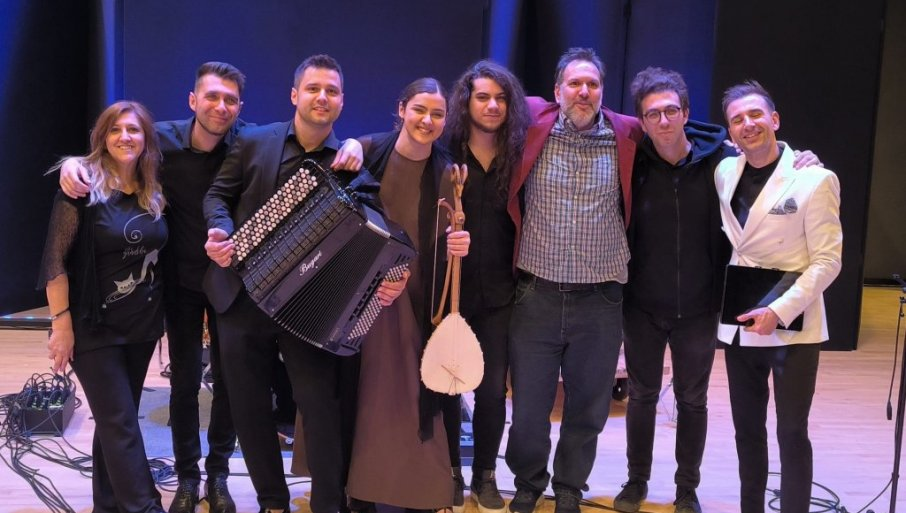
Thanks to Bojana, the gusle arrived at the Sibelius Academy.
“The Department of Global Music in Helsinki allows students from all over the world to study and bring their own artistic identity with them. In my case, singing with the gusle,” says Bojana. “The range of students in my class was large: from the gusle to beatboxing or anything else a person had seen or not. A way was found for students who enter the academy, four to six students, to be maximally involved in all teaching activities. I used the gusle in every subject as my main instrument. That’s how we exchanged knowledge. Colleagues could learn about my instrument, my country, its origin, and I about theirs. We were taught by prominent professors from various parts of the world. For individual lessons and mentors, I chose professors who play similar instruments.”
Among them was Adriano Adewale, born in Brazil, who plays the berimbau, an Afro-Brazilian one-stringed instrument.
“There were no gusle professors at the Academy, but I could take lessons from Serbia because there is a possibility to include people who are important for our education according to our needs,” says Bojana. “I used that for my master’s thesis. Professor Iva Nenić from Belgrade was my mentor for the topic I was dealing with. She studied female guslars and their place in musical performance in Serbia. The professors, their vast experience, and their attitude towards us helped me a lot to understand myself, my music, the potential of my instrument. At the Sibelius Academy, I was the only one with the gusle. It would be great if other guslars went there too!”
“One of the most beautiful performances in Finland was my master’s concert where I combined the gusle and electronic music with Tim Kaukolampi. That evening was special and I will always remember it. The gusle carries memories, knowledge, experience, the depth of past centuries, but it is also a great inspiration for contemporary and future achievements. I love playing from epic poetry to experimental tendencies. Art and music are part of my imagination and a conversation with many impulses that I feel within myself.”
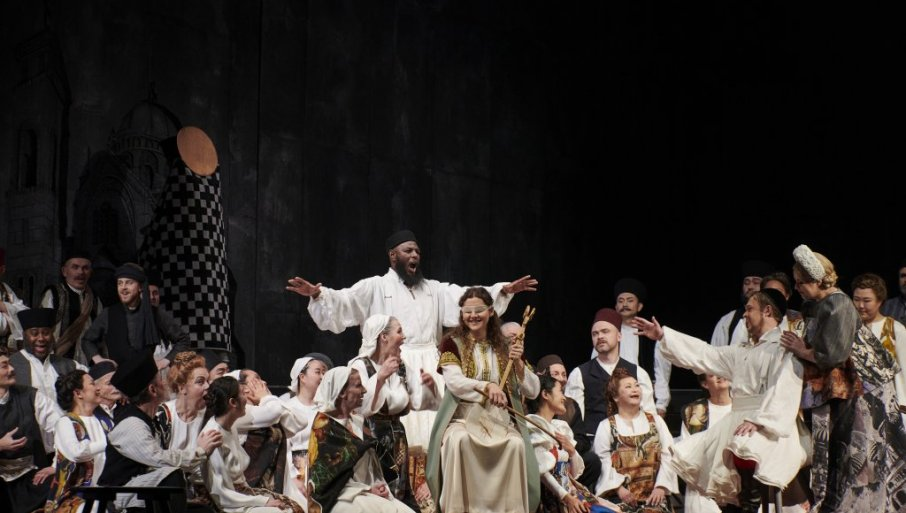
After her master’s degree, Bojana spent several months in Germany, as the opera La Montagne Noire (Black Mountain) was performed at the Dortmund Theater. Bojana participated as a woman guslar.
“That project is important for our people, for presenting the heritage of our region, but also for singing with the gusle,” she says. “Augusta Holmes, a French composer of Irish origin, wrote an opera in 1895 inspired by epic poetry and guslars. It also features Saint Sava, who symbolically protects and spiritually guides his people. My string brings to life memories of a story that tells of two brothers, love, deceit, and war.”
However, Bojana feels best in Kraljevo:
“It’s incredible how much a person loves their hometown and how much that connection and love for your city means in life. I’ve been living in Belgrade for a year now. I’m here for now, and maybe I’ll stay permanently. I missed life in Serbia, my family, friends, and my group “Art femili” with whom I create. Last year we were in the USA. We performed at Emory University in Atlanta and presented the gusle to the American audience.
This spring, Bojana will present a project for children that she is working on with her cousin Relja Jakovljević: the gusle will come to life in a new and interesting way on a CD.
READ MORE:
Source: Novosti.rs, Photo: Privatna arhiva