




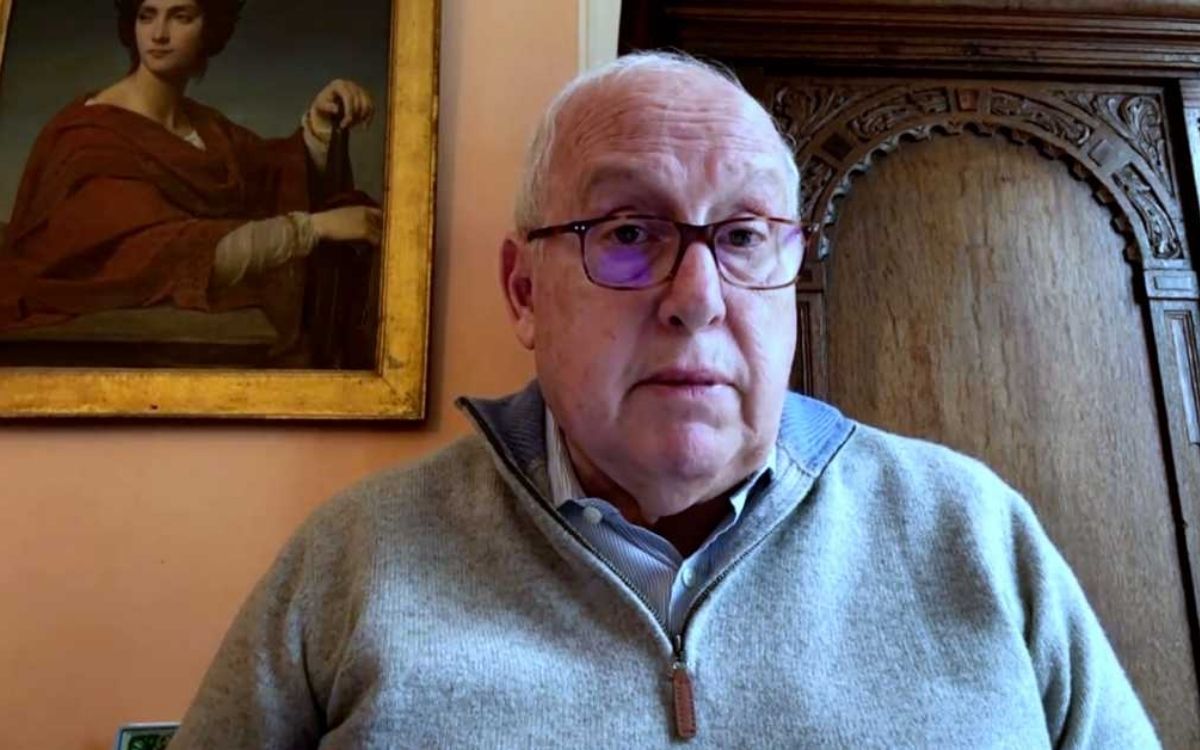
The commander of French special forces within KFOR in 1999 and former commander of the elite Parachute Regiment within the Foreign Legion, retired colonel Jacques Hogard, believes that the NATO aggression against the Federal Republic of Yugoslavia in 1999 was a violation of international law, and that its effects are still visible 27 years later through a systematic attempt at the ethnic cleansing of Serbs from Kosovo and Metohija. Commenting on conflicts in the Middle East, Colonel Hogard considers it “yet another senseless war,” and that the EU’s resistance to joining it will contribute to peace.
“My comment is simple: it is a war of aggression launched by NATO, the armed wing of the USA and Germany, which is a model NATO student and which today is in fact almost the sole inspirer of the European Union and hatred toward Yugoslavia. Hatred toward Serbia enabled the launch of that aggression, whose sad results we see 27 years later. The region is unstable. A puppet republic was created out of Kosovo and Metohija. And that puppet republic has the goal of ethnically cleansing Serbs, and as a consequence also causes the departure of part of the Albanians from Kosovo, who mostly go toward Western Europe. Therefore, this is a complete failure of that aggression, it is a violation of international law. It is a situation which, from a political, social, humanitarian standpoint, was a catastrophe,” Hogard said in an interview for the RTS internet portal.
He notes with regret that France also participated in the aggression against the then FRY, explaining it by the desire of the authorities at the time to “move closer to NATO contrary to the policy of Charles de Gaulle.”
“France, unfortunately, took part in that aggression against Serbia, forgetting the centuries-old friendship that bound us, of course since the Great War 1914–1918. And we can even go back to the Middle Ages, to Helen of Anjou, to the Battle of Kosovo, etc.,” the retired French army colonel states.
Recalling that around 3,000 people were killed during the NATO bombing, he emphasizes that the USA also used depleted uranium munitions at the time.
“That is then a war crime,” Hogard stresses.
He recalls that a similar situation with the use of prohibited weapons and ammunition is repeating today in the bombing of cities in Lebanon.
“In Lebanon today, the Israeli-American aggression is using phosphorus bombs that are completely banned under international war conventions,” he points out.
A dramatic situation for Serbs in Kosovo and Metohija
Asked how he comments on the current position of Serbs in Kosovo and Metohija and what has changed since the time when he led the contingent of French special forces during KFOR’s entry into the territory of Kosovo and Metohija, the former legionnaire says that for all 27 years it has been a “dramatic situation” for Serbs, which has been evident in recent months and years.
“It is a permanent persecution of Serbs. It is an intention to expel the last Serbs who remained in Kosovo, through fear, intimidation, violence, terror, administrative persecution. I am referring to tariffs on products imported from Serbia, to vehicle license plates… All reasons are used for the persecution of Serbs in Kosovo today. Therefore, over 27 years of that regime, we see that the Serbian population has literally disappeared from Kosovo. Certain footholds have remained, of course, there are relatively preserved areas of shrines,” Hogard says, highlighting the monasteries of Gračanica, Dečani and the Patriarchate of Peć.
He says there are other important places for Serbs that are still under international protection due to, as he states, the “obsession to expel the Serbs.”
“The madness of the violent rule of the Albanians effectively in Kosovo, Mr. Albin Kurti and others, represents an obsession. They want to expel the last Serbs from Kosovo. It is an obsession. For 27 years. There was the pogrom in 2004, but regardless of that, there is a whole series of constant actions aimed at agricultural estates, at isolated farms, at isolated villages, at schools, in order to terrorize the Serbian population as much as possible so that they would leave. That is the real situation in Kosovo today. Very far, very far from the model democracy as Mr. Kouchner or Mr. Bernard-Henri Lévy liked to say. Europe, for me, died in Pristina in 1999,” Hogard emphasizes.
Destabilization of the Balkans
He claims that the bombing of the FR Yugoslavia in 1999 did not destabilize only Kosovo and Metohija, but the entire Balkans.
“We see especially what is happening in Kosovo today, but we also see what is happening in Bosnia and Herzegovina. We see what is happening in Republika Srpska. We see the pressures being exerted on Serbia. It is clear that the Balkans have not regained peace. That aggression from 1999 against Serbia represented a violation of international law, it represented a violation of the UN Charter and UN Security Council Resolution 1244, which is still in force,” Hogard specifies.
He adds that the NATO Charter was also violated in 1999, because the Alliance at that time, for the first time, “became a war machine” instead of a defensive force.
“If I should speak about the consequences on a global level, on a European level first of all, the war in Ukraine since 2022 is a direct consequence of the war against Serbia. NATO in 1999 was transformed from a defensive alliance into an offensive alliance. That materialized through NATO’s expansion to the east. An example in the region is Montenegro. For me, Montenegro’s accession to NATO is something completely incomprehensible and even scandalous. But if we go further, if we broaden the view, what is happening today in the Middle East is a consequence of what happened in 1999. The USA, which is the dominant force of NATO, wants to remain the dominant force of NATO. Otherwise, it would rather abolish NATO. But the USA wants to maintain its world supremacy, its global hegemony,” Hogard believes.
He emphasizes that examples supporting this claim include US actions in Venezuela, and then Iran, Lebanon and Palestine.
“What I want to say is that American power does not accept sovereign and independent countries. Essentially, what happened in 1999? An incredible international coalition, gathered under the NATO flag, carried out aggression against Serbia because one of its provinces, Kosovo, was also the subject of an armed rebellion of foreign origin,” the French colonel stresses.
Events in the Middle East
He is convinced that something similar is happening today in the Middle East.
“Unfortunately, in the internal affairs of the Middle East, we have the same intervention of the USA and its regional ally Israel. Whether it is Palestine, the West Bank, the Gaza Strip, where terrible things have happened, whether it is Iran, which is a great sovereign and independent power, whether it is Lebanon, that unfortunate Lebanon with which we French are very closely connected. King Saint Louis was the protector of Christians in Lebanon. He even decreed that the Maronite community be an integral part of the French Kingdom. And here is where we are today,” Hogard says.
As a good connoisseur of the Middle East, he describes the current situation in that part of the world as “yet another senseless war.”
“For me, the war in the Middle East today is yet another senseless war, like the war in Ukraine, like the war in Yugoslavia. It is a war launched mainly by the imperialism of the United States. It is American imperialism that stands behind it, joined by Israeli imperialism. The pretext is that Iran was in the process of acquiring nuclear weapons. That is a lie. Iran, if it had wanted to acquire nuclear weapons, would have done so. It began doing so during the time of the Shah of Iran, before the Islamic Revolution of 1979. And the authorities of the Islamic Republic of Iran prohibited the development of nuclear weapons at that time. What happened later is that Iran wanted to develop its industry based on energy resources that are superior and clean, which civilian nuclear energy can provide. And everything is based on that,” Hogard believes.
Another goal of the war, he adds, is the desire, on the one hand, to create a Greater Israel, and on the other hand the aspiration of the USA to control the vast gas and oil resources of Iran.
“The situation from a military standpoint is extremely serious,” Hogard emphasizes.
He believes that the question of control of the Strait of Hormuz is currently essential for further developments in the Middle East, but also claims that the blockade of energy flows through this route is not solely the responsibility of Iran, but also of major insurance companies that do not want to take risks and insure companies transporting oil.
“Iranians contribute to the control of the Strait of Hormuz, but in reality, the oil companies that insure oil companies transporting oil through the Strait of Hormuz do not want to insure them given the risk of war. Therefore, we are in a situation that is extremely complicated and extremely tense. But I still have good hope that at some point reason will prevail with Mr. Trump and that he will say to the Israelis, otherwise very exhausted by the Iranian response: ‘Now that is enough, we are returning to the status quo, we are at least returning to a ceasefire.’ That is what I think about it,” Hogard says.
Diverging voices in the EU a path to peace
Asked how the stance of a majority of EU member states that do not want to participate in the American-Israeli military operation should be understood, Hogard says that the key problem is that there is no “European position.”
“Interests are too different, we see it every day. Today there are very strong tensions between Germany and France, and the British are playing their own game. And here we have really seen the first clear and very determined reaction from Spain, which is against this war. Prime Minister Sánchez, whose views I do not always share, this time had a very wise, very intelligent and very brave stance. As soon as he decided that Spain would not support the war, the American-Israeli aggression against Iran and Lebanon, Mr. Trump immediately threatened sanctions and isolation,” Hogard states.
He adds that France’s position regarding the current crisis in the Middle East is far more complicated.
“Mr. Macron is a figure who, as he himself says, at the same time wants a bit of everything. He simultaneously wants to remain a friend of the Americans and Israelis, while at the same time he wants to remain a friend of the Saudis and, at the same time, he wants to remain a friend of the Lebanese. If he still thinks so. Therefore, he has a more moderate position compared to Germany, for example. But he has a less clear position than the Spanish prime minister. It is clear that in all this there is no position of the European Union. And that is because, I deeply believe, the European Union, in fact, does not exist,” Hogard believes.
He is convinced that political elites in Brussels want to establish a federalist position and join military operations of the USA and Israel, but that he hopes most EU countries will resist.
“That is an element that will influence, I hope, in favor of peace at some point. If European countries refuse to engage in an operation under the NATO flag in the Strait of Hormuz, I think that is an argument in favor of peace,” concludes former French military officer and commander in the Foreign Legion Jacques Hogard.
MORE TOPICS:
LEST WE FORGET: The March pogrom in Kosovo was deadly for many Serbs, while thousands got expelled!
Source: RTS; Foto: Printscreen RTS