




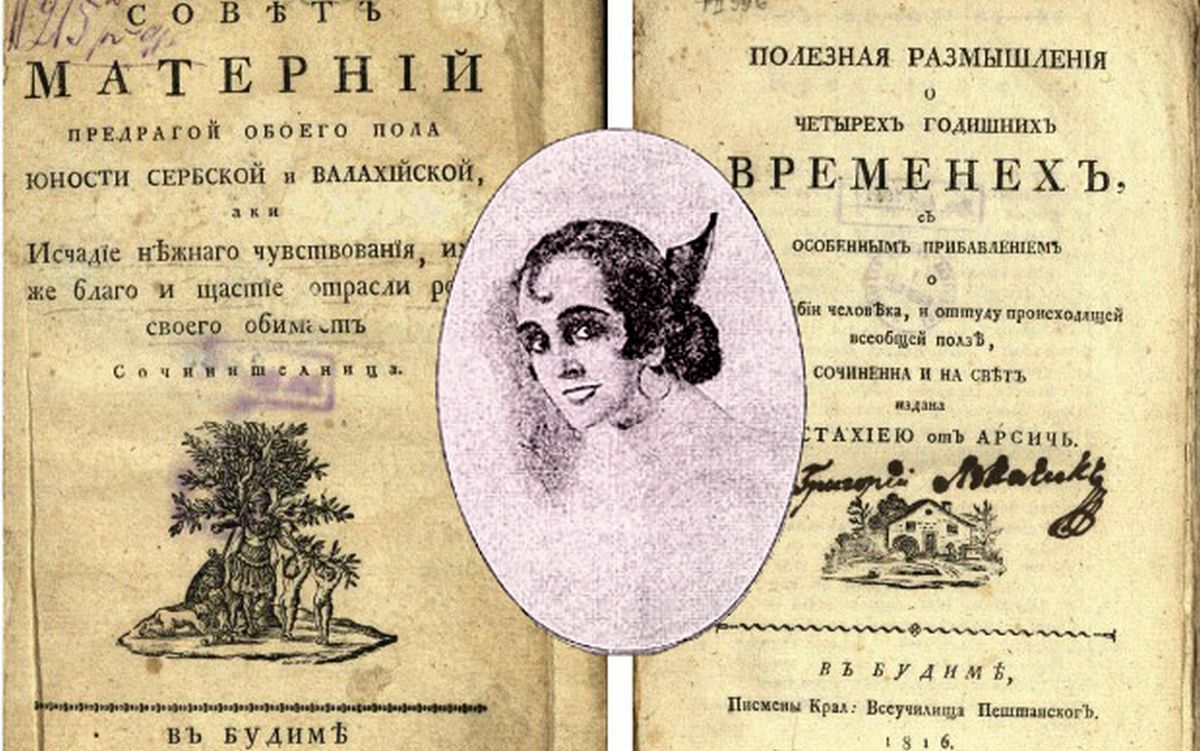
She’s often referred to as “the first Serbian poet after Jefimija,” but in her 66 years, she packed at least three biographies – one literary, one as a true and genuine philanthropist, and a third – as a woman.
If a survey were conducted among the more educated part of our nation, asking them to list the names of women who have entered the anthologies of national literature in the last two centuries, most would primarily mention Desanka Maksimović and Isidora Sekulić. Those with a bit more insight and knowledge would recall Anica Savić-Rebac, and from the Romantic era, Milica Stojadinović Srpkinja. The list would most likely stop there.
At the same time, contemporary writers, screenwriters, and directors seem to be increasingly turning to history, seeking personalities from national culture about whom something could be filmed or written. Although in the majority of cases these are men – let’s remember the romanticized series about Laza Kostić, the film about Petar Kočić, or Stevan Sremac’s “cameo role” – it’s likely that at some point, some of the great women of our literature will also get their turn.
It’s fascinating how no one has yet noticed or done anything about a name that, without comparison and above all, offers itself for such work. Even in an imagined screenplay, with the usual dramatic excess of fictionalization, the biography of this person would still seem unrealistic, completely fabricated, and exaggerated, like something out of a novel. Yet, this name and this biography, still largely unknown outside of expert circles, are completely real and thus even more astonishing.

The First of Her Gentle Sex in Serbian Literature
Born on March 14, 1776, in Irig, Eustahija Arsić, a Serbian writer, possesses a biography that even significantly more modern and advanced cultures of that time couldn’t boast. Marked as the first contemporary Serbian poet and in the usual, regularly mentioned parallel that serves as a metaphor for our four-century historical misfortune, she is referred to as “the first Serbian poet after Jefimija” – thus, from the Middle Ages. As if in a tremendous personal and general cultural rush, she wanted to make up for centuries of backwardness of an enslaved and humiliated civilization. In her 66 years, Eustahija Arsić packed at least three biographies: one literary, one as a true and crucially important philanthropist, and a third – as a woman.
She spent her childhood in Irig, a place she herself wonderfully described as where exceptional people “who are outside the world” are born, and she grew up in Arad, one of the more significant cities for our history and culture. She was born into a family where education was clearly valued, all in the spirit of the Enlightenment whose ideas were known and spread by more learned Serbs – those from across the Sava and Danube, of course, not those from then still subjugated, Asian-backward Turkish Serbia without a single school.
Such foundations, in which the future poet was educated in natural and social sciences, in languages – she spoke at least four – and, of course, in literature, created not only broader personal education but also the possibility of free, or rather, free-thinking, individualism. From which it was just a step to awareness of the position of women and future self-engagement and advocacy for education and schooling – for “the upbringing of women.”
Later, as an adult, she became acquainted with key works for her – she read Jovan Rajić and Atanasije Stojković, and as with almost all future intellectuals of that generation, certainly the most important encounter was with the writings and ideas of Dositej Obradović, for whose works she was one of the first subscribers.
She started writing late and publishing even later – it wasn’t until 1814 that she published, anonymously, her first work, “Maternal Advice” (“for youth of both Serbian and Wallachian sexes,” full title), a didactic work in the spirit of the time, combining verse and prose. In addition, she published another book, “Useful Reflections on the Four Seasons of the Year,” also in the then-style of cumbersome titles. After that, she didn’t write much more, and her works gained more fame from being written by a free-thinking and educated woman than from actually being read.
By her death in 1843, she was almost forgotten. Her plea in verse, a desperate begging not to be forgotten, is terribly poignant: “Remember me with songs, muses’ darlings, for I need the sacrifice of gratitude.” This first, painful “Remember me with songs” will immediately remind anyone who still remembers our modern poetry of Trifunović’s verse “Remember me by my songs…”
The Philanthropist
Unfortunately, with Eustahija Arsić, it wasn’t so for a long time, and perhaps not at all, and the reasons for which she is remembered today are mostly extra-literary. Moreover, she wasn’t even remembered, but rather literary historians and editors like Andra Gavrilović and Ilija Ognjanović Abukazem began to rediscover her only towards the end of the century, at the end of Romanticism.
It wouldn’t be entirely fair or responsible to place all the blame for this long-standing neglect of the writer on an undoubtedly misogynistic society and culture. The reason for her lesser renown, besides the gender issue, most likely lies also in Eustahija’s writing style and, above all, her language. She wrote in Slavonic-Serbian, the language of Serbian enlighteners close to Dositej, that is, in a style that attempts to make a step towards the vernacular but retains an archaic, hybrid character and the learned pomposity of an already outdated style and vocabulary.
After the national revolution, during her lifetime, came the time of a linguistic revolution and a Copernican shift of the Serbian and South Slavic languages – or, with an accurate metaphor: the time of the Vuk’s turning point. It’s interesting then that Vuk showed open respect and praise for Eustahija Arsić. However, without any intention of being malicious, the reason for this certainly didn’t lie in the quality of her writing, and especially her style and language – by their characteristics, they belong to everything that the great Vuk Stefanović fought against. The powerful and noble reason lay elsewhere.
This is the second part of Eustahija Arsić’s biography – that of a fantastic philanthropist. And precisely in the case of Vuk, who was always struggling with money, lies the most beautiful and touching example of Eustahija’s generosity. Vuk, in his Herzegovinian sharpness, flattering her as “the grateful and highly educated lady,” begged her to find subscribers for his collection of folk songs, that treasure of our people and culture today. Eustahija Arsić gathered about a hundred names of subscribers who duly paid their share. In a poignant epilogue, it was revealed that she had sold only a few copies of his book, and she bought and distributed all the rest herself, spreading the artifact of the revolution of the apostle of the new language – this very one we are writing in now.

Eustahija the Noble Arsić
Her third biography within the same life, the one that would undoubtedly be the most appealing and provocative material for an imagined film about her life, falls into the murky area where the public, general, social and the private, personal female, moreover erotic and sexual, intersect.
One cannot even imagine what it must have been like in that era, on the eastern edge of a conservative monarchy, for a woman to marry three times and separate from two men. That would have been a scandal of indescribable proportions even in a Paris of that time, let alone in our regions – moreover, in the closest ones to us, in Croatia: Eustahija’s first marriage was to a merchant in Koprivnica, the second to a wealthy merchant in Karlovac, the third in Arad to the nobleman Sava Arsić, whose surname she would take and from that moment on she herself would become Eustahija the noble Arsić.
For such a woman, from high society, to leave a marriage and even do so unpunished, without stigma (except symbolic), that must have been a unique occurrence of the time. Not only from the petty bourgeoisie, but condemnation also came from fellow writers; thus, the confused Joakim Vujić writes somewhere that Eustahija was “very unhappy in marriage,” while according to another source, “infidelity was not alien to her.” When Vujić’s “Autobiography” was financed by her own money, this divorcee would then become “grateful until her last breath” for him.
It’s difficult today to empathize with the context of the time in that sense, but it’s quite easy to imagine what a pregnant Flaubertian or Jane Austen-esque scenario could now be drawn from that part of the biography of the strong-willed writer with an independent mind and body.
This independent, self-willed, educated, and stubborn woman, of course, still paid the price. We cannot even comprehend what it was like to fight, from within, not just from without, with the prejudices of the time, with the environment, with the provincial, narrow-minded culture, with a feeling in which awareness of the right to equality, to creativity, to opinion, to participation in society, to work “for the benefit” of the people, collides with guilt, views, internal conflicts, and contradictions. How was it, above all, to be “the first Serbian woman with a pen in hand, as a writer,” as Andra Gavrilović wrote.
Remaining a widow and childless, she nevertheless selflessly and without bitterness, before her death in 1843, drew up a will and left everything to others: to churches, the one in Arad, the city where she died, and the one in Irig, the city where she was born, she left a fund for a hospital, Serbian schools, and for Matica Srpska itself, and interest money for poor widows.
But she also bequeathed to the homeland and our people, and especially to her fellow sufferers, her “comrades and sisters” – women, in short – something perhaps even more important when she writes to them almost manifest, proto-feministically, a generally valid imperative for the future: “Buy little books (…), write down your dear names, so that we may be remembered while we live here in the short time of life. Our descendants will find our names in books, and they will remember and see that there were readers of our sex even in this present century.”
All later female writers of our kind are indirect heirs of Eustahija Arsić. And that is why she who begged “Remember me with songs” should be honored with a clear and distinct, conscious gesture, not with the songs of others, as she asked, but with her own verse, which, with its compactness and challenge, if not entirely its language, sounds more modern than many contemporary poets, a verse in which she bids farewell to two abstract, ambivalent, and unstable qualities – to “hope and happiness” – “nadežde i ščastija” – “hope and honor,” and tells them:
“From now on, play with others!”
May Eustahija Arsić be remembered forever.
MORE TOPICS:
Source: P Portal; Photo: Wikimedia Creative Commons, RTS