




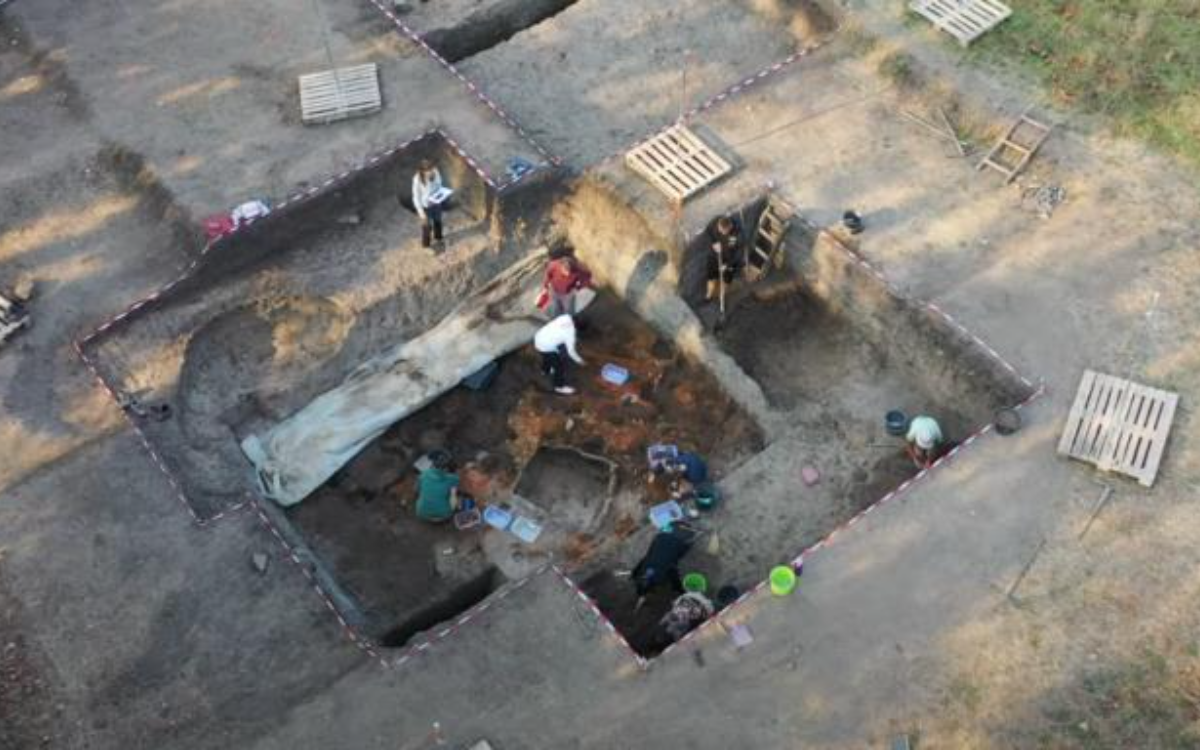
Austrian-Serbian research at the Svinjarička čuka site near Leskovac continued throughout August and September 2024. Archaeological research on the river terrace where several phases of early Neolithic settlement (Starčevo culture) have been recorded continued this year and has been ongoing since 2018.
This year’s research thoroughly examined a newly discovered structure interpreted as the remains of a house built using a wattle-and-daub technique, with remnants of wooden posts, dating back about 7,600 years.
The collapsed remains of the architecture cover the floor within the house, as well as various everyday objects and ceramic vessels around the house.
These remains, older than the aforementioned, represent early evidence of the settlement of Neolithic farming communities in the region, about 8,100 years ago. Within this complex rectangular structure, several storage spaces were recorded, which have undergone various micro-archaeological analyses to gather the most accurate data on these early farming communities, according to Jugmedia.
New Micro-Archaeological Analyses So-called micro-archaeological analyses at the Svinjarička čuka site include micromorphological analyses and systematic sampling of collected archaeological materials for a wide range of analyses, such as botanical and zoological, soil chemical composition analyses, isotopes, lipids, and ancient DNA.
The investigated Neolithic houses have yielded a wealth of archaeological finds, such as ceramic vessels, stone tools, stone and clay jewelry, stone querns, figurines, and various objects for food preparation. Upcoming analyses of archaeological material, as well as various laboratory analyses, will provide new data on the daily life of early Neolithic communities in the central Balkans.
Significance of the Discovered
Remains Some of the tools and vessels found within this archaeological structure are believed to have been used for storing food such as grains and seeds. Experts believe that this recent discovery has called into question previous models that predicted that the early settlers of Europe were nomads or only seasonal settlers. This was assumed because of the wide pits that were believed to have contained huts. “Instead of nomadic or only seasonally settled small groups, the pioneers of the Neolithic in the Balkans were clearly building stable houses with grain storage facilities,” explained Barbara Horejš, a researcher.
Experts also note that this culture represents the oldest Neolithic community in the Balkans and also played a key role in the spread of agriculture from Anatolia to Europe. Svinjarička čuka also contributes to a broader understanding of the spread of Neolithic culture and technology across the region, revealing the complex social dynamics and connections that shaped early European societies.
Fieldwork, international cooperation, and artists in archaeology The Austrian-Serbian project at the Svinjarička čuka site, for the first time this year, was a site for fieldwork and practice for students of the University of Vienna. In addition, the existing international cooperation was expanded with the participation of experts from various fields, such as those for chipped stone objects, the origin of stone raw materials, jewelry, and ceramics. An internationally recognized artist, as part of the Artists in Archaeology program, recently initiated by B. Horejš and the Barvinski Art Gallery from Vienna, collaborated with the archaeological team and students.
READ MORE:
OVAJ ČOVEK JE NEZAUSTAVLJIV: Ilon Mask kupuje najpoznatiju fabriku aviona na svetu!
Source: Kurir
Photo: Printscreen Youtube