



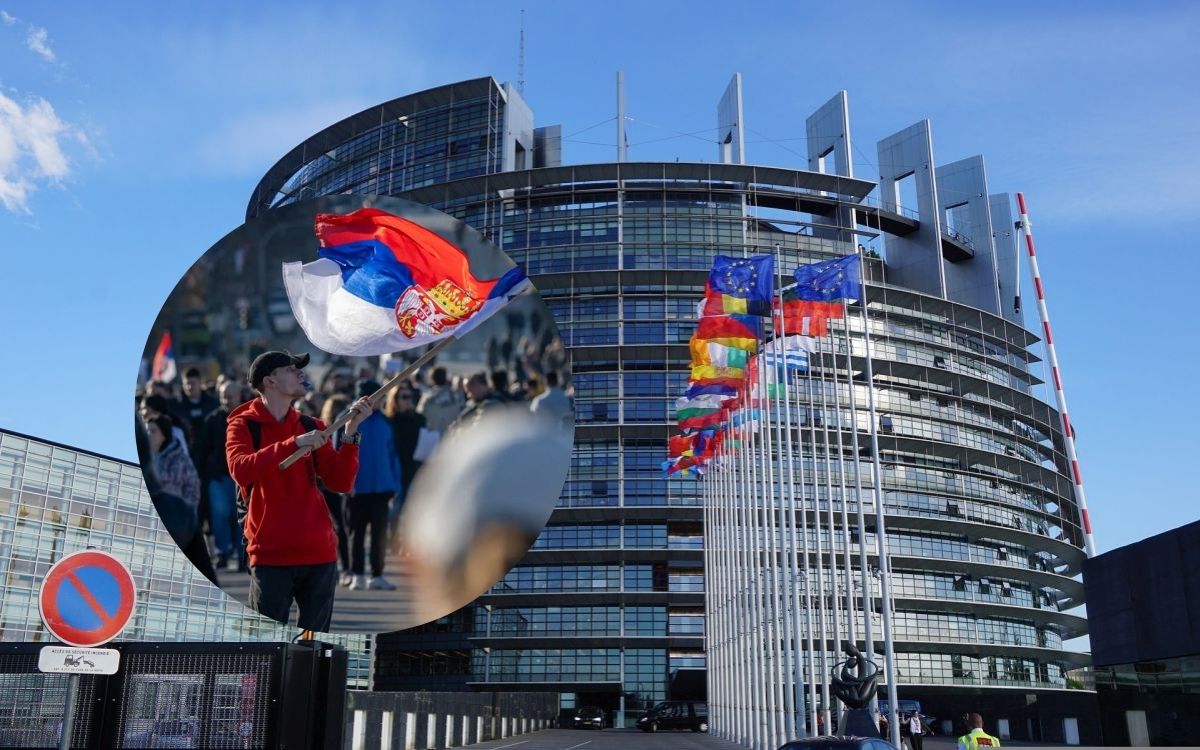
The draft resolution of the European Parliament on Serbia will be presented to MEPs today, and it is clear at first glance that the regime of Aleksandar Vučić has come under an unprecedentedly strong attack. The authorities in Serbia are called upon to fully clarify the collapse of the canopy in Novi Sad, the sanctioning of those responsible is requested, absolute support is given to the students, the camp in Pioneer Park is called illegal, and concern is expressed that the ruling party has engaged persons with a criminal past for counter-protests. The point that will most disturb the regime in Serbia is under number 30, and it warns all participants of EXPO 2027 about the corruption linked to the ruling structures.
This is the complete Draft Resolution on Serbia.
Marks, one year after the tragedy, the 16 victims who lost their lives and those who were injured after the collapse of the canopy of the Novi Sad railway station on November 1, 2024; reiterates its calls for full and transparent legal procedures following an investigation by the competent authorities, so that those responsible are brought to justice, in accordance with the rule of law; calls for an independent technical examination of the structural failure, a comprehensive review of building permits and supervision procedures, as well as a full assessment of possible corruption or negligence; appeals to the Serbian authorities to guarantee victims’ families effective access to justice and adequate compensation; stresses the need to broadly examine the extent to which corruption led to the lowering of safety standards and contributed to this tragedy.
Supports the right of Serbian students and citizens to peaceful protests, calling for accountability and democratic reforms directly connected to the rule of law, which the EU expects from Serbia; emphasises the importance of civil courage, commitment to non-violence and youth engagement for Serbia’s progress on the European path; notes that Serbian students have been shortlisted for the 2025 Sakharov Prize for Freedom of Thought; supports genuine attempts at dialogue on how the government can meet student demands; expresses deep concern that the situation in Serbia remains burdened by tensions and polarisation that easily can lead to violence, which is a direct consequence of hate speech, the promotion of violence, smear campaigns against opponents and anti-EU/pro-Russian propaganda widely spread by government-controlled media, as well as state officials, and a gross failure of the official side to confront and reckon with the past; calls on all political and social actors in Serbia to refrain from such rhetoric and contribute to fostering a climate of mutual respect, democratic dialogue and de-escalation (EPP C mod); calls on the government to promote inclusive political participation and guarantee equal media access for all political parties and candidates; stresses the importance of depolarising public discourse and cultivating a political culture based on tolerance, compromise and respect for democratic institutions; calls on civil society, media and educational institutions to play an active role in bridging social divisions and strengthening democratic resilience.
Strongly condemns the wave of state-influenced violence, intimidation and indiscriminate arrests against peaceful protesters, journalists, civil society organisations and opposition representatives in Serbia; condemns smear campaigns, media intimidation and misuse of personal data to discredit protesters and calls on the Serbian authorities to ensure media freedom; calls on high officials to end the inflammatory rhetoric that incites hostility or violence; condemns the use of illegal surveillance, such as Pegasus, Cellebrite, Novi Spy, against demonstrators; expresses particular concern about the use of Long Range Acoustic Devices (LRAD) and the intensive use of tear gas against civilians; calls for the adoption and implementation of clear protocols on lawful crowd control technologies and independent oversight mechanisms; calls on the Serbian government to fully guarantee and respect the right of people to assembly and freedom of expression in accordance with the Constitution of Serbia, the Universal Declaration of Human Rights and the European Convention on Human Rights; further condemns all forms of hate speech and incitement to hatred, especially against national minorities.
Holds the Serbian leadership politically responsible for the escalation of repression, the normalisation of violence and the weakening of democratic institutions; expresses regret due to the fact that the highest state officials are actively spreading conspiracy theories that the canopy collapse was an act of sabotage or a terrorist attack; is concerned about the lack of reaction from state institutions, including prosecution bodies and the judiciary, to refute these unfounded claims.
Warns against the misuse of criminal law to suppress civic participation; emphasises that amendments to the Criminal Code, the Criminal Procedure Code and the Law on Juvenile Offenders must not result in the criminalisation of peaceful behaviour or non-violent forms of protest; recalls that the proportionate application of criminal sanctions is a cornerstone of the rule of law and Serbia’s obligation under the European Convention on Human Rights.
Is concerned about the unlawful arrests ahead of the protests on March 15 and June 28, 2025, which were preceded by leaks of recordings of suspects’ conversations published in pro-government media; notes that several political activists and members of the Free Citizens Movement (PSG) were arrested on these grounds and that some are still under house arrest or in exile; calls for their immediate release.
Calls for urgent, impartial and transparent investigations into all allegations of unnecessary and disproportionate use of force, arbitrary arrests, detentions, torture, sexualised violence against detainees, politically motivated prosecutions and other grave human rights violations, including spitting and beating of tied detainees, verbal humiliation and death threats; calls on the authorities to thoroughly examine allegations that these violations originate from high-ranking officials of the JZO, especially its commander Marko Kričak; reiterates that such actions may constitute inhumane and degrading treatment prohibited by international law and police protocols.
Notes the resignation of Prime Minister Vučević, confirmed by the National Assembly on March 19, 2025, and the subsequent appointment of a new government led by Đuro Macuta, on April 16, 2025.
Notes the arrests in August 2025 and subsequent release of former ministers Tomislav Momirović and Goran Vesić on charges of abuse of office and suspicion of damaging the Serbian budget for at least 115 million US dollars in connection with the reconstruction of the Hungarian-Serbian railway line, including the collapsed Novi Sad railway station; deeply regrets the obstruction of justice in holding those responsible for the canopy collapse accountable and condemns the smear campaigns on pro-government channels against judges and prosecutors working to implement the rule of law.
Strongly condemns the government’s retaliation against employees in the education and culture sectors for supporting the protests, including dismissals, salary reductions, withdrawal of funding for public universities, and police presence in university buildings.
Calls on the Serbian authorities to immediately restore funding to universities; calls on the competent institutions to ensure the unhindered participation of the academic and research community in projects financed by the European Union.
Condemns the actions of members of the ruling party in organising an illegal camp in Pioneer Park in front of the Presidency building and its subsequent expansion to the plateau in front of the National Assembly; is seriously concerned about numerous reports that the ruling party mobilised persons with a criminal past in counter-protest activities, who attack protesters with pyrotechnics, further escalating tensions, violence and polarisation in the country; condemns incidents against members of national minorities, where pro-government media used ethnic slurs to target them.
Condemns the arbitrary use of presidential pardons for persons convicted or prosecuted for violence against students and other citizens participating in peaceful protests, considering that such actions represent a direct interference with justice and a serious undermining of the rule of law.
Calls on the Serbian authorities to enable the safe return of all citizens who left the country due to political repression, intimidation or fear of persecution, and to guarantee their full protection and reintegration in accordance with the law and Serbia’s international obligations.
Strongly condemns the unlawful arrests and expulsions of EU citizens who made statements in support of the protesting students, as well as the public disclosure of personal data of EU citizens by convicted war criminals; expresses concern about the growing number of cases of detaining EU citizens at Serbian borders.
Condemns in the strongest possible terms the verbal attacks by the highest Serbian officials on Members of the European Parliament following their participation in student protests or statements; the most prominent example includes President Vučić’s attack on MEPs from the Green/EFA group on September 5, 2025.
Condemns the open interference of the Russian Federation in the Serbian protests through disinformation by its officials, including Vladimir Putin, claiming it is a “colour revolution” supported by the West; rejects all claims by Serbian officials and pro-government media that the EU and some of its member states were involved in organising student protests with the aim of initiating a “colour revolution”; calls on the Serbian authorities to take measures against such malicious propaganda in domestic media, instead of participating in its dissemination; remains concerned about the presence of nationalist narratives in parts of the protest movement; regrets the continued use of narratives such as “Greater Serbia” and “Serbian World”, which have been promoted by some members of the Serbian government in the past; recalls that such rhetoric has no place in EU-Serbia relations and undermines regional stability.
Notes with concern that, parallel to the ongoing protests, the government seems to be negotiating with the owners of the United Media company to “weaken” these media outlets; warns that, if confirmed, this would constitute a serious attack on the already vulnerable media pluralism in Serbia; calls on Serbia to align with EU policies in countering foreign interference and disinformation campaigns.
Calls for the immediate and full implementation of all OSCE/ODIHR I-EOM recommendations to ensure free and fair elections in Serbia, especially those related to the independent audit of the voter roll, the transparent and pluralistic appointment of members of the Regulatory Body for Electronic Media (REM) and ensuring fair and equal access to time on the public service broadcaster RTS for all political actors.
Calls on the Serbian authorities to conduct a comprehensive, technical, security-focused and fully transparent inspection of all infrastructure facilities, including along the railway line from Belgrade, through Novi Sad, to the border with Hungary, to ensure their structural integrity, safety and compliance with international standards; appeals to the Serbian authorities not to put into operation any infrastructure facility that does not have the necessary permits and certificates for safe and unhindered use, especially those on international and regionally important transport corridors.
Encourages Serbia to strengthen cooperation with GRECO (Group of States against Corruption) and to fully implement its obligations under the UNCAC; calls for greater transparency of ownership and financing in public procurement for infrastructure projects; stresses that Serbia must protect environmental standards and the rights of local and national minority communities when approving such projects.
Calls on the European Commission and Member States to carefully monitor the implementation of reforms through the EU accession process and the Reform Agenda adopted under the Reform and Growth Instrument; acknowledges Serbia’s progress in certain areas, including economic growth, regional infrastructure connectivity and cooperation with the EU in migration management and energy security; welcomes Serbia’s participation in EU-funded projects under the Western Balkans Growth Plan and the Green Agenda; encourages Serbia to continue reforms in line with EU standards and reaffirms the EU’s readiness to support the people of Serbia in their efforts towards a democratic, prosperous and European future.
Underlines its long-standing commitment to Serbia’s European perspective and future membership in the European Union, clearly emphasising that progress in accession depends on full respect for the Union’s values, a truly merit-based process and respect for democracy, the rule of law and fundamental rights, the so-called Copenhagen criteria.
Reiterates that accession negotiations with Serbia should only progress based on measurable and sustainable progress in fundamental areas, especially the rule of law, the fight against corruption and organised crime, the independence of the judiciary, media freedom, public administration reform, full alignment with the EU’s CFSP and sanctions against Russia; recalls that Serbia remains a significant exception in the Western Balkans when it comes to alignment with the CFSP; stresses that progressive alignment with the CFSP is a key requirement for all EU membership candidates; calls on the Serbian authorities to encourage a fact-based and open debate about EU accession.
Reaffirms its strong support for civil society organisations, human rights defenders and independent activists working to strengthen democracy, the rule of law and fundamental rights; calls on the Commission to ensure adequate and accessible funding, as well as effective protection mechanisms for civil society actors; condemns any form of intimidation, harassment or administrative pressure on NGOs and activists; emphasises the vital role of civil society in promoting transparency, monitoring democratic standards and holding public authorities accountable.
Supports the swift dispatch of an ad hoc EU mission to Serbia, with the participation of the European Parliament, to assess the state of democracy, ongoing protests, attacks on protesters and repression targeting students, academics, educators and public sector employees on the spot.
Calls on the highest European officials to refrain from unfounded statements praising the reform processes in Serbia; welcomes the new tone of the Commission President during her recent visit to Serbia, which is more credible regarding Serbia’s deep problems and negative performance on fundamental reforms; notes the announced agreement regarding the independent verification of the voter roll and the REM Council, while emphasising that progress is assessed based on the implementation of reforms.
Calls on the European Commission to launch an initiative for targeted individual sanctions against those responsible for serious violations of law and human rights in Serbia in accordance with the EU Global Human Rights Sanctions Regime.
Calls on EU Member States to strengthen protective measures for vulnerable persons, including emergency visas and relocation programmes; calls on the EU and diplomatic missions of Member States to closely monitor all ongoing judicial proceedings related to the protests; calls on EU Member States to adopt a unified response to Serbia’s democratic backsliding, including considering targeted sanctions against individuals responsible for serious violations of law and human rights in Serbia.
Calls on all participating countries at the upcoming EXPO 2027 in Serbia to take into account serious concerns and evidence of widespread corruption linked to the ruling structures, as well as the alleged disregard for basic construction standards and legal requirements in the organisation and construction of the exhibition.
Instructs its President to forward this resolution to the President of the European Council, the Commission, the Vice-President of the Commission/High Representative of the Union for Foreign Affairs and Security Policy, the governments and parliaments of the Member States, as well as the President, Government and National Assembly of Serbia, the OSCE Office for Democratic Institutions and Human Rights (ODIHR), the OSCE Parliamentary Assembly and the Parliamentary Assembly of the Council of Europe.
MORE TOPICS:
Source: Nova.rs; Photo: Pixabay, AFP