





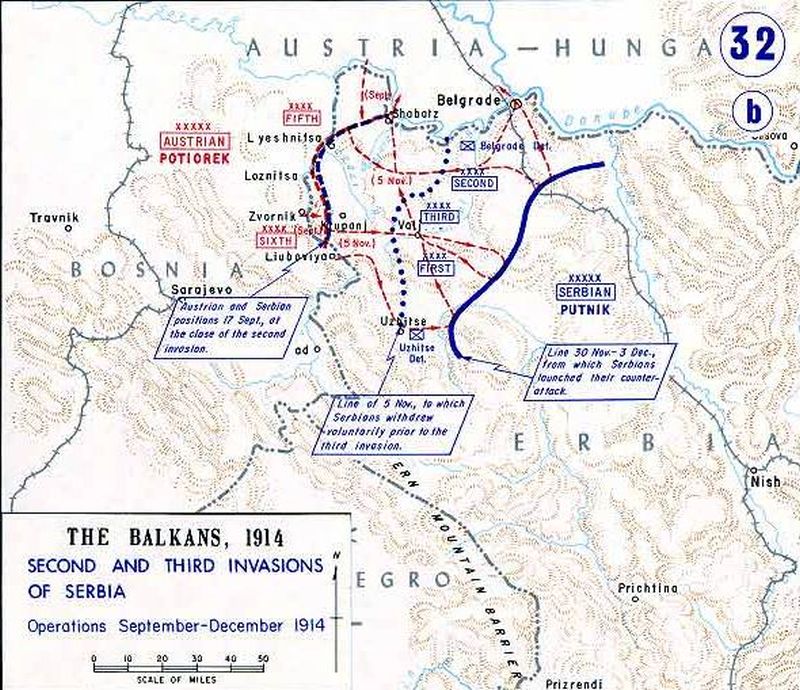
The Battle of Kolubara, the largest one the Serbian army fought in the First World War, began in 1914 on a front about 200 kilometers wide from Belgrade to Guča, in which the Serbian army, after a month of heavy fighting, utterly defeated the Fifth and Sixth Austro-Hungarian Armies under the command of General Oskar Potiorek.
The Serbian Supreme Command (SSC) hoped that the flooded rivers and marshy banks would help in stopping the penetration and issued a directive that the Čovka elevation must be held at all costs, as it planned to launch a counter-attack from those positions. Serbian troops managed to hold the Austro-Hungarians for several days due to Oskar Potiorek’s misjudgment that Serbian protective forces were stationed there. Because of this, on November 20, he introduced the 15th and 16th Corps of the VI Army into the fight.
The introduction of new forces forced the I Army (which was numerically outmatched) to retreat and it occupied new positions on the Suvobor ridge on the night of November 21st to 22nd, but the Austro-Hungarians reached the front line during the afternoon of the 22nd.
Živojin Mišić began planning a counter-attack from the Suvobor positions, but due to the difficult situation in the Maljen Detachment, he abandoned the idea, which proved to be a good assessment, because the Austro-Hungarian army already defeated the Maljen Detachment in a bitter fight on November 24 (the commander of the detachment also died in the fight). This defeat forced the left wing of the I Army to retreat to the Igrište-Babina Glava-Podovi line. The advance of the Austro-Hungarian troops continued with the occupation of the Čovka elevation, which forced the Morava Division I call to retreat to Kremnica, which forced the retreat of the right wing of the III Army.
On November 26, Živojin Mišić assessed the situation in which the I Army was as very bad and therefore decided to remain in the current positions for a few more days so as not to jeopardize the entire front of the Serbian army, but without exposing himself to a possible defeat and to withdraw the main force to positions west of Gornji Milanovac, i.e. the Lipe-Tripavac-Mramor(457)-Glavica(530)-left bank of Dičina line, as well as to secure the retreat with protective forces.
In accordance with the development of the situation, i.e. due to the loss of: Konatice, Lazarevac, Čovka, Guboš and Maljen, the Serbian Supreme Command decided to make preparations for a retreat to new positions, which it was also driven to by the too wide front. The Serbian Supreme Command moved its headquarters from Belgrade to Kragujevac on the same day. As a last attempt to stop the enemy advance, a directive was issued to the Obrenovac Detachment to carry out an attack on the Austro-Hungarians near Konatica and Stepojevac, and to the II Army to support this attack.
CONSEQUENCES OF THE BATTLE
The greatest significance of the Battle of Kolubara is reflected in the fact that Austria-Hungary failed to destroy the Kingdom of Serbia with its own forces, which is why the Central Powers were forced to fight on three fronts even during 1915 and, more importantly, Germany was forced to send aid in manpower to the Balkan front, thus weakening its forces on the remaining two fronts, and thus its chances of successfully eliminating one of them.
The battle was also important on a global level. The powerful Serbian victory delayed the entry into the war of Bulgaria, which was preparing to enter the war on the side of the Central Powers, assuming that Serbia was defeated and that it would reach the territories around which it fought the Second Balkan War against the Kingdom of Serbia a year earlier without a fight. The Serbian victory contributed to the decision of the Kingdom of Italy to enter the war on the side of the Entente.
General Živojin Mišić was promoted to the rank of Vojvoda (Field Marshal) for successfully leading the operation, while his rival Oskar Potiorek was dismissed from the position of commander-in-chief of the Balkan Army at the end of 1914, and the German Field Marshal August von Mackensen was appointed in his place.
SIGNIFICANCE OF THE BATTLE OF KOLUBARA IN THE HISTORY OF WARFARE
The Battle of Kolubara went down in the history of warfare as a unique example of an army, which was predicted to completely collapse, reorganizing itself in a short time, going into a counter-offensive, and inflicting a decisive defeat on the enemy. The tactic of regrouping only the I Army and the concentrated strike on the VI Army (which was spread out on a wide front), performed by Živojin Mišić, is studied today in military schools all over the world.
The Battle of Kolubara is also significant because both armies did not have strategic reserves in the operations, with which they could strengthen their lines where necessary, but achieved this by transferring forces from one part of the front to another.
MORE TOPICS:
WITHOUT MOBILE PHONE EVEN DURING BREAKS: Serbia bans the use of phones in schools, bill is ready!
Source:Nacionalna Geografija Photo: Wikipedia Commons