




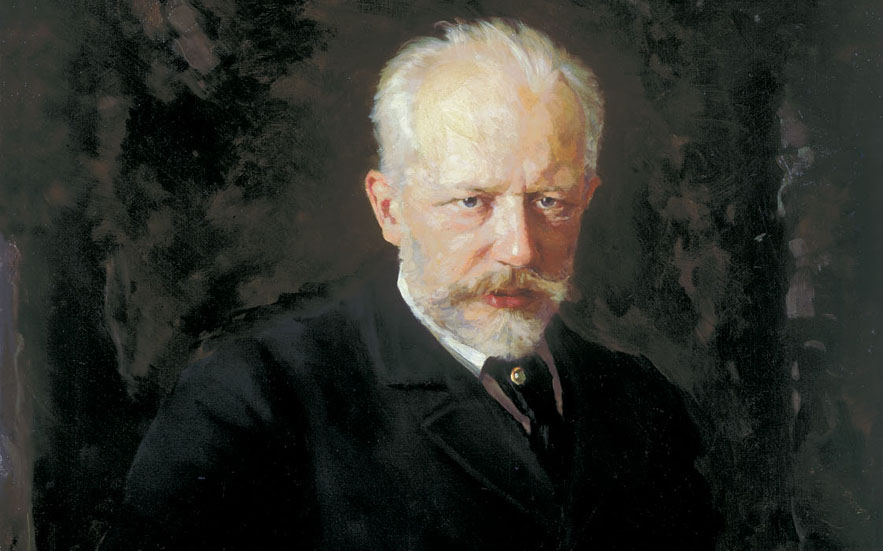
Nikolai Nikolayevich Raevsky came to Serbia twice. Little is known about his first stay in 1867, considering the significance of what he did. During his second arrival in 1876, he did the most he could on the Moravian battlefield and became a legend. And it was probably these and other legends from this war that most inspired Pyotr Ilyich Tchaikovsky to compose his “Serbo-Russian March” in 1876.
The melody that, at its first performance, brought tears to the eyes of the Russian public, full of Pan-Slavic sentiments, was named “Serbo-Russian March” by Tchaikovsky. Who and how renamed this composition, adding the title by which it is known today – “Slavonic March”!
According to A. Budyakovsky, Tchaikovsky’s best march, of a bravura-pompous character, is the march dedicated to the liberation of Serbs from the Turkish yoke. Initially, the composer intended to write a symphonic fantasy. For this, it seems, he lacked sufficiently acceptable Serbian folk melodies. Therefore, for his composition, he chose the melody of the Russian anthem and several Serbian folk songs, wanting in this way to express the solidarity of his people with the small Slavic people fighting for liberation.
If one looks at the biography of the famous composer, it is not easy to find ideas for Pan-Slavic aspirations in it. On the contrary, even in musical lexicons, Pyotr Ilyich Tchaikovsky (1840-1893) is described as “the greatest composer of the Western-oriented Russian school.” It is most often emphasized how his art combined elements of Russian national tradition, German Romanticism, and contemporary Italian and French music.
Despite his pronounced musical talent from his earliest childhood, Pyotr Ilyich was sent to the School of Jurisprudence in St. Petersburg, where officials were educated. At that time, he was already learning piano and singing in the church choir, but his teachers had not yet recognized a distinct musical talent in him. Perhaps that is why he had to encourage himself, allegedly stating on one occasion: “In ten years, I will be a great composer.”
He was possibly also dissatisfied with becoming a clerk in the Ministry of Finance at the age of nineteen. After four years, he decided to leave civil service to enroll in the newly founded St. Petersburg Conservatory in 1863. There, he studied composition with Anton Rubinstein, who knew Johannes Brahms from the time when the latter composed works based on Serbian folk melodies, and we will especially emphasize that he met Vuk Karadžić in Vienna.
For his “Serbo-Russian March,” Tchaikovsky used the melody of the Russian anthem and three Serbian folk songs: “Bright sun, you do not shine equally,” “This is the threshold of dear Serbs,” and “Because the gun powder” (the second part of the song “The Serb gladly goes to war”). He found the melodies in Kornelije Stanković’s collection “Serbian Folk Melodies,” printed in Vienna in 1862, for which the Serbian composer was awarded the Russian Order of Saint Stanislaus by imperial decree.
Goethe learns the Slavic antithesis
Although less known, Vuk Karadžić again played a major role in the breakthrough of Serbian folk songs into European music. Aside from the fact that Alberto Fortis took precedence for the discovery of this poetry, having published four Serbian folk songs, including “Hasanaginica,” significantly before Vuk, all in his travelogue through Dalmatia. To be sure, it was only later, after “Hasanaginica” was translated by no less a figure than Goethe, that his name alone ensured the song’s popularity even beyond the German-speaking area. But both Fortis’s discovery and Goethe’s translation would have remained without such significance and resonance had Vuk not spoken out with his collections of Serbian folk songs.
Parallel to the enormous interest in translating songs from Vuk’s collections, mystifications based on Serbian folk poetry also arose, and all of this together did much both for the popularization of Serbian poetry, which was placed alongside Homer’s, and for the introduction of a people, without a homeland and freedom, whose spirit gave birth to such supreme flights.
Besides Goethe, and after him, many, including the greatest poets of the time such as Pushkin, Shevchenko, Mickiewicz, translated and adapted them, but they were also popularized by writers through their famous mystifications, including Charles Nodier and Prosper Mérimée, for example.
Much more could be said in favor of the influence of Serbian folk songs on European artistic poetry, but, for example, let us mention how Goethe used the “Slavic antithesis” and, under his influence, a whole series of German poets. Likewise, the unrhymed five-syllable verse, called the “Serbian trochee,” became an integral part of German metrics, used by the most important German poets of that time.
The most intense phase of the acceptance of Serbian folk songs in European music only began in the seventies and lasted until the beginning of the twentieth century. In just one decade, seven composers appeared with their Serbian songs: Dvořák, Janáček, Thieriot, Brahms, Henschel, Rubinstein, and Czervinski. This development continued in the eighties in the works of four composers: Brahms, H. von Herzogenberg, Huber, and Tchaikovsky; in the following fifteen years, songs by seven more composers were published: Aulin, Behm, Bungert, Hermann, Reger, Suk, and Winterberger.
We consider this overview of the breakthrough of Serbian folk songs into European literature, and then into music, necessary in order to understand how Brahms, for example, could compose eight of his works based on Serbian folk melodies, or how Tchaikovsky was enchanted by the Serbian folk song “Bright sun, you do not shine equally,” and therefore used it in his work.
Serbian Fantasy
But, following the course of events, we will single out the year 1867. The events that took place that year were of great significance for Russia and for the entire Slavic world. In the spring, a large ethnographic exhibition was being prepared, a Pan-Slavic Congress was organized, and great diplomatic activity was underway, with the most important figures from Slavic countries arriving in St. Petersburg and Moscow. A concert was held in St. Petersburg at which, in the spirit of the general idea, works with exclusively Slavic themes were to be performed.
The historical concert, significant in many ways, was held on May 12, 1867, in St. Petersburg in the Duma Hall, under the direction of Balakirev… Among other works, Nikolai Rimsky-Korsakov’s “Serbian Fantasy” was performed. This work was repeated at the request of the audience. Korsakov’s “Serbian Fantasy” was one of the first works of the young twenty-three-year-old composer. In the 1867/68 concert season, this work was performed two more times in Moscow.
Nine years passed from that event until Tchaikovsky agreed to write his “Serbo-Russian March.” How and when he decided to compose this work was explained by his friend and biographer N. D. Kashkin. He emphasized how Serbia’s war with Turkey aroused an unusual surge of sympathy in Russian society for the enslaved Serbian people. The immediate cause was that Nikolai Rubinstein, Anton Rubinstein’s brother, conceived the idea of organizing a concert for the benefit of the Slavic Benevolent Committee, which sent Russian volunteers to Serbia and helped the war wounded. Tchaikovsky fully shared the mood of Russian society, so at Rubinstein’s suggestion, he gladly agreed to write a work especially for that concert and “undertook the task with great enthusiasm.”
Pyotr Ilyich preferred to create on a Polish estate, in the house of his friends. It is not known exactly when he began work on this piece. However, Konstantin Paustovsky left behind a thrillingly sincere confession about such creative aspirations:
“Tchaikovsky liked that wooden house. There was a faint scent of turpentine and white carnations in the rooms. Carnations bloomed richly in the meadow under the porch. Shaggy, dried, they didn’t even look like flowers, but resembled tufts of down stuck to the stems. (…) In this house, the simplest musical theme sounded like a symphony. (…) The house was located on a hill. The forests descended, into a singing expanse, where a lake lay in the middle of the thickets. There the composer had his favorite place – it was called Rudy Yar. The very path to Yar evoked excitement. It happened that in winter he would wake up in the middle of the night in a damp Roman hotel and begin to recall that path, step by step: first through the clearing, where pink nightshade blooms by the stumps; then through the low birch forest full of mushrooms, then across the broken bridge over the overgrown stream and a gentle ascent upwards, into the tall pine forest. (…) He knew that after visiting that place today, he would return – and the dear theme of the lyrical power of that forest region, which lived somewhere within him, would overflow the edges and rush in a torrent of sounds.”
Besides such a mood, Tchaikovsky also needed a suitable musical template. What were these Serbian folk melodies, and how many more were there, and what was the source of the musical material, and where did he get it?
Besides Tchaikovsky, Dvořák, Rubinstein, Winterberger, Janáček, Aulin, Suk… also composed on Serbian themes. Brahms composed as many as eight of his works based on motifs from Serbian folk songs. And Nikolai Rimsky-Korsakov’s “Serbian Fantasy,” one of his first major compositions, was, as we would say today – a hit of the concert season in Moscow.
FIND OUT MORE:
The Serb gladly goes to war
It has been reliably established that the Russian composer chose three Serbian melodies, which he used for his work. These are: “Bright sun,” “This is the threshold of dear Serbs,” and “Because the gun powder,” which is the second part of the song “The Serb gladly goes to war.”
As for the second part of the question – where did Tchaikovsky get the Serbian melodies – part of the answer is probably contained in the high imperial decree by which the Russian Tsar awarded the Order of Saint Stanislaus to the Serbian composer Kornelije Stanković. This happened when Stanković first printed his “Serbian Folk Melodies” in Vienna in 1862, after which this seminal work must have reached Russia. After all, he received the order for that work.
Tchaikovsky completed his work on September 25, 1876, and the composer put that date on the last page of the manuscript.
The first performance of the “Serbo-Russian March” was on November 5, 1876, in Moscow under the direction of N. G. Rubinstein, at a symphonic concert of the Russian Musical Society in favor of the Slavic Benevolent Committee. The work was a great success and was repeated at the request of the audience.
Immediately after the concert, Tchaikovsky received a letter from an enthusiastic admirer:
“I am finishing my letter upon returning from the concert where I heard your ‘Serbian March.’ I cannot express in words the feeling that overcame me while listening to it. It was a bliss that brought tears to my eyes. Enjoying that music, I was inexpressibly happy at the thought that its author was somewhat mine, that he belonged to me and that no one could take that right away from me. In your music, I merge with you into one being, and in that no one can be my rival.”
This is what a doubly infatuated woman wrote to Tchaikovsky after the performance of his march. Her name was Nadezhda Filaretovna von Meck. She sincerely expressed her feelings both for the music and for the composer. How significant this woman was for the biography of the famous composer is evidenced by the fact that Edward Garden placed Tchaikovsky’s acquaintance with Leo Tolstoy and the beginning of his correspondence with Nadezhda von Meck on the same level.
Tchaikovsky never met this woman personally. He allowed her to admire his music, even dedicated his famous Fourth Symphony to her as his “best friend,” and in return, he remained in correspondence with her for almost a decade and a half, receiving her patronage of six thousand rubles a year. He never responded to her declarations of love outside of music.
The personality of Nadezhda von Meck, a wealthy widow, a great patron, and a unique music enthusiast, is certainly interesting. Her passion was to have concerts held in her home. On one occasion, she lacked a pianist for her chamber trio. So she turned to the Paris Conservatory and Professor Marmontel with a request to recommend a pianist. He soon replied, suggesting that she invite the then young Claude Debussy. Since his musical performance made an understandably excellent impression, Madame von Meck invited him to come to Russia with his family and spend the summer on her estate.
Finally, the composer’s attitude towards his work is unusually important. What was Tchaikovsky’s attitude towards the “Serbo-Russian March”? “Not only did Tchaikovsky write it ‘in one breath,’ but he himself often performed it much later. Knowing how difficult it was for Tchaikovsky to venture into public conducting, especially with his own compositions, and how carefully he prepared those performances and with how much attention he chose the program, one can assume that the ‘Serbo-Russian March’ was indeed one of his favorite works that had its own value even in his eyes…
Although the “Serbo-Russian March” was dear to the composer’s heart as a favorite work, that title is usually mentioned incidentally, in brackets, alongside the later changed title, “Slavonic March.” Without going into when and for what needs the change occurred, it is important, and it is true, that Tchaikovsky himself wrote the title of his composition “Serbo-Russian March.” The authentic manuscript is kept in the Glinka Museum in Moscow.
MORE TOPICS:
SERIOUS INCIDENT IN BELGRADE: Part of the ceiling collapsed in KBC Bežanijska kosa, a nurse injured!
Source: Srpsko Nasleđe, Photo: Wikimedia Creative Commons