




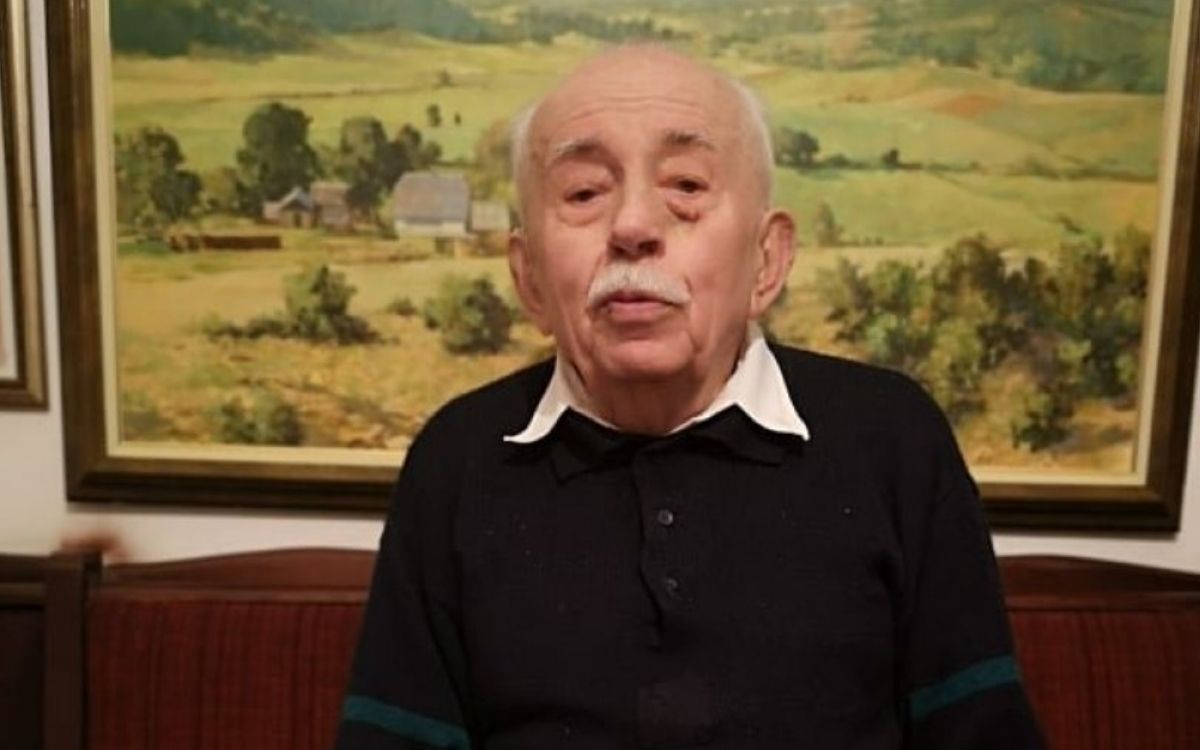
The truth about one of the most horrific crimes against Serbian civilians during World War II, the massacre in Stari Brod and Miloševići from April 1942, suppressed for decades, is slowly coming to light. Milorad Ćebić (83), one of the few who survived the Ustaše rampage, testifies about the horrors he witnessed with his own eyes as a ten-year-old boy.
In an interview for “Večernje novosti,” Ćebić reveals a harrowing story that took place in a spring that forever marked the history of the Drina region, and about which silence had to be kept for decades.
Serbs in eastern Bosnia resisted Ustaše attacks until early 1942. The defense was organized and led by pre-war officers.
–The people chose Sergeant Radomir Nešković to be the commander of the Serbian defense, because Muslims were already in Ustaše uniforms. The Serbian territorial defense, which preserved us at the beginning of the war, became part of the Yugoslav Army in the Homeland. There were no Partisans. Only us, the Serbs. My father was killed in the autumn of 1941, defending the village from the Ustaše.
In the spring of 1942, the NDH authorities launched an offensive to exterminate the Serbs, from Sarajevo to the Drina. Tens of thousands of refugees from Foča, Zvornik, Rogatica, Višegrad, Han Pijesak, Kladanj, Sokolac, Olovo and Pale poured into a column trying to reach Serbia.
–The roads were clogged with livestock and carts carrying all belongings and the helpless. The Italians, who guarded the Višegrad bridge, demanded that people separate from the wagons, allegedly so that the passage would not be blocked. Those who obeyed were taken to the German camp at Staro sajmište, which was located in the NDH, and not, as some claim today, in Nedić’s Serbia.
FIND OUT MORE:
The Serbian refugees desperately began searching for another way out. It spread that from Stari Brod, a narrow area between the Drina and the mountains, boats were transporting people to the other side of the river.
–A narrow path along a mountain cliff led to Brod, slippery from the rain, which even sheep did not want to walk on – Ćebić recalls. – Somehow we passed with what we had on us and reached a plateau covered with thousands of miserable and frozen people who were sheltering from the heavy rain under makeshift tents of branches and blankets. The crowd pressed in the mud by the Drina trying to get into boats. Serbs who had gold to pay were also transported by German soldiers in their rubber rafts.
Those who did not have it jumped into the Drina and tried to cross by holding onto a rope tied to the raft. German soldiers struck them on the head with oars until they drowned. When the Ustaše approached, the Germans banned crossing the Drina.
–Part of the refugees headed toward the village of Miloševići, from where no one came out alive. An uncle who somehow crossed to the other side of the Drina managed to save us at the last moment. He gave German soldiers a gold ducat from his wife’s bridal necklace for every head they transferred by boat.
On the right bank of the Drina, Ćebić’s family joined the unfortunate people around bonfires trying to warm up and dry off. The Germans kept the refugees on the bank to watch as the Ustaše and Muslim militia carried out a bloody rampage.
–25 Ćebić family members were slaughtered then. The killing lasted until nightfall, and then everything fell silent. At dawn, the Ustaše commander Jure Francetić appeared on a white horse and the massacre began again. Later, German military motorboats arrived from Višegrad. They fired into the air and shouted: “Ustaše curik.” Later we learned that Nedić had begged the Germans to stop the massacre.
FIND OUT MORE:
The massacre in Stari Brod was halted, and Francetić told the survivors they could freely return to their villages. That was a lie; all were killed on the way. At that time, 72 of my relatives were also slaughtered. The youngest was only seven days old.
Serbian refugees on the right bank, who had escaped the Ustaše knife, were threatened by hunger.
–They took us to abandoned houses in nearby villages. My mother gave a large gold chain for a sack of corn which she ground, and sent us children to pick primrose. For days we ate cornbread made of corn flour mixed with that plant. Soon that ran out too, we thought we would die of hunger. And then food arrived from Serbia. We were saved. Nedić managed to obtain permission from the Germans to receive us into Serbia.
Parents, faced with extreme poverty, gave their children to the Commissariat for Refugees, which took them to Mataruška Banja, the first reception center for Serbian children from the NDH.
–In the spa we got clean clothes, ate and slept in warmth and were safe. Then more Serbian orphans began to arrive, hundreds every day. The spa was soon overcrowded with children, thousands of mouths had to be fed, and food became increasingly scarce. Serbian hosts took children into their homes, but they too lived in poverty. Then epidemics broke out. My younger brother and his caretaker died on the same day from mumps.
Ćebić’s mother came to bury her son and took the remaining children with her. Milorad, as the oldest, at 12 years old, was assigned to go with his uncles to seasonal work, harvesting corn in Banat.
–A host from Lajkovac whom we met on the train convinced my uncles to leave me with him. The good man wanted to adopt me. I stayed with him until the liberation in 1944, and my mother did not come, although she had promised – Ćebić recounts with tears in his eyes. – My host hid from me that my mother had been killed by communists with rifle butts because her brother was in Draža’s army. Serbs in the Drina region, who defended their people, were persecuted and killed without trial. None of the Muslims who were almost all in the Ustaše were held accountable for the crimes.
Ćebić was later taken from the foster family to a home from which he went on to learn a trade. After military service, he remained in Serbia and found employment in Trstenik. He visited his native village Brankoviće only for a few days a year, while his grandfather was alive.
–The village was deserted, almost everyone had been killed or displaced. The crime in Stari Brod was kept silent. Only in 2007 did a few of us survivors from Serbia and Australia build a memorial chapel for the victims from Branetići.
A vow of silence because of “brotherhood and unity”
After the end of the war, this crime could not be spoken about in socialist Yugoslavia. The victims remained without memorials for decades, and the survivors were persecuted. Ćebić testifies that after the liberation, communists killed his mother with rifle butts simply because her brother was part of the Yugoslav Army in the Homeland.
“Shame on us Serbs, be ashamed for forgetting the 6,000 slaughtered in Stari Brod who for decades did not even have a cross,” Ćebić said in 2007 when the construction of the memorial chapel had just begun.
Today, Stari Brod finally has a memorial museum and a chapel, serving as a permanent reminder of the terrible price the Serbian people in eastern Bosnia paid for their survival.
MORE TOPICS:
LEST WE FORGET: The March pogrom in Kosovo was deadly for many Serbs, while thousands got expelled!
Source: Novosti.rs, Foto: Promo