




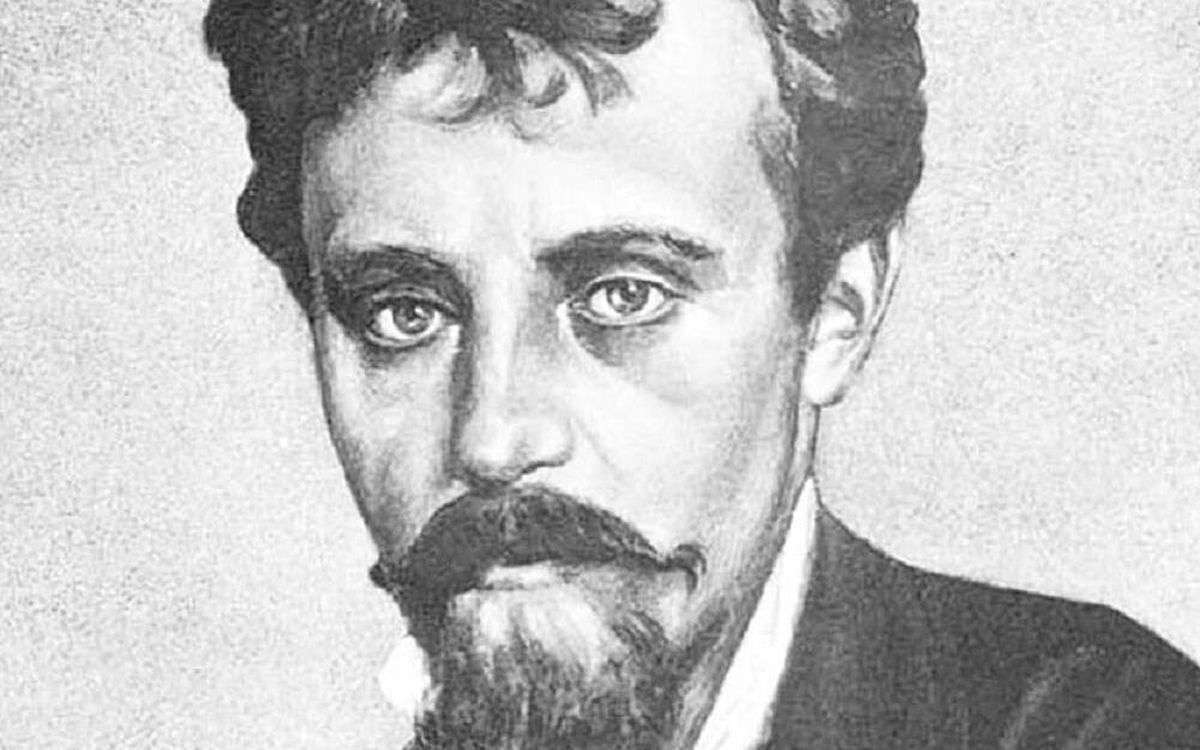
Serbian writer, short story author, and doctor Laza Lazarević was born on May 13, 1851.
He died of tuberculosis, as did his two sons earlier – Kuzman at the age of one and Vladan at the age of two. Although he wrote only nine short stories, he left a large and indelible mark on Serbian literature.
Lazarević was born in Šabac in 1851 into a merchant family – his father Kuzman and his brother Mihailo owned a trading shop. He was the third child, after his sisters Evica and Milka, and after him, Katica was born. Although he was very frail and sickly as a child, he did not give up later. At the age of only nine, he lost his father, and a year later, his uncle, so his mother Jelka took over the care of him and his sisters, quickly falling into great debt. Nevertheless, she enrolled him in elementary school and lower gymnasium, which he completed in his hometown. In early childhood, he had the opportunity to get to know and love literature, and he read a lot. At the age of 14, he left his mother and his native Šabac and enrolled in higher gymnasium in Belgrade. He lived the whole time with his sister Milka, who was married to Milorad Šapčanin, a very respected citizen at the time.
At the age of 16, he enrolled in the Faculty of Law at the Great School. He became the secretary of the Great School association “Pobratimstvo”. During his studies and under the influence of Svetozar Marković, he began to learn Russian and follow Russian literature. Towards the end of his law studies in 1871, he was chosen as a state scholar and sent to study medicine at the faculty in Berlin, which at that time was one of the most respected in Europe. His scholarship was revoked due to the circumstances that arose as a result of the Paris Commune. Although he did not like law, he used the time and finished the faculty. He became an intern at the Ministry of Education. He had always wanted to become a doctor, and luck smiled on him a year later when he received a scholarship again. He went to study medicine in Berlin, but during the Serbian-Turkish War (1876–1877), he returned to Serbia due to military duty. He served as a medical assistant and was awarded a silver medal for diligent service. After the war, he returned to Berlin and completed his medical studies in March 1879.
Upon his return to Belgrade, he was appointed doctor of the Belgrade district, and in 1881, he became the first doctor of the General State Hospital in Belgrade. He treated prominent and wealthy people, as well as the poor and needy, whom he received without payment, giving them medicine, clothes, and care. It was said that he forbade newspapers from publishing praises written by his patients. In February 1889, he became the personal physician of King Milan. He was promoted to the rank of lieutenant colonel in the medical corps.
FIND OUT MORE:
In 1881, he married Poleksija, the sister of his friend Kosta Hristić, with whom he had three sons: Milorad, Kuzman, and Vladan, and a daughter, Anđelija. They settled in Hilandarska Street. However, there was no idyll in the warm and long-awaited home. The death of two children and differences in character led to him working excessively hard to please his wife and children. His career progressed, but so did his tuberculosis.
Alongside his demanding practice, he also worked on literature. In ten years, he wrote only nine short stories, while eight remained unfinished. At the beginning of 1888, he was elected a member of the Serbian Academy of Sciences for his merits in the literary field. The same academy awarded his last short story “On zna sve” (He Knows Everything) on July 8, 1890.
Laza Lazarević ranks among the most important prose creators of Serbian literature. He is considered the creator of the Serbian psychological short story and one of the best stylists. He also engaged in translation work. His remaining short stories include “Prvi put sa ocem na jutrenje” (The First Time with Father at Matins), “Školska ikona” (The School Icon), “U dobri čas hajduci!” (Good Luck, Outlaws!), “Na bunaru” (At the Well), “Verter”, “Sve će to narod pozlatiti” (The People Will Gild All That), “Vetar” (The Wind), and “On zna sve” (He Knows Everything). He did not publish the short story “Švabica” (The German Girl) during his lifetime because it was, as many believe, too autobiographical, describing his great love with Ana Gutjar and even greater moral dilemmas he had during that relationship. It was published only seven years after the writer’s death, in 1898, in the book “Pripovetke Laze K. Lazarevića” (Short Stories of Laza K. Lazarević) edited by Ljubomir Jovanović.
MORE TOPICS:
Source: Kurir; Photo: Wikipedia