




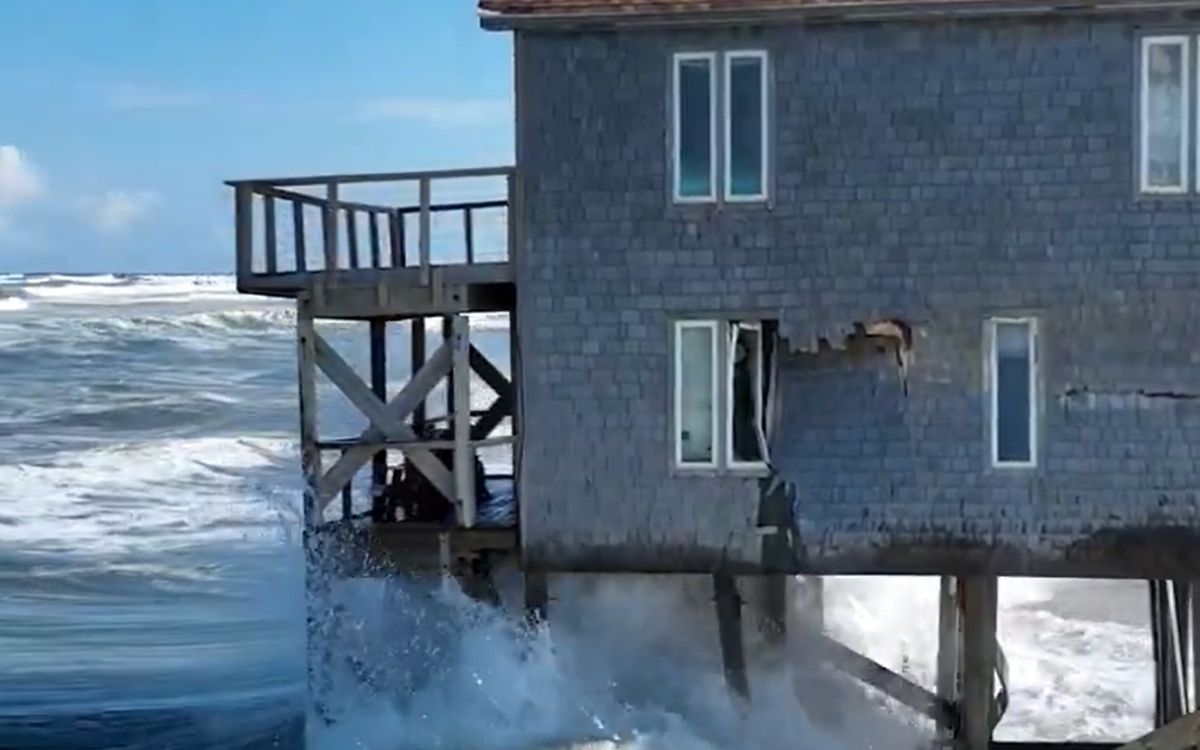
Hurricane Erin hit the outer banks of North Carolina with strong winds and waves that flooded parts of the main highway and undermined the soil of houses right on the beach.
Meteorologists predicted that the storm would peak on Thursday and could strengthen again to reach the strength of a “major hurricane”, category 3 or higher, but it is not expected to directly hit the east coast before turning further out to sea.
The National Hurricane Center in Miami announced that tropical storm conditions are in effect in parts of the outer banks and on the Virginia coast. In Bermuda, residents and tourists were warned not to swim due to rough seas expected until Friday.
Powerful waves from Hurricane Erin hit beachside homes and flooded streets along North Carolina’s Outer Banks on Tuesday. pic.twitter.com/K5ZZ3K7Ayw
— AccuWeather (@accuweather) August 20, 2025
As the outer bands of Hurricane Erin hit the outer banks, water overflowed the main road connecting the islands, and several houses on stilts above the beach were in danger. On Wednesday evening, authorities closed Highway 12 on Hatteras Island due to the increasing sea surge and rising waves. On Thursday, the road was still closed, and the connection with the ferry terminal of Ocracoke Island was cut off.
Officials predicted that the biggest waves during high tide would cut off villages and houses on the outer banks and cause dangerous currents from Florida to New England.
Beaches in New York were closed for swimming on Wednesday and Thursday, and some in New Jersey, Maryland, and Delaware were also temporarily off-limits. Moderate flooding of coastal areas of Long Island and parts of New York was expected.
A spectacular view of Hurricane Erin swirling north as lightning flashes throughout the system. pic.twitter.com/tfno3tQ4Qo
— CIRA (@CIRA_CSU) August 21, 2025
Off the coast of Massachusetts, Nantucket Island could experience waves of more than 3 meters this week. However, the biggest threat remains on the outer banks of North Carolina, where the locals have not shown much concern.
“I remember canoeing from my yard to school, so I don’t think it will be that bad now,” said Jacob Tron, a resident of Hatteras Island who works in surf shops.
Despite the beach closures, some swimmers ignored the warnings. Lifeguards rescued more than ten people on Tuesday, the day after more than 80 people had to be rescued.
🚨#BREAKING: New footage from the Outer Banks in North Carolina is showing flooding during low tide from Hurricane Erin.
— Matt Van Swol (@matt_vanswol) August 20, 2025
This is one of the most vulnerable communities for flooding from the hurricane.
Please pray for North Carolina today. pic.twitter.com/vgu3K8O1AH
“You may think you know how to handle it, but it’s not safe,” said meteorologist Bob Oravec. “No matter how aware you are, it can still be dangerous.”
North Carolina officials warned that the combination of strong winds and huge waves of about 6 meters could cause flooding in many coastal communities.
“Dangerous conditions are felt far from the center of the storm itself, especially with a large-scale system like Erin,” said Will Ray, director of the North Carolina emergency service.
People watch as powerful waves from Hurricane Erin hit beachside homes along North Carolina’s Outer Banks on Wednesday morning. pic.twitter.com/KXwpT19xpm
— AccuWeather (@accuweather) August 20, 2025
-Dozens of beach houses, already damaged by chronic erosion and weakened protective dunes, could be in danger, said David Hallac, superintendent of the Cape Hatteras national park.
Most residents decided to stay despite the ordered evacuations on Hatteras and Ocracoke islands.
MORE TOPICS:
SERBIA, BE PROUD! Adriana Vilagoš won first place at the meeting in Lausanne! (PHOTO)
Source: Kurir; Photo: Printscreen X