




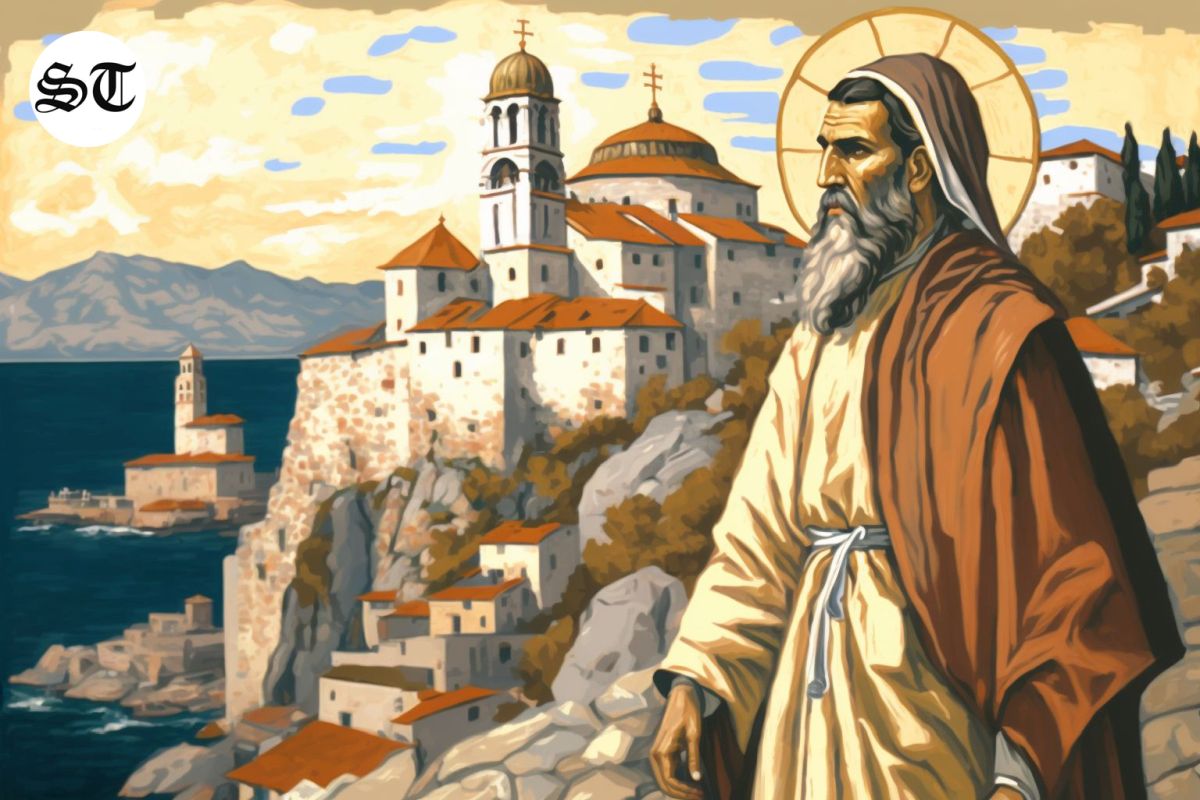
On this day, September 14, 1219, the autocephaly of the Serbian Orthodox Church was proclaimed, with its seat in the Žiča monastery, which was secured by Saint Sava, the first Serbian archbishop, from the Nicaean Emperor Theodore I Laskaris and the Ecumenical Patriarch Manuel I of Constantinople.
Eight centuries have passed since the genius of one man, who, thanks to his refined political sense and developed social intelligence, managed to secure something that did not seem certain.
On the territory of today’s North Macedonia, Christianity has been known since the time of Apostle Paul. From the 4th to the 6th century, the Archdiocese of Ohrid alternately depended on Rome and Constantinople. At the end of the 9th and beginning of the 11th century, it had autocephalous status, as an archdiocese, and then as a patriarchate, with its center in Ohrid.
The Serbian Archdiocese existed until 1346, when Tsar Dušan elevated it to the rank of a patriarchate.
As the country had no urban settlements, the diocesan centers were in monasteries. The center of the archdiocese was in the Žiča monastery, and from 1253 in Peć – the Archdiocese of Peć.
The founding of the Serbian Archdiocese was bitterly opposed by the Archbishop of Ohrid, Dimitrije Chomatian, but without success.
The youngest son of Stefan Nemanja (Saint Sava) recognized the ambitions of the Archbishop of Ohrid, Dimitrije Chomatian, who believed that the Serbian Church should remain under his spiritual authority, so he completely bypassed him in his quest for autocephaly.
Dimitrije Chomatian was at the head of the most important spiritual institution of the then Epirus, so Sava Nemanjić decided to seek his fortune in Nicaea. The exiled Ecumenical Patriarch Manuel Serantinus consecrated him as the first Serbian archbishop, and the survival and struggle with unfavorable historical conditions would be a characteristic of the Serbian Orthodox Church in the centuries to come.
Even after Saint Sava, when the archdiocese was to be elevated to the rank of a patriarchate, a part of the then political and ecclesiastical elite of the surrounding countries also opposed it – precisely the Ecumenical Patriarchate which had enabled the autocephaly of the Serbian Church.
Nevertheless, before the coronation of Tsar Dušan, Archbishop Joannicius II became the first patriarch of the Serbian Orthodox Church.
That ability to adapt and the desire for survival even in very unfavorable socio-historical circumstances was carried through the centuries.
It was of particular importance during periods of discontinuity: the Serbian Orthodox Church officially did not even exist as a church organization for a period of exactly 249 years (from 1462 to 1557 and from 1766 to 1920).
And in the story of the survival of the Serbian Orthodox Church, “as it should be,” there is also mythology.
The Serbian cultural elite created, and society accepted, the thesis that Mehmed-pasha Sokolović was most deserving of the revival of the Serbian Church, allegedly a close relative – in some versions even a brother – of the then Patriarch Makarije I of Serbia.
However, although it sounds good, Mehmed-pasha became grand vizier several years later, historian Dejan Ristić explained. Such a decision on the restoration of the Serbian Patriarchate could only have been made by the sultan.
Even during periods of discontinuity, the Serbian Orthodox Church had a significant social role – it represented the center of cultural activities, it was the founder of the first schools, libraries, and archives…
Some things, however, are not part of mythology, although they have such a connotation. After the Communist Party of Yugoslavia came to power, the Serbian Orthodox Church was indeed under serious repression in the years that followed World War II.
Probably no one could have guessed that five decades later, religious education would become an elective subject in elementary schools.
MORE TOPICS:
TRAMP CONFIRMS THE DEATH OF CHARLIE KIRK: “Great, legendary, now he is no longer with us…”
GREAT HOLIDAY AND RED LETTER DAY: Today we celebrate the Beheading of Saint John the Baptist!
Source:Serbian Times, Foto: MidJourney prompt by Serbian Times